

Why You Won't Find A Single Stop Sign In Paris
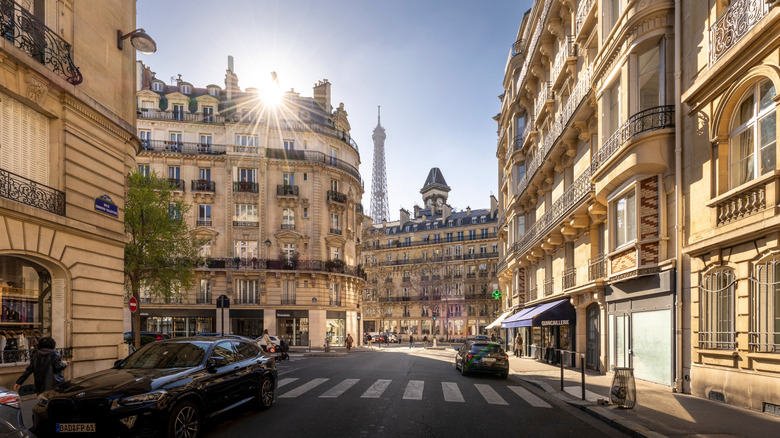
Paris is a spectacular city with incredible attractions. It boasts the Eiffel Tower, the Louvre art museum, and many other great sights to see. But in the entire city of Paris, France, across every one of its 6,500 streets, there is not a single public stop sign to be found. (This means that Paris is one of those places where drivers will not need to know why stop signs are octagons instead of round or square. In addition, Parisian drivers won't ever need to worry about why some stop signs are blue.)
The story of why Paris has no stop signs goes back to before the 1950s, when France became the 10th country to adopt the United Nations Protocol on Road Signs and Signals. This is when stop signs first appeared in France. But Parisian drivers already had a system for dealing with city traffic — "priorité à droite," which means drivers should yield to those merging from the right. For its traffic control, Paris depends primarily on this principle, backed up with traffic lights and yield signs. Over time, the city's stop signs gradually disappeared, with the last one removed in 2016.
Another change to the traffic situation in Paris was made in 2025, when Parisians voted in a referendum to eliminate automobiles from approximately 500 streets, also removing 10,000 vehicle parking spaces. It would appear that the preference of Parisians is for streets that are increasingly vehicle-free and more pedestrian-friendly.
How does the 'priority to the right' rule help traffic flow better in Paris?
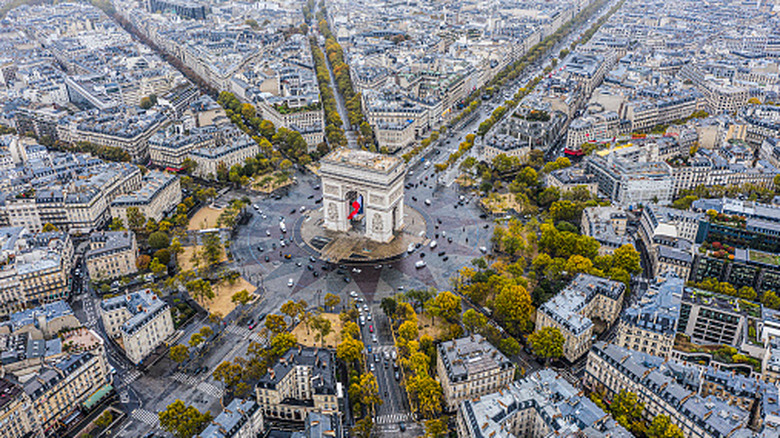
Paris believes the "priority to the right" strategy keeps drivers attentive while maintaining traffic flow. However, the rule does not apply in most roundabouts, where vehicles already in the roundabout are given the right of way. One major exception to this rule is the Place de l'Etoile, which is the roundabout that circles the Arc de Triomphe, shown above, where the traffic entering the roundabout gets the right of way. One more safety-based reason is the low speed limit of 18.6 miles per hour in most of Paris.
Some added benefits of eliminating stop signs include no fines being levied for drivers going through them. Dating back to long before the age of automobiles, Paris also has many narrow streets that make the use of stop signs difficult. In case you're wondering, the stop sign is alive and well in the rest of France, where the country's driving code still includes it, requiring you to come to a full stop should you encounter one.
An interesting recent development in U.S. traffic safety is the increasing use of roundabouts. While U.S. drivers are wondering if there's a speed limit in a roundabout, France has the most roundabouts of any European country.