

How Much Does An Alternator Replacement Cost? Here's What To Know
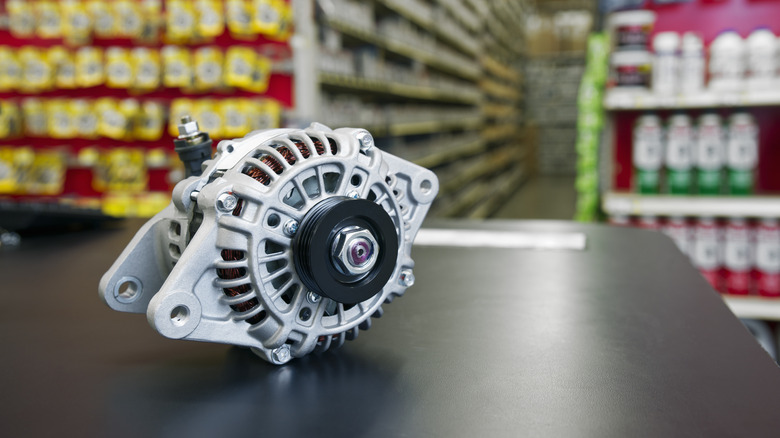
An alternator is an important part that enables you to power your car's electrical system and maintains the batteries charge. While the battery stores enough of a charge to get the vehicle's engine running, it's not doing much once the vehicle is in motion.
The alternator, which gets its power from the engine, runs systems like your dashboard lights, power windows, and even electric power steering. So, you can't operate a car without a healthy alternator (at least not for long). There are ways to tell if your car's alternator is bad, especially if your electronic components start flickering or dimming, and this isn't something to ignore.
An alternator typically lasts up to a decade, though there are ways to extend their lifespan, so, older vehicles will eventually need а new alternator. The cost of a new alternator depends on several factors, such as your vehicle model and your mechanic's labor rate. According to J.D. Power, typical prices fall between $100 and $350, not including installation.
If you include the cost of the part along with installation, you're looking at $230 on the low end and north of a $1,000 on the upper end. In addition, since the alternator is belt driven, you may need to invest in a new belt, pulley, and tensioner, which can run anywhere from around $30 up to $300. Of course, you can always save money by making the repair yourself.
Is replacing an alternator a challenging do-it-yourself project?
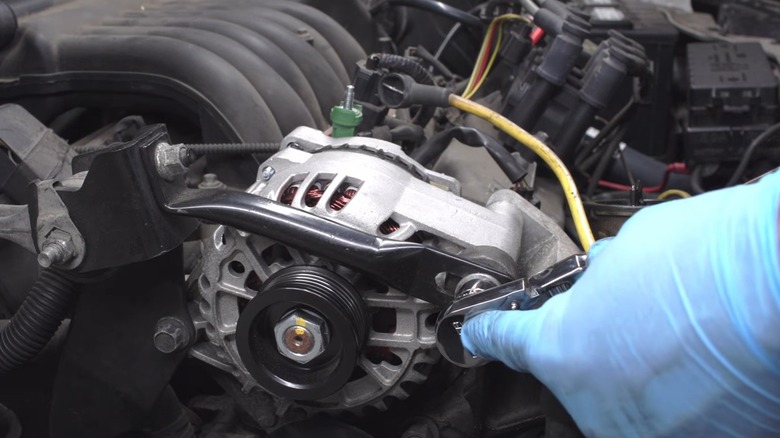
If you have some familiarity around vehicle engines, replacing an alternator is a fairly straightforward job. You'll need some basic tools like a socket set in order to remove the bolts that hold the part in place. However, depending on the engine configuration, the ease of accessing it can vary. Before getting anywhere near the alternator, you must first disconnect your car's battery, which helps protect the electrical system and prevents you from getting shocked.
Next, take a picture of the belt going around the alternator so you'll have an idea of how it wraps around the various pulleys. Remove the belt going around the alternator by loosening the tensioner, which holds it taut. You can find various instructional clips showing this process, such as O'Reilly Auto Parts' YouTube video, "How To: Replace an Alternator."
Once the belt is lifted off the pulley on the alternator, you have two different connections to remove; a plug which regulates voltage, and a positive cable, which is held in place by a nut. Finally, there are a few bolts holding the alternator in place that will need to be removed. Once you extract the old part, simply install the new alternator and follow these steps in reverse.
Can you repair an alternator instead of replace it?
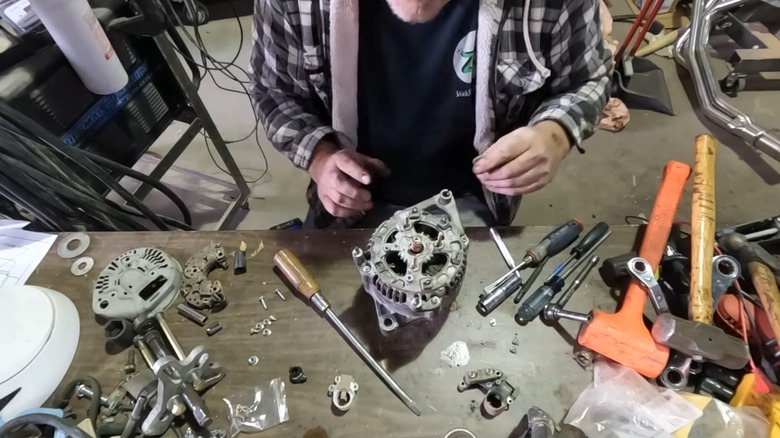
You can choose to have an alternator fixed rather than replace it with a new unit, but it only makes sense in certain situations. The age of the part, complexity of the repair and your skills are the determining price factors when opting whether to fix or replace it. If the alternator is only a few years old for instance, it might be worth fixing yourself, especially if you want to save some money.
Current must flow only one way in an alternator, and this is accomplished with diodes, which can sometimes develop faults. This is something you can check using a multimeter as demonstrated by the maddoxmechanic YouTube short called, "Quick Check: How to Test Alternator Diodes with a Multimeter." The diodes themselves typically run around just under $50, but they do require you to take apart the alternator, which demands more skill. Optionally, you can also find alternator rebuild kits, which can be between $28 and $60.
However, if you're not comfortable with more in-depth automotive tasks or are short on time, having a mechanic do the repair work might not save much money at all. This is especially true if the part is old and worn, which would be better to replace rather than salvage. Labor costs for replacing the diodes could run between $150 and $400, per Partcatalog.com.