

What Are The Green Lights On Fighter Jets For?
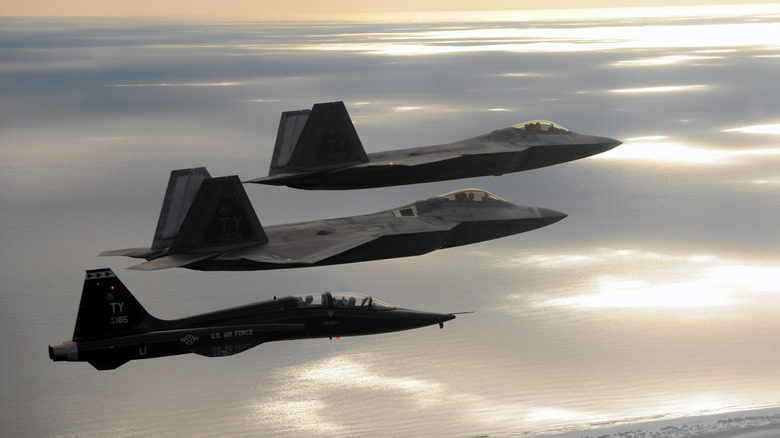
It is safe to say that nearly everyone has seen a plane flying at night overhead with flashing red and green lights on them. These lights are navigations lights and are critical for determining the planes position and in turn, keeping it and its occupants safe. Military aircraft, however, have more than just the required navigation lights. They also have glowing green strips running along their fuselage and tail during nighttime operations. These lights look like tape or glowing panels that are attached to the aircraft's surface. What are these unusual lights?
These are formation lights, also known as slime lights. Formation lights came about in 1955, during the Cold War as a means for pilots to see friendly aircraft during night operations without exposing themselves unduly to a potential enemy. The formation light system provides enough illumination for military aircraft flying in formation, while also maintaining a relatively low visual signature.
Why fighter jets use slime lights
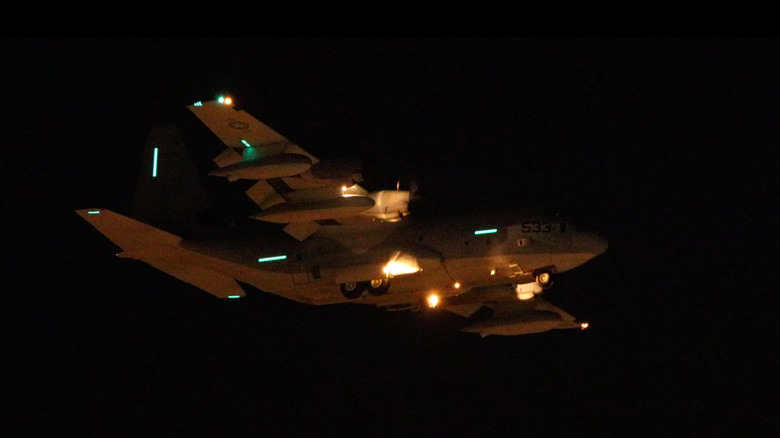
Fighter jet operations frequently require them to fly in groups, especially during training exercises, aerial refueling, aircraft carrier approaches, and combat missions. Every one of these operations are made exponentially more difficult when conducted at night or in low visibility situations.
Slime lights provide a valuable function in offsetting this by, according to the Aeronautical Design Standard, providing "visual, unambiguous orientation information regarding the attitude and position of the lead aircraft to the pilots of aircraft in the formation." In other words, these lights help pilots keep track of one another and avoid mid-air collisions.
Traditional aeronautical lights are often too bright and not suitable for tactical operations. Slime lights, however, emit a dim green glow and infrared light that can usually only be seen at relatively close range by allied aircraft. This allows pilots to properly maintain spacing and orientation in formation without broadcasting their location across the sky. The placement of the lights are specific to each aircraft, but they are typically installed on the fuselage, vertical stabilizers, and sometimes the wings to make the aircraft's shape easier to identify.
How these lights became a standard feature on modern fighters
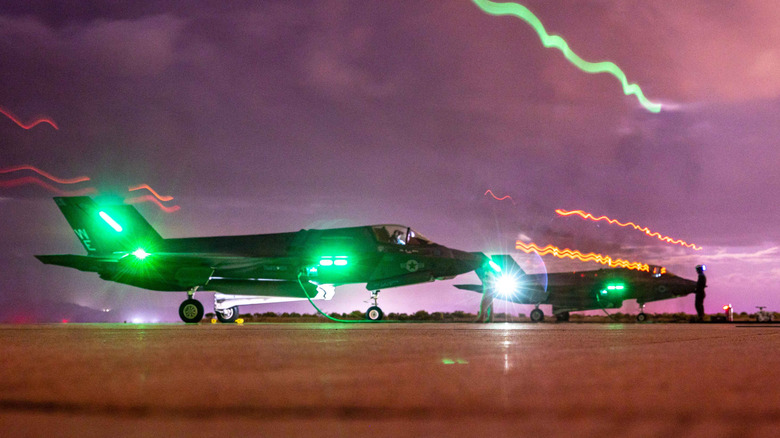
The need for formation lights was born out of the experiences of U.S. pilots during WWII, where the rate of accidents for pilots flying at night was two to four times greater than during the day. With the onset of the Cold War and the deployment of U.S. aircraft to various NATO countries, the advanced Cold War fighter jets were operating at greater speeds and closer together than ever before, furthering the necessity for a safer visual reference system.
Today, slime lights remain common on even the most advanced and modern fighters, despite the use of radar, night-vision equipment and advanced sensors. Even fifth generation fighters such as the F-22 Raptor still use variations of the system, because no electronic aid can completely replace a pilot's ability to visually identify nearly aircraft — at least not yet. To some, they may look like futuristic decals, but these glowing green strips are a simple safety feature that helps pilots fly diverse missions in the dark of night.