

5 Everyday Tech Items You Might Not Realize Came From The 1960s

Every decade in modern history has had that one invention that defines the era. So much so, in fact, it can be pretty surprising to learn that an iconic piece of tech actually pre-dates the time period people associate it with. Daily life in the 21st century is full of great examples. You wouldn't believe how many of the technologies people use on the daily go back decades earlier than when they got popular.
The 1960s are one of the most important periods like this. Throughout the decade, researchers, developers, engineers, and inventors introduced ideas that would later go on to define the '70s, '80s, '90s, and beyond. We brought together five of the best examples here. Each of these '60s creations would go on to play a foundational role in communication, computing, entertainment, or retail. And every single one is still in use today. In fact, you might just encounter all five on a daily basis.
LEDs

It's hard to imagine a time when LEDs weren't everywhere. In the 21st century, they're used in everything from household lighting and traffic signals to television and laptop screens. Their presence is so common that most people rarely think about when the technology was introduced in the first place. Turns out, the light-emitting diode first appeared in the 1960s. The breakthrough came in 1962 when Professor Nick Holonyak Jr. developed the first practical visible-spectrum LED for General Electric.
Holonyak had studied under Nobel Prize-winning physicist John Bardeen and spent much of his career focused on semiconductor innovation. And though research on the technology dates back even before the '60s, it was Holonyak who first found a practical way to generate visible LEDs. Flash forward over 60 years, and LEDs are essential to displays, signs, electronic devices, interior design, flashlights, remote controls, and countless other technologies. Now every time a device flashes to signal a notification or power status, it's thanks in part to Holonyak's work in the early '60s.
The cassette tape
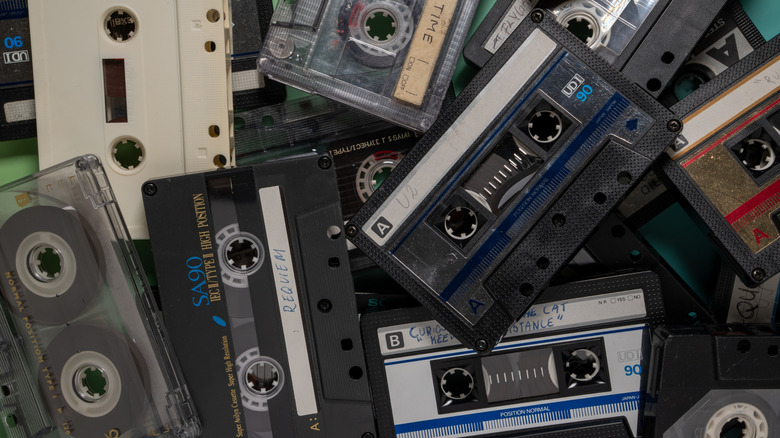
Nowadays, when you want to listen to music in the car, you're spoiled by aux cables, Bluetooth, and satellite radio. But if you're a driver of a certain age, you know the cassette tape used to be the way things were done, and even though you might associate them with the '80s and '90s in your mind, cassettes actually date back to the early '60s. The compact cassette was first developed in 1962 by Dutch engineer Lou Ottens. Working for Philips, Ottens intended it as an analog media format for dictation.
However, as the technology spread, it became clear just how much potential there was for it to go beyond just voice recording. The compact cassette was much easier to transport and store than vinyl records, and its storage capacity meant more music than what was contained on an 8-track. By the late 1970s through the early 1990s, the old format was the dominant audio format, and now the cassette tape is having a little comeback, with many artists putting their new stuff out on tape and vinyl in addition to the standard CD. But it's the '60s that you really have to thank.
Video game consoles
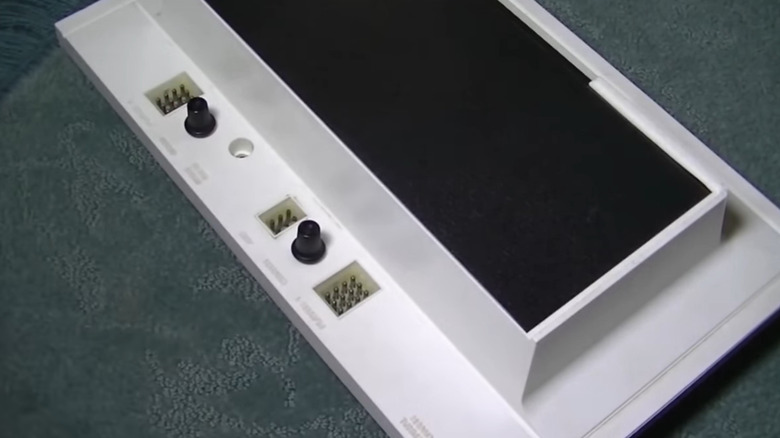
"Grand Theft Auto V" has made more money than any other single piece of entertainment in history. Pokémon games have raked in billions upon billions, as well, but video game consoles themselves go back all the way to the late '60s. At the time, televisions were entirely passive: People watched them, but they didn't interact with them beyond changing the channel or turning up the volume. In 1966, Ralph Baer began toying with the idea of interactive TV experiences.
By 1967, Baer and his fellow Sanders Associates technician Bob Tremblay had created one of the earliest video game test units. The aptly named "TV Game Unit #1" let users to control a dot displayed on-screen. The tests were a success and allowed them to develop it further into the Brown Box. Or, as it would soon be known, the Magnavox Odyssey, a forgotten pioneer of gaming consoles. Sanders Associates licensed the '60s technology to Magnavox, and the company released it as the first video game console in 1972.
The computer mouse
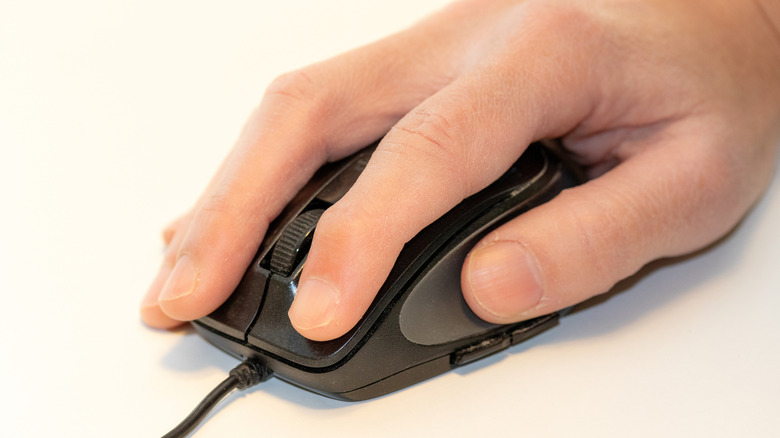
Can you imagine using the computer without a way to move the cursor around? It's a foundational part of any desktop or laptop today, but in the '60s, there was simply no such thing. The computer mouse didn't come to be until the early 1960s, when engineers at SRI thought people needed a way to navigate around the screen more easily.
By 1964, they had the first computer mouse prototype. The earliest versions only relied on wheels, but later designs brought multiple buttons into the fold. As was seen with the early video game console prototype, the name wasn't snappy yet, by any means. They called it the "X-Y Position Indicator for a Display System," not receiving the "mouse" moniker until later. From there, the technology (and its cutesy nickname) was history. Now, instead of relying solely on keyboards or specialized commands, people could interact directly with the information on the computer screen.
Barcode scanners

Scanning your groceries at checkout is such a quick and easy act; most stores will let you do the scanning all by yourself. But even though self-checkout machines feel relatively new, the technology behind them first emerged in the 1960s. As it turns out, barcodes themselves actually go back to the early '50s, but it wasn't until the '60s that someone came up with a way to actually read and scan those barcodes quickly and efficiently.
Credit goes to David Collins and Computer Identics Corporation. He was the one experimenting with laser technology and recognized its potential for reading barcodes. In 1969, Collins' Computer Identics installed its first barcode-reading systems. From there, competing barcode formats were invented and used until IBM's 12-digit Universal Product Code became the industry standard in 1973 and started hitting supermarkets one year later. Now, you'd be hard-pressed to find a store that doesn't use them.
Methodology
To make our picks, we focused on inventions that either originated during the 1960s or saw a major technological breakthrough during that decade. Of those inventions, we prioritized the ones that remain recognizable and relevant to everyday life today. Each item represents a tech item that either directly evolved into a common, modern product or helped establish the foundation for one.