

Audi Revives A 1930s Design For Beastly New V16-Engined Supercar
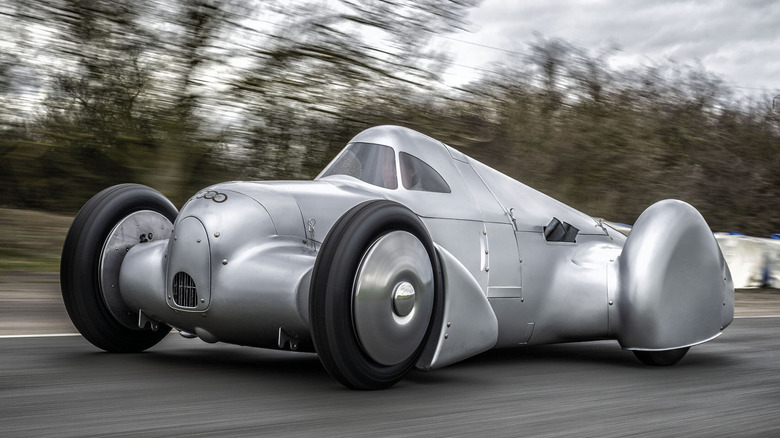
Audi has recently unveiled a new supercar with a V16 engine, but it is far from a "new" car. Instead, Audi has recreated one of the most renowned cars from its past life as the German brand Auto Union, which began with the merger of the DKW, Horch, Wanderer, and Audi brands. Its logo is made up of the four interlocking circles that represent the merged brands, the same cool vintage car logo used on today's Audis, a brand you might not realize is owned by Volkswagen.
Seen above is the Auto Union Lucca, a car originally designed in the 1930s to set speed records on both tracks and the superhighways that were being built at the time. The Auto Union Lucca went out for a run on the autostrada near Lucca, Italy on February 15, 1935. There, it set a record average speed for the flying mile of 199.005 mph (320.267 km/h), while the car also hit a top speed of 203.173 mph (326.975 km/).
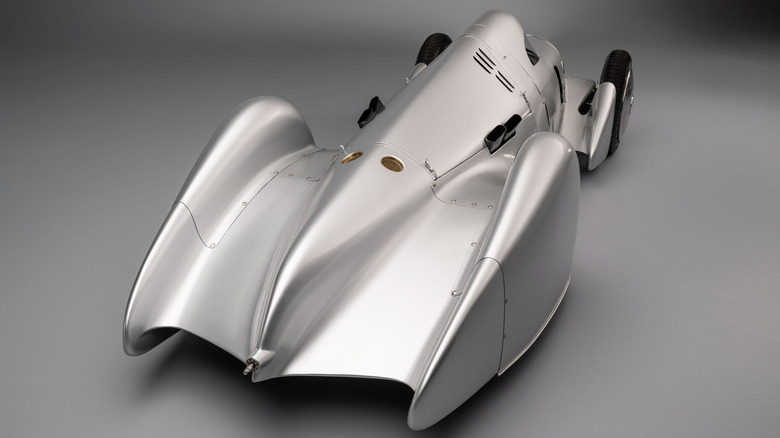
This new version of the Lucca was created by the British firm Crosthwaite & Gardiner over three years, based on historical documents and photographic evidence. Every part of the Lucca was made by hand by these specialists, so this is likely a project you should not try at home. During the build, the completed body underwent wind tunnel testing, which showed that the Lucca has a 0.43 drag coefficient, spectacular for the 1930s and still decent even by today's measurements. The closed bodywork led the press of the day to call it "Rennlimousine," or "racing sedan."
What should you know about the Lucca's V16 engine?
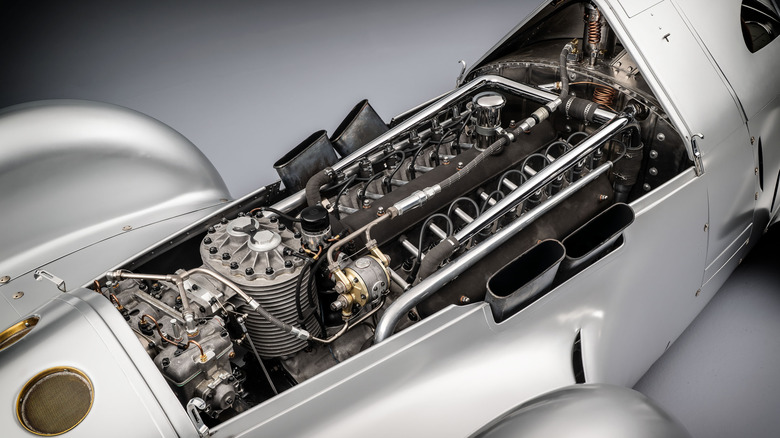
The V16 engine that sits in a mid-engine position behind the Lucca's driver is not the same version as the one that powered it during its original record run. Instead of the 5.0-liter engine that was used on that day in February 1935, the 6.0-liter engine from the later 1936 Auto Union Type C was used. This was done to improve engine reliability, as the 5.0-liter engine could have suffered from heat-related problems during its demonstration runs. As it is, the more dependable 6.0-liter version of the V16 has no visual differences from the failure-prone 5.0-liter engine. The car's ventilation system was also upgraded.
The Lucca's engine is fitted with a supercharger that compresses the intake air before sending it to the car's 16 cylinders. It runs on a fuel blend of 40% premium unleaded, 50% methanol, and 10% toluene. While earlier versions of this engine started out with 343 horsepower, the current 6.0-liter version has an output of 520 PS or 512.886 horsepower at 4,500 rpm. The curb weight of the entire car is 2,116 pounds, while measuring 66.9 inches wide, 47.2 inches high, and 179.9 inches long.
As a vehicle built with a single specific objective in mind, the Auto Union Lucca compares well with the later 1984-87 Audi Sport Quattro as a one of the most intense homologation special cars in history. While the Lucca was meant to be the apex speed-record predator, the Sport Quattro fulfilled its role as the ultimate rally weapon.
What else should you know about the Lucca's speed record run?
The Auto Union Lucca's run near its namesake town, where its recreation was initially shown, was not the first place where the 16-cylinder Auto Union was slated to show its capabilities. It was originally intended to take place in Gyón, Hungary, but a combination of bad weather plus a mechanical failure put an end to the run. The next location for the Lucca's speed record attempt was supposed to happen farther south, near Milan, Italy. Snow on the roads there caused another cancellation. Finally, a wide, straight, grippy, and flat location about five kilometers long was found on the Italian autostrada between Florence and Viareggio. This would be the place, a significant distance south of Milan and very close to Lucca, that would give this special-purpose car its name.
After a day devoted to testing various setups on the car, it was time for the Auto Union Lucca to show its capabilities. With the legendary driver Hans Stuck in control, and many thousands of onlookers watching the event, the Lucca set its two records. An average of two runs in opposite directions led to the Lucca claiming a flying-start mile record, while it took the top-speed record on the way back. The Lucca would now be known as the "fastest road racing car in the world."
There is a way that you can see the Auto Union Lucca in action this summer. It will make its first public appearance while moving at this year's Goodwood Festival of Speed, held from July 9 to 12, 2026.