

Here's How Many Diesel Engines Modern Cruise Ships Use
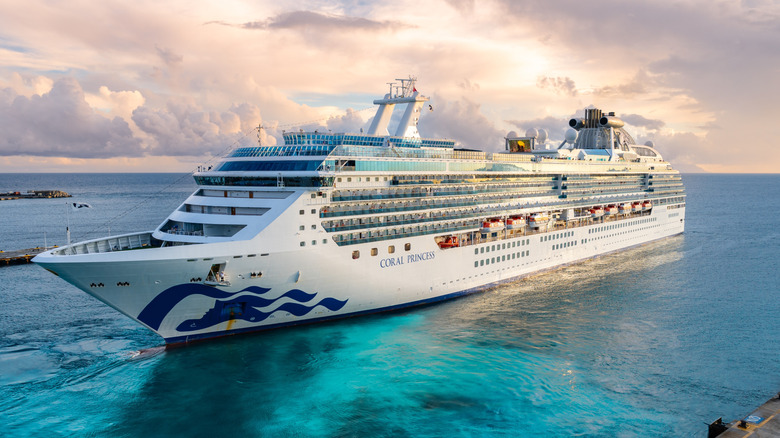
Whether or not you enjoy the idea of setting off on a cruise, there's simply no denying how impressive the ships themselves are. Cruise ships are among the largest vessels on the sea today, and the biggest examples are even larger than the U.S. Navy's aircraft carriers. The Legend of the Seas, for example, is just under 1,200 feet long, weighs more than 250,000 tons, and can carry nearly 10,000 passengers and crew members.
As you'd imagine, moving one of these behemoths across the ocean takes some serious horsepower, and the engine rooms on these vessels are quite astonishing. These vessels' engine rooms usually house diesel engines – although in most cases, the diesel engines don't provide propulsion themselves. Instead, they power the generators that drive the ship's electric motors and propellers.
Along with helping move cruise ships across the open ocean, these diesel engines also supply the generators that power other essential hardware, from HVAC and lighting to elevators and the massive freezers and refrigerators where food is stored. This means that one diesel engine is insufficient. Multiple engines are the norm on modern ships, with cruise ship engine rooms typically having between four and eight individual engines, depending on the ship's size and power needs.
A big ship needs big power
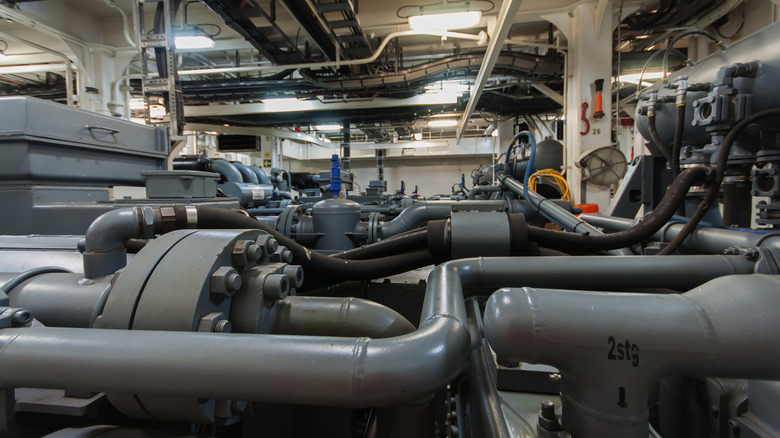
Even if they aren't designed to go particularly fast, the sheer size and power of modern cruise ships' engines are nothing short of incredible. Some 14-cylinder marine diesel engines, like the Wärtsilä 46, are nearly 40 feet long and weigh nearly 250 tons. Royal Caribbean's Icon of the Seas, the world's largest cruise ship as of mid-2026, uses three of those 14-cylinder engines, along with three slightly smaller 12-cylinder engines that still weigh over 200 tons each. In total, the six engines make an astonishing 67,500 kW of power — or over 90,000 combined horsepower.
As we mentioned, these engines don't drive the ships themselves; instead, they power electric generators, which supply juice to the ship's equally impressive electric propulsion system. On the Icon of the Seas, this system consists of three powerful Azipod thrusters that can rotate 360 degrees, propelling and steering the massive ship through the water. There are also five smaller thrusters in the bow of the ship to help navigate in port spaces.
Some cruise ships take a different route, going with fewer, larger engines. While it's technically an ocean liner rather than a cruise ship, Cunard's Queen Mary 2 uses four Wärtsilä 16-cylinder engines on its trans-Atlantic voyages. You also sometimes find ships with an odd number of engines, like the MSC World Europa, which runs five Wärtsilä 14V 46F 14-cylinder engines.
Dual fuel for the future?
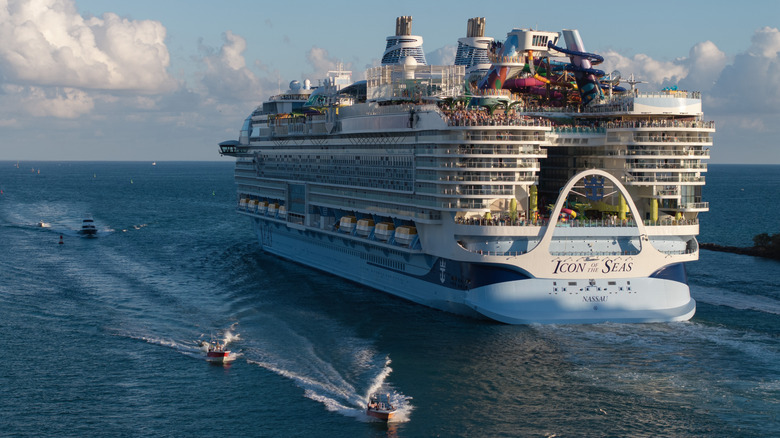
With vessels like the Icon of the Seas acting as floating cities, complete with waterparks, dozens of restaurants, and other onboard amenities, the multiple engines are crucial for supplying electricity at sea. They can take a break in port, though, as modern ships can hook into local power grids, which helps reduce their emissions.
Reducing air pollution is, unsurprisingly, a major goal for cruise ship operators. While these vessels are likely unsuited to the high-tech WindWings that some commercial ships have tried, the industry has explored other ways to reduce emissions. This has mainly come in the form of using liquified natural gas (LNG) as a fuel source. The engines of both MSC World Europa and the Royal Caribbean Icon of the Seas are among the growing number of cruise ship engines capable of dual fuel operation, meaning their engines can run on both conventional marine diesel and cleaner-burning LNG.
Despite the positives, LNG still has some drawbacks for maritime applications, including the need for larger onboard fuel tanks and reduced availability at depots. The greater issue, though, might be the risk of unburnt methane escaping into the atmosphere, though modern dual-fuel maritime engines are said to reduce this significantly.