

Asus ROG Zephyrus Duo Review (2026): 2 Giant Screens Make 1 Massive Gaming Laptop
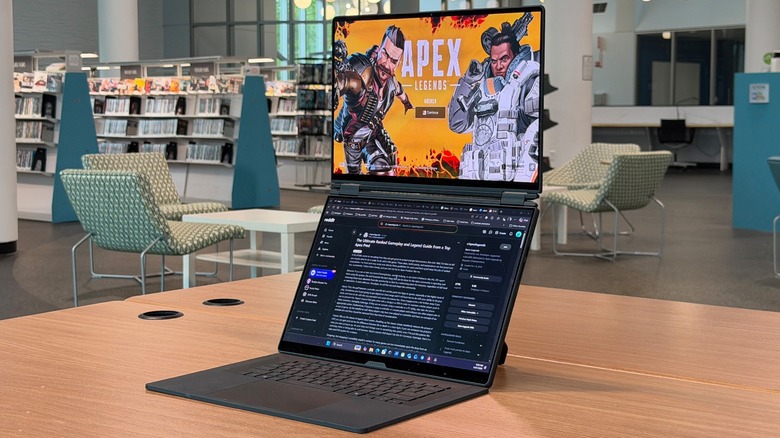
One thing that has become clear to me is as a reviewer is I'm a sucker for dual-screened laptops. There's just something lovely about opening up a laptop and being greeted by two huge screens staring back at you. At home, I have a triple monitor setup — though I've been considering eliminating one of them lately. Multiple monitors are an integral part of my workflow, whether I'm editing other articles or writing my own.
So, when Asus asked if I wanted to review the Zephyrus Duo, of course I said yes, but I'm not sure I really knew what I was getting into. Because a separate part of my job involves being mobile. I work in a lot of different places, which is why a dual-screen laptop is attractive. But this is the ASUS ROG Zephyrus Duo — it's a dual-screen gaming laptop
Typical traits of gaming laptops involve lots of power and quirky design, both of which are delightful. But they also tend to be big, heavy, and pretty hard on the battery. I'm both pleased and saddened that the Asus ROG Zephyrus Duo embodies all of these traits — unapologetically. I've been using an Asus ROG Zephyrus Duo review sample, provided by Asus for just under a week, including lugging it on a trip across the country and back, and these are my thoughts.
It's huge
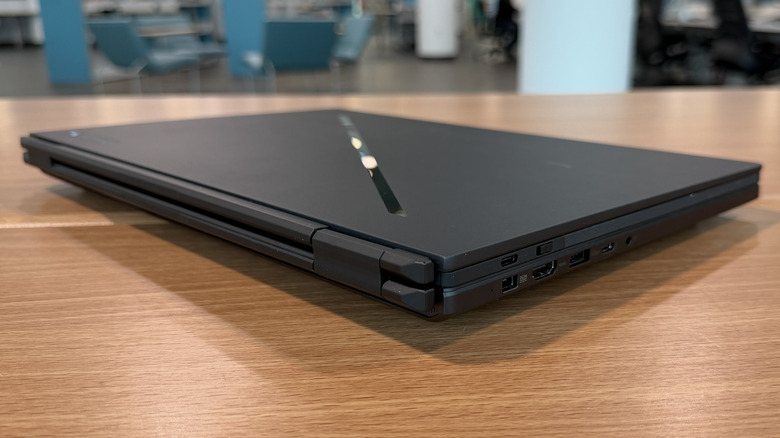
Make no mistake, this laptop is gargantuan. When I first unboxed it, I hearkened back to the beastly laptops that my wife used to have issued to her at work in the early 2000s. I'm talking about those kinds of beasts. More recently, around 2020 I was in the market for a PC that I could use to edit videos, and I landed on a gaming laptop from a different manufacturer. Gaming laptops haven't gotten much thinner since then, but this laptop is almost a full inch thick when closed.
Compare that to some other laptops that I've reviewed recently, and it's shocking. The last few laptops I had on my desk include the ThinkPad X13 Gen 6, and the MSI Prestige 13, one of the adorable pieces of tech I took to MWC. Even more recently, I've worked with the Asus ZenBook A16 and the Samsung Galaxy Book6 Pro, both of which are large, 16-inch laptops that are no thicker than half an inch and weigh around 2.5 pounds.
By contrast, the Zephyrus Duo checks in at almost three times that weight — 6.17 pounds. In case you're not keeping score, let me spell it out for you — this is not a subtle laptop, by any stretch of the imagination. But that's okay; it's a gaming PC.
Gaming design
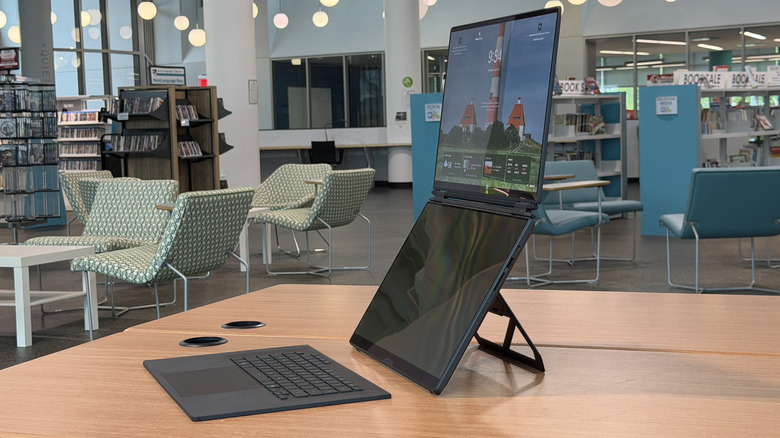
I always have a soft spot for gaming laptops, despite their ridiculous size. The features on them that make them gaming laptops are always so refreshing and delightful. The Zephyrus Duo has Asus's trademark LED slash across the lid that lights up when the laptop is working. The keyboard, which like its non-gaming cousin is removable and easily sandwiches in between the screens, has fully customizable RGB backlighting.
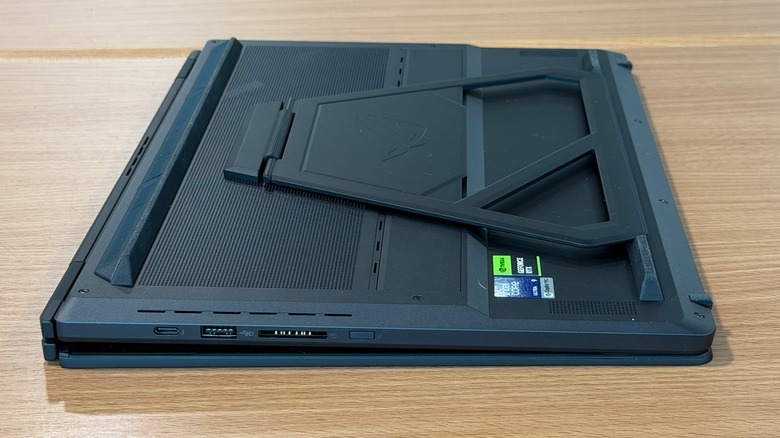
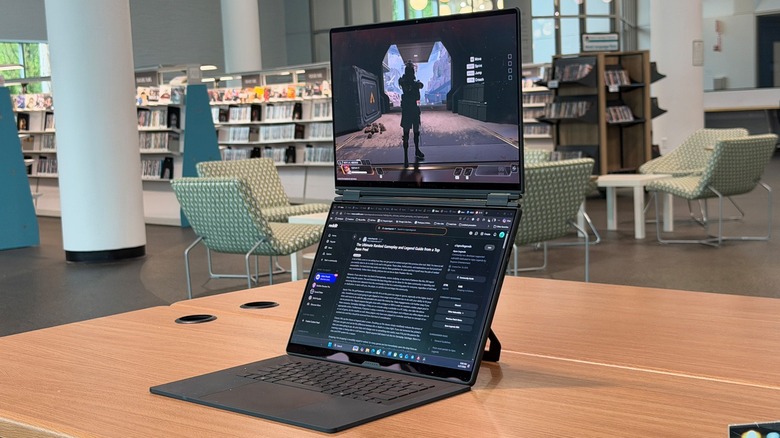
Even the wallpaper on the home screen is animated in a delightful way when you first bot up the laptop, or when you switch it from "laptop mode" to dual screen mode. The kickstand on the back that allows you to prop up the screens is built in, and it works in both landscape and portrait, which is a lovely bonus.
There is ample space for cooling, with vents wrapped all around the chassis. Even the charging brick is massive and uses a proprietary jack, though the laptop can charge (slowly) with USB power delivery. All of these combine to give the Asus Zephyrus Duo a slightly understated (there are certainly more ostentatious gaming laptops) but undeniable gamers aesthetic that is just plain fun.
Power to spare
Underneath the hood, this laptop has everything you could possibly want in a gaming laptop, let alone a dual-screen gaming laptop. As reviewed, it's powered by an Intel Core Ultra 9 386H processor, with an Nvidia RTX5090 GPU with 24GB of VRAM. The laptop also has 32GB of RAM and 1 TB of storage.
The displays are 16-inch "Nebula HDR" displays with 120Hz refresh rates and go up to 1,100 nits of brightness. The front-facing webcam camera is a 1080P IR camera that supports Windows Hello. There is no fingerprint reader, I'm sad to report. The kickstand is built into the bottom of the laptop and adds to the overall bulk.
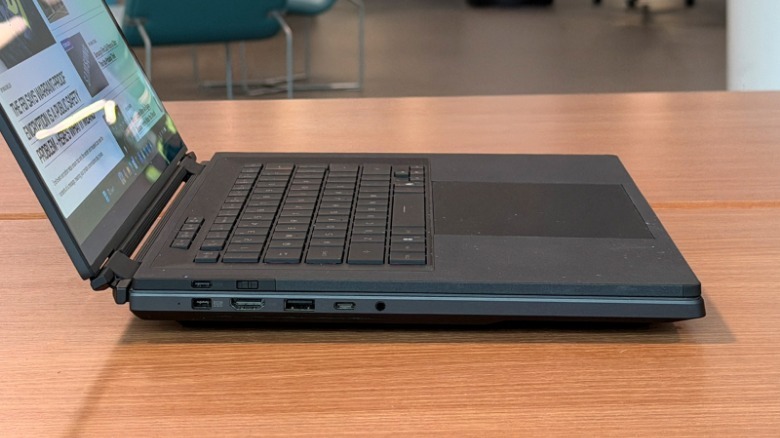
Meanwhile, in terms of I/O, the laptop has two Thunderbolt 4 ports with DisplayPort and Power delivery capability. There are also two USB 3.2 Type-A ports, a microSD card reader, a 3.5 mm audio jack, and an HDMI 2.1 port. The laptop also supports Wi-Fi 7 and Bluetooth 6.0. It's equipped with a 90 Wh battery should you ever decide to unplug it, and you probably shouldn't.
Keyboards aplenty
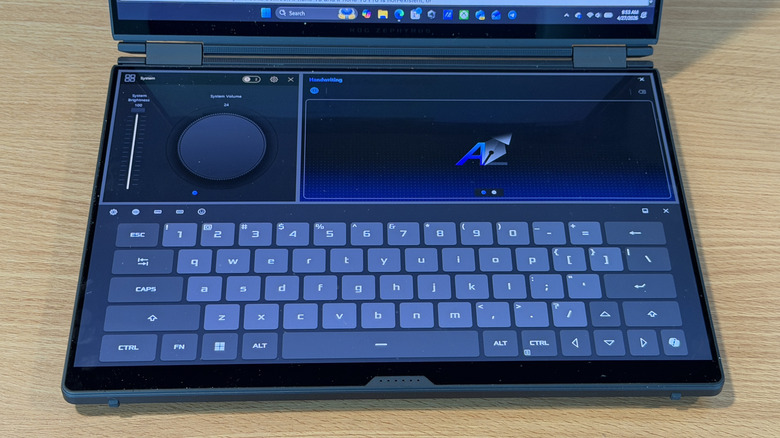
The Asus Zephyrus Duo comes with a physical keyboard sandwiched between the two screens. When you open the lid, the machine works just like a 16-inch laptop. The keyboard attaches to the bottom screen magnetically and connects with pogo pins to charge. You can also charge the keyboard with USB-C if you prefer.
 Adam Doud/SlashGear
The keyboard itself is very thin and feels really nice. There's a soft-touch coating around the outside that feels great to rest your palms on. The keys are nicely separated with great pitch and a little more travel than I'd normally prefer, but that's subjective. The keyboard tends to slide around on slippery table surfaces, so bear that in mind.
There's also a virtual keyboard if you want to use one. If you tap on the screen with three fingers on both hands, you can summon and dismiss it. You can also drag with six fingers down to move the keyboard down. That opens up some extra widgets that allow you to use handwriting and adjust system controls like brightness and volume.
Powerful and power-sucking
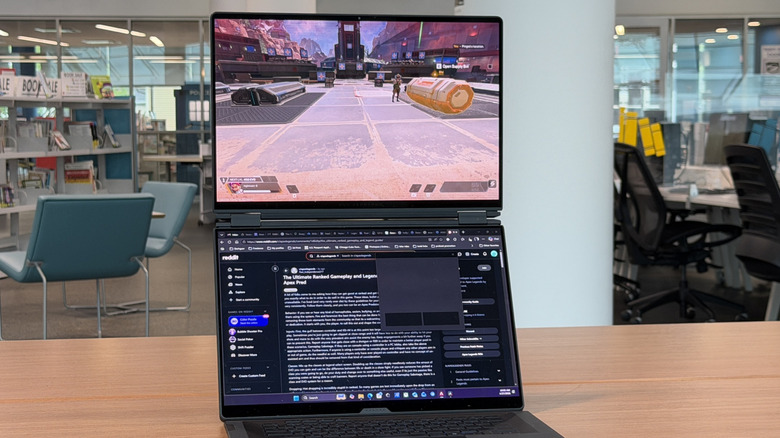
As for performance and battery, they behave exactly like you'd want a gaming laptop to behave. It's ridiculously powerful, and it drinks battery accordingly. It's already tough enough to power a laptop with dual screens, but when you add a power processor, discreet GPU, and fancy lighting into the mix and you've got a recipe for short battery life (if you're ever unplugged, that is to say).
I haven't used the laptop as much as I would like to determine a fair average battery life off-charger, but in the few days I've used it under a normal workload, it has lasted around four to five hours. That includes a couple of dozen browser tabs and a couple of messaging apps, all running at around 50% brightness with music streaming in the background for good measure. All told, that's not bad for a gaming PC.
As for performance, I tested out a couple of features. I played a bit of "Apex Legends" after I paired the laptop up with a Razer Pro Click V2 gaming mouse. I also built and edited a short video (in 1080p) with the laptop, and both performed very well. As for numbers, it clocked Geekbench 6 at 2,889/16,902 single and multi-core scores, which are both very respectable numbers in the category.
Asus ROG Zephyrus Duo price, availability, and verdict
This laptop as reviewed checks in at a no-nonsense price of approximately $5,500 and you can pre-order it from Asus directly or from its retail partners starting today.
Overall, this is a fun, but bulky machine to carry around, but I keep coming back to the fact that it's a gaming laptop. It's also pretty expensive, but again, it's a gaming laptop. By their very nature, gaming laptops are top-of-the-line machines built to get every frame per second you can out of it. That comes at a cost, especially in this day and age. It's definitely at the top end of the price spectrum, but it's a special machine.
The Zephyrus Duo is not for me — I tend to favor much thinner and much lighter laptops because of my job and because of the fact that I'm really not much of a gamer. But if you are, and you like the idea of playing a game on the top screen while you stream on the bottom, or have a map open, or something similar, this is a very tempting device to pick up. But it's going to cost you — both in your wallet, and on your back. So, if you want to explore this device, be very, very sure you want everything it will give you, because you're going to pay a lot to get it.