

Philippine Navy Weapon Disables Enemies With 'Extremely Loud Disturbing Sound'
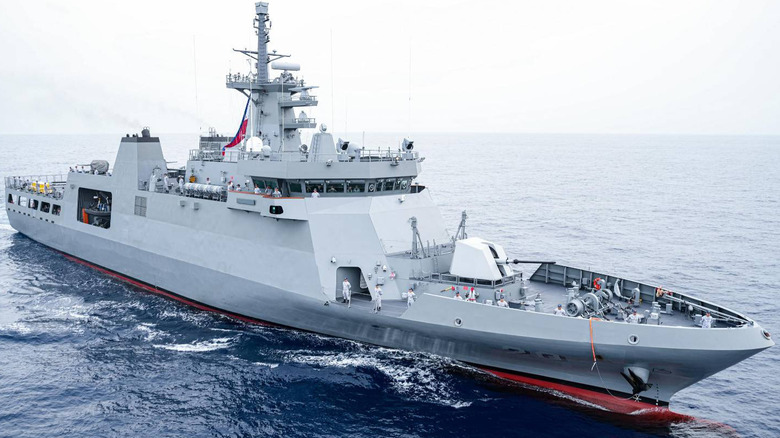
Long Range Acoustic Devices (LRAD) are a popular class of sonic weapons that are deployed by law enforcement agencies, and they're now being deployed by the Philippines' defense agencies on its offshore patrol vessel (OPV). The Asian nation's navy has installed a pair of Multirole Acoustic Stabilized Systems (MASS) atop its BRP Rajah Sulayman (PS-20) patrol ship, combining noise and light as a deterrent for enemies.
This marks the first time that the Philippines is deploying sonic weapons in the South China Sea, which has long been a contested marine territory with a history of skirmishes with superior naval powers. Notably, China was criticized for using long-range acoustic devices (LRAD) against a Philippine Coast Guard (PCG) vessel as recently as 2025. It seems the Philippines is now readying itself for countermeasures, and according to Naval News, the country has plans to expand the usage of such sound and laser-based weapons across its South China Sea patrol fleet. The Multirole Acoustic Stabilized Systems (MASS) system acquired by the country is actually a combined kit that also used laser and bright light in tandem with piercing sound blasts to deter enemies. Predominantly though, the use of LRADs has been associated with local law enforcement agencies to manage protests and disperse rioters.
What can this sound weapon accomplish?
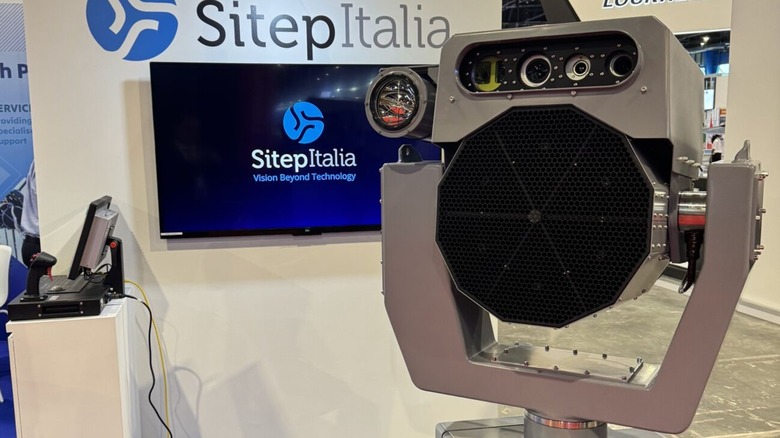
The Multirole Acoustic Stabilized System (MASS) SX-424(V)122 system installed on the 2,400-ton vessel is supplied by an Italian company. Per the product description, it comes equipped with a video camera system to spot enemies, and sound equipment to blast a warning. If the threat escalates, the system can blast disorientingly loud noise, while also shooting light and laser beams at the enemy. Sitep Italia, which makes the LW MASS CS-424 system, notes on its website that the device produces "an extremely loud disturbing sound, high-intensity light, and a laser dazzler" when an approaching threat is detected.
The sonic weapon can produce a loud noise that can reach a distance of up to 3,000 meters for communication and warning. Within the 2,000-meter range, the high sound levels also serve as a deterrence. And if the enemy comes within the 125-meter range, that's where the "pain barrier" kicks in. Now, sonic weapons like the LW MASS CS-424 system aren't blunt deterrent. In fact, their impact depends on factors such as frequency of the noise, the raw power, and exposure time. According to research published in the Chinese Journal of Traumatology, low-level exposure can cause headaches, fatigue, and swallowing difficulties.
At close quarters, it can cause immense pain and permanent hearing damage, especially within a 15-meter radius. The use of LRADs has been questioned, and careful restraint has been advised, by organizations such as Physicians for Human Rights (PHR) and the International Network of Civil Liberties Organizations (INCLO). As far as the deployment of a multi-role sonic weapon on a naval vessel goes, it's an early deterrence tactic to avoid a more serious confrontation.