

Why Do People Fill Engine Blocks With Epoxy?
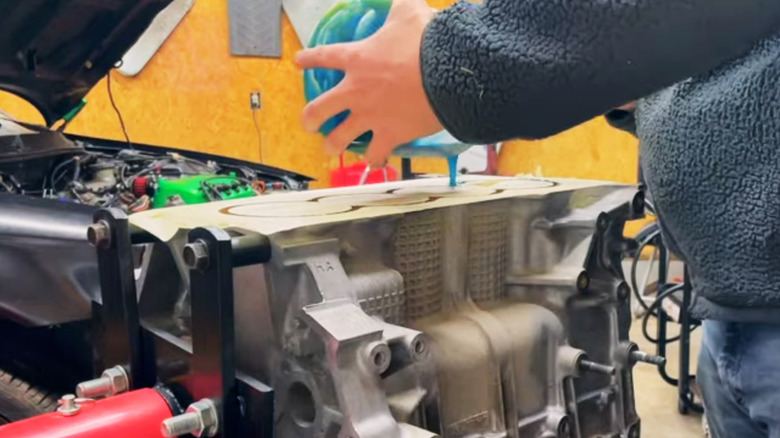
Skilled mechanics that can build a motor feel like next-level technicians when compared to those people who just like to tinker in the garage. This is especially true when it comes to working with the engine block itself, which some people fill with epoxy resin. But while it may seem like an odd technique, it's actually done to strengthen the engine, and make it more durable in the process. It's also why people fill their engine blocks with concrete.
Epoxy resin, which can even be added to your garage floors, reinforces the cylinder walls, making the engine tougher than before. But even with the epoxy, coolant can still circulate through the block itself. This is done by carefully controlling the amount that's added, then reopening important pathways after it cures. This creates a closed-deck design often found in more high-performance engines. The block is better able to withstand high stress situations, while also allowing the engine to regulate temperature.
Epoxies can also repair existing damage by sealing cracks in the engine block, cylinder head, or even the oil pan. This is possible because of the epoxy's ability to bond with metal surfaces. That bond holds up under high temperatures, and doesn't shrink, rust, or break down over time. Since it becomes part of the engine, epoxy can be drilled, sanded, or machined, as needed. An important caveat to this is that the epoxy used must be specially formulated for engine repair, or it may not perform as intended.
What to know before adding epoxy to an engine block
While adding epoxy to an engine block is ideal for high-performance scenarios, there are some drawbacks. You have to consider how much cooling your engine will need after the process is complete. Filling the block completely can interrupt, or even block airflow, which can negatively affect your engine. Even partially filling can be tricky, as it requires exact precision. Otherwise, you could unintentionally seal the engine's existing coolant passages, which need to remain open.
Everyday engines are a bit more nuanced because they're driven over longer periods of time. That's why those engines could benefit more from a partial fill, as it allows for a consistent circulation of coolant. This setup is more sensible, because you don't really need those short bursts of power on the road as you would in drag racing, which isn't quite the same as roll racing. Everyday driving just doesn't demand that sort of performance, which means you may not need to modify your engine at all.
The most important thing to remember is that adding epoxy to an engine block is a specialized process. It requires an exact application, along with a clear understanding of how the epoxy works, and how the engine itself is going to respond. Then there's the engine's built-in cooling systems, which need to be considered and accounted for, during any such modification. So before you move forward on your own, it's best to consult an automotive professional first.