

More Than Just Rubber: What Are Tires Made Of?
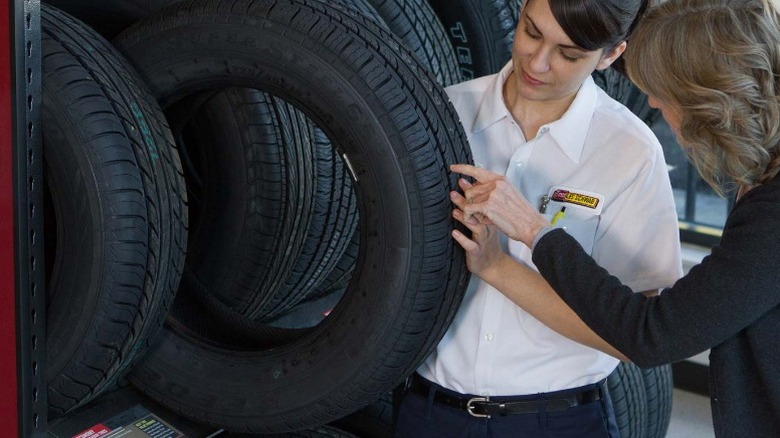
We drive our vehicles every day, often without thinking of all the engineering that goes into making them possible. For example, cars, trucks, SUVs, and even motorcycles all require a set of road-ready tires if you want them to get anywhere. We're talking about a giant steel chassis carrying body panels, windows, seats, and passengers — thousands of pounds of weight — all balancing on four little air-filled wheels. Not only that, but these humble tires can travel tens of thousands of miles over rough asphalt, gravel, and various other abrasive forms of terrain before needing to be replaced. It's pretty impressive when you stop to think about it.
The expression, "Where the rubber meets the road," is used to refer to the moment when a plan or theory becomes a reality. But that very rubber is actually what makes modern automotive travel possible in a much more literal sense. You might not realize it by looking at them from the outside, but tires are surprisingly complex, with specific types of rubber that can remain grippy while enduring the constant beating of weight, pressure, and miles. Of course, there are dozens of major tire brands out there that each have their own blueprints and formulas, but there are a few basic design elements that they all have in common. So with that in mind, it's worth taking a look at what these miraculous little things that we so often take for granted are actually made of. What kind of rubber is used to produce car tires, and what other materials are involved in their construction?
How is tire rubber made?
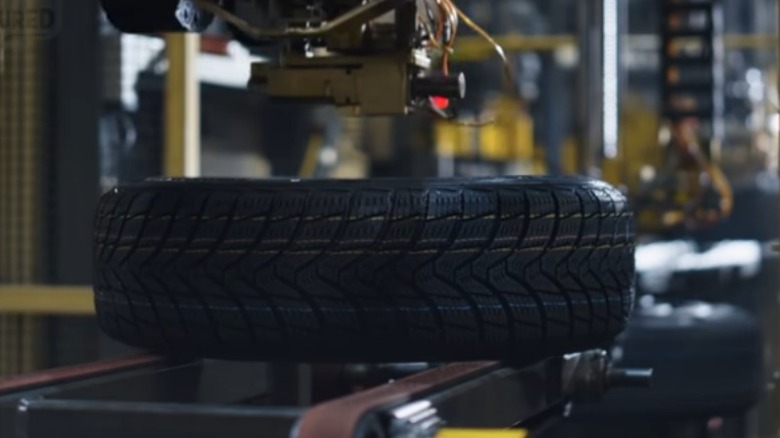
Tire rubber is pretty different from the rubber used in your dog's chew toys. It's actually a complex blend of different materials that can be mixed and matched to achieve different effects such as elasticity, durability, grip, and speed. "Over 200 raw materials go into tire composition," says Michelin Tire. "Researchers draw on this extensive array to combine tire components, each of which has a role to play, depending on the type of tire produced. The rubber compounds are made up of elastomers, reinforcing fillers, plasticizers and others chemicals elements."
It starts as a combination of 40% natural and 60% synthetic rubber. The natural rubber is actually refined from the pale latex that is extracted from the bark of naturally occurring rubber trees that primarily grow in Southeast Asia. This is then coagulated with acid and shaped into blocks to be used later. Meanwhile, the synthetic is a petroleum-based product, produced by separating hydrocarbons from crude oil. Natural rubber is essential for reducing the heat generation caused by friction and sun-baked asphalt, while synthetic rubber is more malleable, deforming under stress and then returning to its original shape, providing elasticity and grip. It's also what makes modern tires last so long without cracking, breaking, or otherwise losing their shape.
These two materials are then reinforced with additives before molding. Carbon black and silica are the main ones. Carbon black dramatically increases wear resistance and can make up 25% to 30% of the rubber's overall composition. It's also what makes tires black. Silica is refined from sand and helps improve tearing resistance. The average modern passenger car tire contains 25 separate components and up to 12 rubber compounds, and you might find wildly different formulas across different brands and models.
What else is in tires besides rubber?
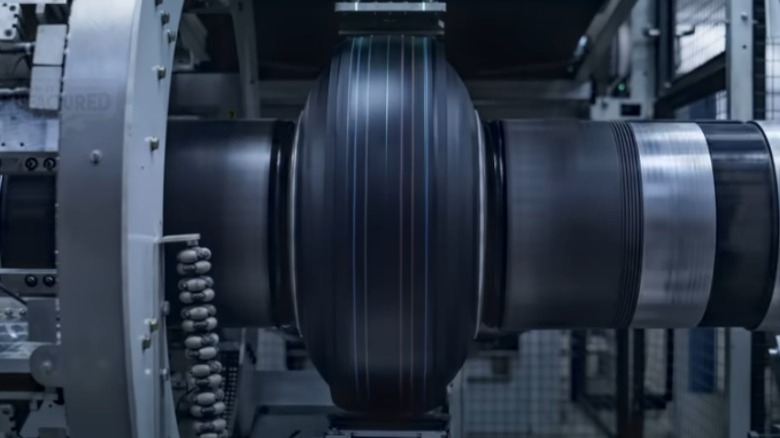
Yet, as complex as these formulas are, rubber isn't the only thing that goes into making tires. Textiles are often shaped into reinforcing threads that are layered into the rubber, just below the tread. These are made from materials like rayon, nylon, polyester, and aramid fibers. If you've ever cut into a tire and seen the tiny little mesh of white string poking out of the rubber, this is what you were looking at. These textiles are particularly important in high-speed, performance-oriented tires, but they also make the tire more resistant to damage, enhance directional stability, and help absorb vibration for a more comfortable ride. A layer of textile cord ply is also used to help control the internal pressure of the tire.
Metal reinforcements are also an essential component in tire design. High-strength steel cord and wire have been a staple in tire manufacture since they were introduced in 1934. A strong chemical coating is applied to the wire to make it adhere to the rubber and make reinforcement belts, which further strengthen the tire from within. This helps the tire maintain its shape, reduces rolling resistance, and increases the tire's longevity, making this reinforcement especially vital in high-mileage tires that are made to go nearly 100,000 miles before the tread runs out. Steel bead cores are also used to ensure that the tire is firmly attached to the wheel. Finally, a different kind of synthetic rubber called butyl rubber acts as a seal for the chamber inside the tire, preventing air leakage.