

Why Do Some 4-Cylinder Engines Have Eight Spark Plugs?
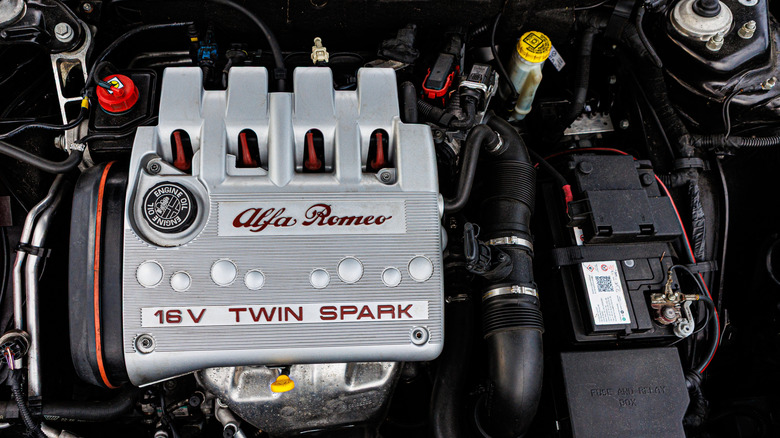
When you think of four-cylinder engines, chances are, you're thinking of a system where each cylinder uses a single spark plug to ignite the fuel. This would seem to make sense; why go through the complexities of engineering a second spark into the equation when one seems to be enough? It's true that most piston engines for aircraft have two spark plugs, but this is primarily a safety feature. You're very unlikely to plummet 10,000 feet to earth if a spark plug fails on your daily runabout.
To answer why some more grounded vehicles use a second spark plug, we need to look at just what else it brings to the party. In a conventional setup, a single spark plug ignites the mixture from a single point, which makes complete sense. By adding a second spark plug, the process can start from two places at the same time. Essentially, this allows the fuel-air mixture to burn more quickly and evenly, resulting in a more complete burn. This helps the engine extract more energy from the same amount of fuel — or more bang for your buck if you'd prefer.
Some manufacturers, including Alfa Romeo with its Twin Spark engines, and Honda with certain i-DSI designs, have used this approach to fine tune performance. It's also a trick that Harley-Davidson used when it introduced its Milwaukee-Eight engine with four spark plugs. Admittedly, that's a two-cylinder engine, but the principle is the same.
Two sparks are occasionally better than one
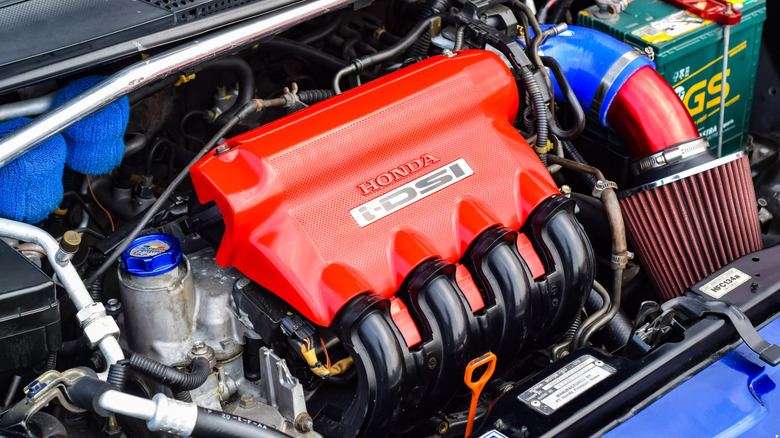
While the concept of two spark plugs per cylinder might seem like a relatively new innovation, its history is longer than you might imagine. One of the early pioneers of the system was Alfa Romeo, the company's signature Twin Spark engine was unveiled at the 1987 Geneva Motor Show. However, while this represents the genesis of the modern Twin Spark, the first Alfa Twin Spark can trace its roots back to a race car from 1914.
Honda was another company to adopt the twin spark plug approach to four-cylinder engines. Dating back to 2001, the 1.3-liter i-DSI engine featured an ignition control system that fired the spark plugs sequentially depending on the engine load and RPM. This approach offered several advantages over single spark plug engines — it allowed Honda to achieve a higher compression ratio, but without increasing engine knock, the latter being a potential problem with higher ratios.
However, twin spark engines do have downsides, one of them being emissions. While twin plugs generally reduce emissions through cleaner burns, the faster and more complete combustion raises cylinder temperatures, which actually increases NOx emissions.
Of course, more components mean added complexity and cost. This isn't simply a case of buying extra spark plugs, but such designs also require additional wiring and more advanced ECU control. Ultimately, it was a mix of this complexity and advancements in engine technology that saw the eight spark plug, four-cylinder engine, remain a rarity.