

An Entire Ocean Could Be Trapped In Rock 400 Miles Below Your Feet
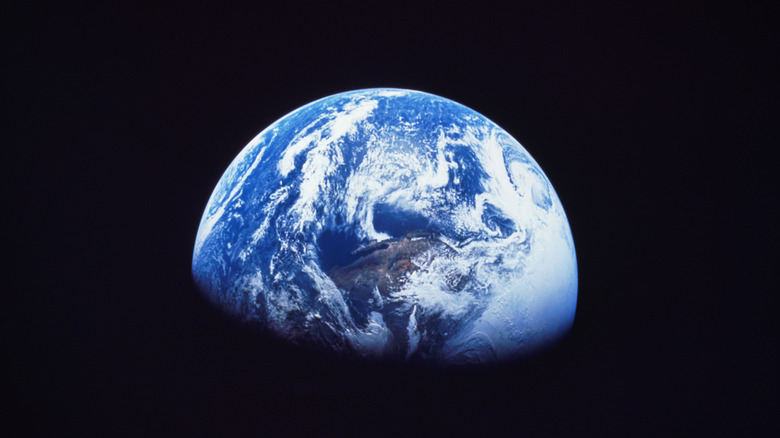
We tend to think of Earth's water as something that normally exists on the surface — or at least close to it. Sure, groundwater exists, but even that typically sits between 500 and 1,000 meters below the Earth's surface. Even in more unusual cases — like the ancient brine that recently burst through Antarctic ice at Blood Falls – the water was still relatively close to the surface. Back in 2014, however, a team of researchers from Northwestern University and the University of New Mexico found something that basically flipped that assumption on its head. In a paper published in Science, they reported evidence of a reservoir of water sitting a whopping 400 miles beneath North America.
Specifically, the water is trapped in a part of the mantle known as the transition zone, which sits between 250 and 410 miles below the surface. It's not just a little bit of water, either. The researchers have estimated that even if water makes up just 1% of the weight of the total rock in that region, it would still add up to roughly three times the volume of the total water in the Earth's oceans.
That said, this isn't the kind of water you could swim in or scoop up with a bucket. Instead, it exists as hydroxyl radicals. Due to the immense pressure in this region, water molecules split to form these hydroxyl radicals, which can be chemically bound to a mineral's crystal structure. Specifically, these molecules get trapped inside the crystal structure of a mineral called ringwoodite. A bright blue rock that only forms under the extreme temperatures and pressures found miles below the surface, this mineral is thought to be very common in the Earth's interior.
How the researchers made this discovery
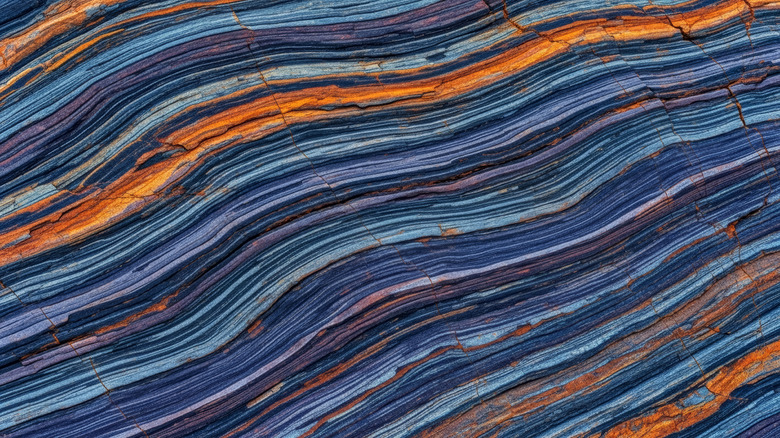
To discover this underground water, the research team listened to earthquakes. More specifically, they pulled data from over 2,000 seismometers spread across the United States that picked up seismic waves generated by more than 500 earthquakes. The researchers then tracked how those waves behaved as they moved through different layers of rock deep underground. The thing is, if a rock is saturated with water, it slows seismic waves down. When these waves hit the mantle's transition zone, the team did observe a reduction in their velocity, confirming that the material down there was soaked.
It's worth noting that the seismic data wasn't the only evidence pointing in this direction. These researchers had already synthesized ringwoodite in the lab and subjected it to deep-mantle conditions. This allowed them to become familiar with what the seismic signature of water-saturated ringwoodite should look like before they went looking for it underground. As one of the study's co-authors Steve Jacobsen told New Scientist, the water-bearing rocks appear "almost as if they're sweating."
Interestingly, the discovery also feeds into the long-time mystery of where Earth's oceans originally came from. One popular theory has been that icy comets slammed into the planet billions of years ago, adding water to the surface. However, these findings suggest that the oceans may have perhaps gradually seeped out from deep within Earth's own interior over time instead.