

US Navy's New Autonomous Ships Are Designed To Be Built At Rapid Speed
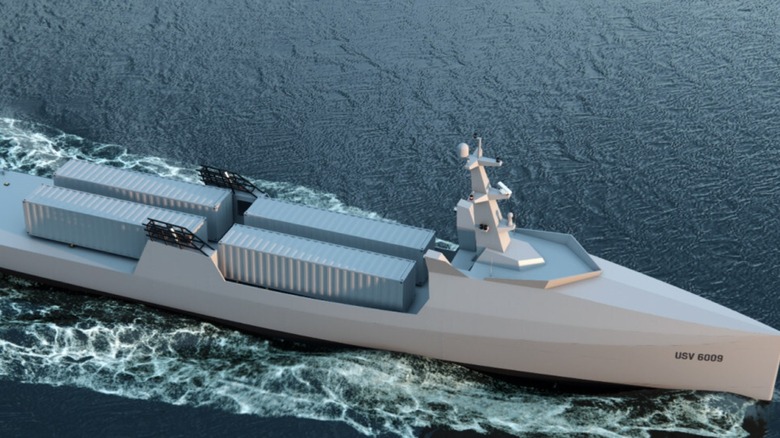
The United States Navy is the most powerful blue-water navy in the world, and it takes a lot to keep it running. While the Navy's aircraft carriers, submarines, and other various types of modern warships get most of the attention, that's hardly all the service employs. Moving all manner of cargo is an essential task for the Navy, and it has been since the beginning. To that end, as the Navy looks to the future, it is embracing autonomously operated vessels to help.
Blue Water, a defense contractor, developed the Liberty class of medium-sized uncrewed surface vessels that can operate for up to three months and cross the Pacific Ocean completely independently. This is an amazing achievement in naval automation, and it could be used to deliver much-needed medical, food, or other supplies, including weapons and ammunition, anywhere in the world.
The Navy, and other militaries around the world, are shifting from entirely crewed large vessels to a hybridized fleet that contains both conventional ships and autonomous ones. With the addition of Liberty Class ships, the U.S. Navy would take a significant step in that direction, as they'd act as force multipliers by reducing the manpower needed for logistical operations, freeing them up for warfighter duties.
Blue Water's Liberty Class autonomous ships
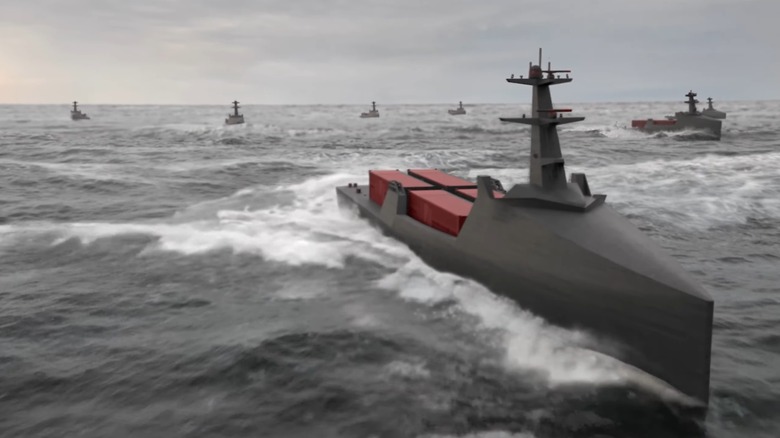
Blue Water developed the Liberty Class using the Damen Stan Patrol 6009 hull as its template, featuring an axe bow design. This improves stability in rough seas, which is vital for autonomous operation. Each vessel measures 190 feet in length with a beam of 30 feet, displacing around 850 tons. They have a maximum speed of 29 mph and can sail for 11,500 miles while carrying four standard 40-foot cargo containers. These allow a Liberty Class ship to carry up to 165 tons.
The ships are designed without any need for heating, ventilation, or air conditioning, as they aren't meant to house personnel. Without crewed spaces, the internal layout requires far less installation of unneeded devices. Without a single human onboard, a Liberty Class ship can operate for 90 days.
Because Blue Water licensed the Stan Patrol 6009 hull, it can be produced far faster than it would through standard naval procurement and production processes. This removes the need for further hull development while allowing for easily installable off-the-shelf components. Blue Water is constructing its Liberty Class ships at Conrad Shipyard in Morgan City, Louisiana, where the production line employs robotic assembly systems and can build these ships at a rate of between 10 and 20 per year. Construction of the first vessel in the product line began in March 2026, and if it works as advertised, it's likely that we'll soon see Liberty Class vessels operating around the world.
Blue Water chose its new ship's name well
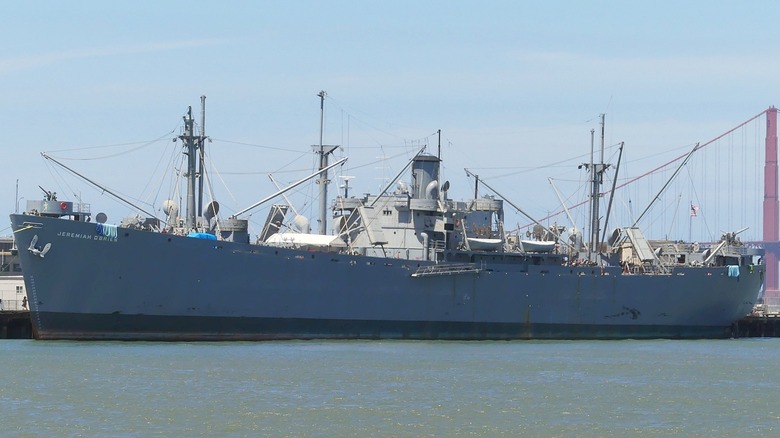
The Liberty Class ships aren't just impressive in terms of technology, but they're designed to be built and employed at a rapid speed. This aspect of their design and their name hearken back to the vital Liberty Ships of World War II. You won't find them listed among the most legendary ships of WW II, but the reality is the conflict might not have ended in the Allies' favor had it not been for Liberty Ships. These were a class of cargo ships that were designed for mass production on a large scale, and they were built incredibly quickly.
Throughout the war, the United States built over 2,700 Liberty Ships, which carried all kinds of cargo and equipment to the fronts. Because Blue Water opted for Liberty in the naming of its ship, the company clearly wanted to highlight the rapid pace of its construction. While Liberty Class vessels will take longer to construct than Liberty Ships, they're still planning on producing them incredibly quickly. Between 1941 and 1945, the U.S. shipbuilding industry averaged three Liberty Ships every two days, which is a rate of industrial naval construction the likes of which hasn't been seen since.
The Liberty Ship that holds the record for being the fastest from the laying of its keel to completion is the SS Robert E. Peary. From start to finish, the Perry took exactly 4 days, 15 hours, and 29 minutes to construct. It's going to take a lot more time to produce the highly advanced autonomous Liberty Class vessels, but it's clear why the name was chosen.