

Your Next Toyota Model May Be Built With The Help Of A Robot Named Digit
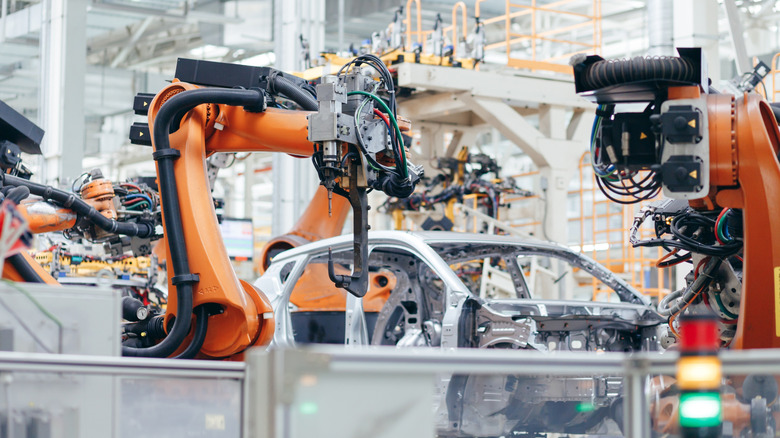
The idea of humanoid robots can either seem like the forefront of innovation or the plot of a slightly creepy, oddly prescient 2004 Will Smith movie. In reality, robots have been a part of manufacturing for decades. In fact, the first industrial robot was developed in 1959, before we even landed on the moon, and GM became the first company in the world to use one on a production line in 1961.
Cars have undergone several transformations since the 1960s, and so has manufacturing, from the materials used to the way vehicles are assembled in the factory. Robotics is used in welding, component installation, vehicle painting, and more, but the non-humanoid robots completing these tasks don't look like us. The most common industrial robots are articulated robots, which look a bit like a human arm with joints that allow them to complete different tasks. Toyota Motor Manufacturing Canada, however, is getting ready to deploy Digit, a humanoid robot made by Agility Robotics, at its manufacturing plant in Woodstock, Ontario. Vehicles at the plant, which builds the Toyota RAV4, are exported to the U.S., meaning your next Toyota could be built partially by a humanoid robot.
The bipedal robot, Digit, looks vaguely human-like. It has a head and LED eyes and stands five feet nine inches tall. Toyota Canada may eventually use as many as seven of them in various tasks, but don't worry, it's not completely building your new car.
Putting Digit to work
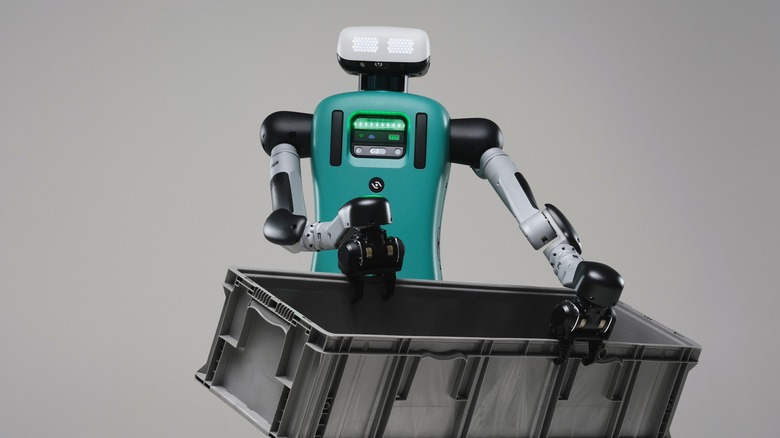
Toyota isn't the only company to deploy Digit: others, including Amazon and GXO Logistics, have already put it to work, and fellow automaker Ford introduced robot dogs several years ago. Toyota Canada plans to begin with three of the seven robots included under its agreement with Agility Robotics as general purpose robots at the manufacturing facility in Woodstock, supporting manufacturing, supply chain, and logistics operations. Digit will take on repetitive and laborious tasks that will help human employees prioritize more demanding tasks and avoid injuries.
Digit has a carrying capacity of 35 pounds and can walk up to 3.4 miles per hour — the equivalent of a brisk walking pace for a human. Its battery will last up to eight hours depending on its task, and it uses numerous sensors and cameras to navigate a safe path, including LiDAR, depth cameras, RGB cameras, and arm force sensors. It's able to detect obstacles on its own, including human workers, without additions to the work environment like magnetic floor strips. Digit can tackle more than just flat surfaces as well, and is able to go up ramps and climb stairs, thanks to its reverse-jointed legs. It can even stand up on its own again after a fall. Toyota and Agility Robotics plan to explore other ways the automaker could use robots and artificial intelligence solutions, so Digit may just be the beginning.