

American And European Tow Hitches Are Different In More Ways Than You Think
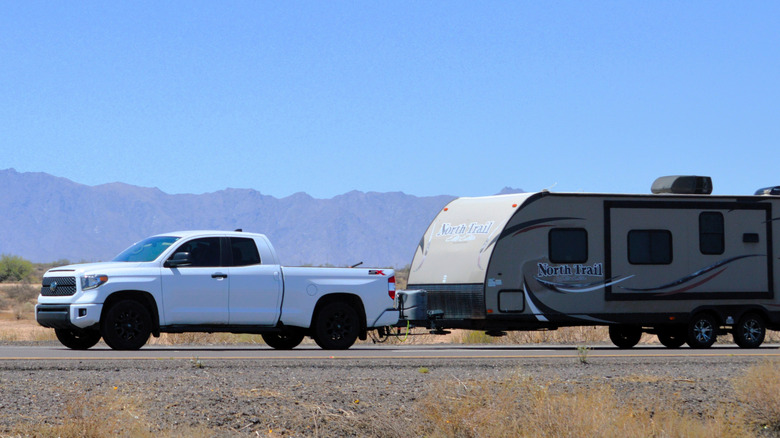
There are quite a few differences between the tow hitches used in the U.S. and Canada, and those used in Europe. Understanding these differences can be very beneficial if you should ever find yourself in Europe with the need to tow something behind your vehicle. The differences in rules and regulations also reflect different approaches to towing in North America compared to Europe.
Tow hitches used in the U.S. and Canada usually fall into two different categories. There are fixed-tongue hitches, and there are receiver hitches. Whereas the fixed-tongue hitch is made in one solid piece, with the ball then being attached to the tongue, the receiver hitches can be used for more purposes than just towing. A receiver hitch can also carry a hammock, a lighting unit, a bike rack, a step, a cargo box, or even a safe for your valuables. The size of the ball on the tow hitch is usually either 2 inches — the standard size tow ball hitch – or 2 5/16 inches, which is the largest size designed for the heaviest loads.
The tow hitches that are commonly used in Europe feature a detachable tow bar or a swan-neck design with a 50 mm ball attached. These hitches are normally smaller than those used in North America, due to the fact that the trailers used in Europe are also smaller in overall size. The detachable style can be removed from your vehicle when it is not being used for towing.
What else should you know about the differences in towing between America and Europe?

In North America, the Society of Automotive Engineers has trailer hitch rating standards running from Class 1 through Class 4. Class 1 is the lowest, with a Gross Trailer Weight of up to 2,000 pounds and maximum tongue weight of 200 pounds. This is for towing items like a motorcycle or a jet ski. Class 4 is the highest rating, with Gross Trailer Weight of up to 10,000 pounds and a maximum tongue weight of 1,000 pounds, typically used by motorhomes and commercial-grade vehicles. There is also Class 5, for GTW over 10,000 pounds, but this class is not SAE-recognized. Check with the hitch manufacturer for information on how much weight you can tow in a safe manner. It's good to know that nearly any car can have a trailer hitch installed.
In Europe, there are regulations governing the combined weight and size of the trailer and the towing vehicle. EU regulations permit a combined length of 12 meters (39 feet, 4 inches), a maximum width of 2.55 meters (8 feet, 4 inches), and a maximum height of 4 meters (13 feet, 1 inch). Trailer-towing speed limits vary by country. For example, Germany allows a maximum of 80 km/h as standard and up to 100 km/h with a permit. In Italy, the maximum is 80 km/h on its highways, and France permits 130 km/h if the trailer is less than 3,500 kg, with a maximum of 110 km/h during rain.