

The Average Lifespan Of Wind Turbines May Surprise You
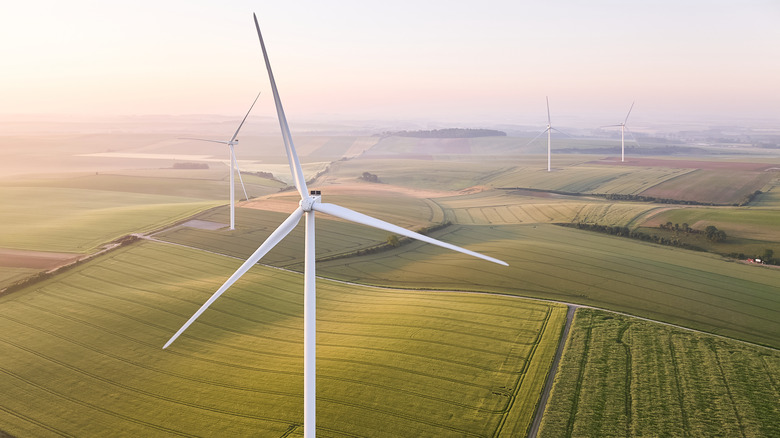
Modern wind turbines dwarf the windmills of old, both in size and capability. We're far from the days of those smaller, wooden structures that were used to pump water or grind grain. Today's wind turbines stand taller than the Statue of Liberty, and almost 84,000 of them are dotted on land across the U.S., serving as the fourth-largest source of electricity generation capacity in the country according to American Clean Power.
Wind turbines are not only increasing in size but are also capable of producing massive amounts of energy, much more than they were able to even just a few years ago. The average capacity of wind turbines installed in 2023 was 3.4 megawatts, up from 1.8 megawatts in 2010. Despite their simple appearance, land-based wind turbines are complex machines with up to 8,000 different components. The U.S. has come to rely on them, and wind energy provides more than 20% of total electricity generation in 12 states, according to the U.S. Department of Energy.
Yet even with all of these moving parts, the average life span of a typical wind turbine is longer than you might think. The Energy Department says life expectancy is approximately 30 years, though it does add that while foundations and towers are expected to last for decades, other components, including the blades, gearboxes, and generators, may need to be replaced sooner. Maintenance is typically required about every six months, and various factors can affect the life of the turbine.
The expected life and impact of a wind turbine

In 2022, a story went viral on social media that claimed the generators in Australian wind turbines were lasting only a few years, far less than expected. According to AAP FactCheck, the claim was dismissed by two experts, including a professor in mechanical engineering and renewable energy and a sustainable energy expert from Sydney. AAP FactCheck also spoke with the management of a wind farm in Illinois called HillTopper8; they also rejected the claims, confirming that they usually don't see issues with generators over a typical 20-year lifetime.
Several factors can impact how long a wind turbine will operate. Average wind speed, strength and frequency of wind gusts, bird and lightning strikes, and other types of damage can all affect its lifespan. Like anything mechanical, careful monitoring and maintenance helps to extend the life of wind turbines. Other parts do often fail earlier, including several mechanical components like gearboxes. Blade erosion is also sometimes a problem. As wind turbines face extreme loads during their lifetime, experts say they're unlikely to last much past 25 years, a few short of that 30-year claim by the U.S. Department of Energy.
While it's difficult to estimate the cost to install and maintain a wind turbine, wind energy also creates thousands of jobs across the United States. The Energy Department says that as of 2022, wind power generates more than 10% of the net total of the country's energy. While turbine lifespan doesn't appear to be an issue, challenges do remain, including the potential for environmental impacts, installation challenges in remote areas, and the visual and auditory impact on the landscape.