

California Let Robots Build An Entire Neighborhood, Here's What Happened To Prices
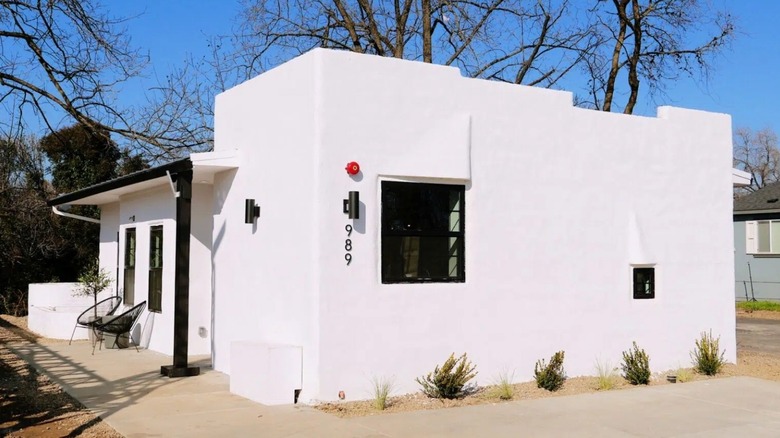
When we envision robots used to build things, our minds might turn to those types used on automotive assembly lines or humanoid robots designed to do the same work as humans. However, neither of those robot types is well-suited to building homes in a neighborhood in the most efficient manner.
The robots building the five new homes making up an entire neighborhood in California's Yuba County are giant 3D printers, which cost around $1.5 million each, that primarily use concrete as filament. The company behind the venture is 4Dify, pronounced similar to fortify. Nan Lin, 4Dify's founder, reported to CBS News that printing the first 1,000-square-foot house took 24 days but expects subsequent printings to take as little as 10 days.
As of February 13, 2026, 4Dify's first 3D-printed house was for sale with a listing price of $375,000. While that's below Yuba County's $450,000 median home price, its $375 per square foot average is higher than the county's median price per square foot, which sits at $268.
Are 3D-printed neighborhoods a sustainable solution or a fad?
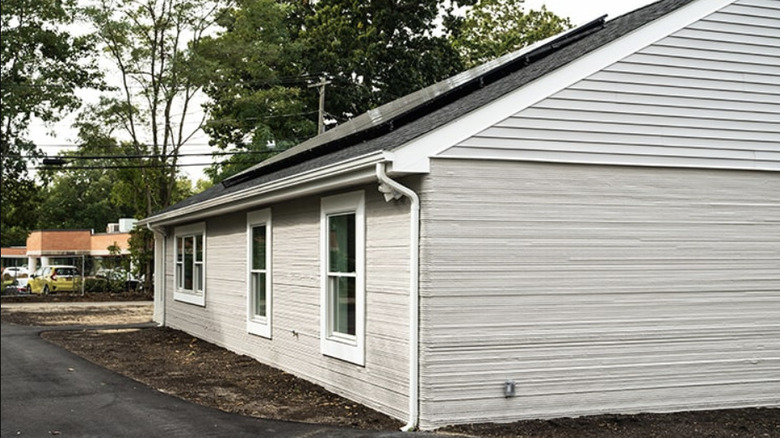
The process of using giant robots to 3D print homes requires less labor and materials and produces less waste, which helps to keep costs down. While the Yuba County 3D-printed neighborhood is new, 3D-printed homes have been considered part of the future of construction for years now.
Icon, an Austin, Texas-based 3D house printing company, broke ground on Wolf Ranch in 2022. Wolf Ranch, with 100 3D-printed homes to its credit, is the largest community of 3D-printed homes in the world. In total, Icon also has over 200 3D-printed houses located across five states and two countries. The first 3D-printed house to receive a certificate of occupancy in the United States was listed for sale with a price of $299,999 in 2021. The 1,400-square-foot three-bedroom home features two bathrooms and a 750-square-foot garage located on a 1/4-acre lot. A couple moved into Europe's first 3D-printed house the same year.
The strength of these 3D-printed homes comes from their mostly concrete walls built up in continuous ribbons laid in layers, inch by inch, from the ground up. Lin says the walls are bulletproof, withstanding ballistic fire from handguns and machine guns. In addition, the homes are fire, pest, and mold resistant, and 4Dify's founder claims proof that insurance rates for their homes are lower than those for traditionally built houses. Whether or not 3D-printed homes find favor with homebuyers remains to be seen. However, the specs and apparent initial build quality hold the promise of future sustainability.