

Scientists Detected A Seven-Hour Burst From Space – Now We May Know What It Was
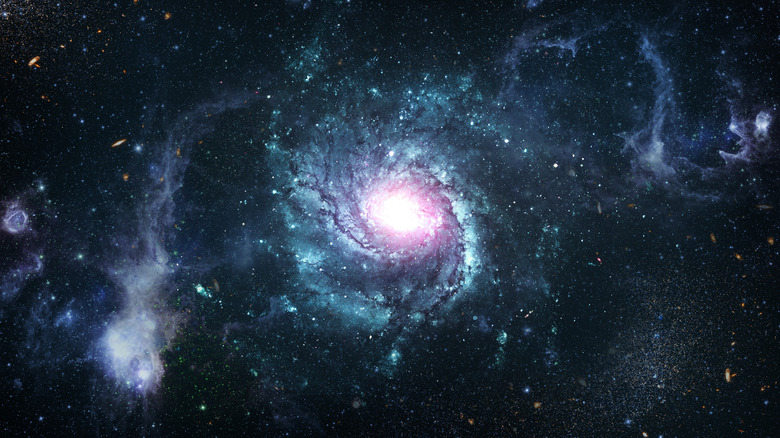
It's commonly believed that there's no sound in space, but that's far from the case. For instance, sonifications from NASA have allowed us to hear the sounds of a black hole, and, in 2025, astronomers recorded a sound from deep space that lasted a whopping seven hours. Dubbed GRB 250702B, this gamma-ray burst (GRB) was detected by five high-energy telescopes and came from a galaxy that may have been a few billion light-years away.
GRBs are massive explosions in space that are generally believed to be caused by the destruction of a star. They're not new to science, with U.S. satellites having observed them since the 1960s, but GRB 250702B's length was definitely unique — and scientists may now have an idea what caused it. In an interview with the BBC's Sky at Night Magazine, Eliza Neights — a researcher at NASA Goddard Space Flight Center — suggested that this anomalous GRB may have been the result of a helium merger.
Helium mergers happen when a helium star that orbits a black hole expands enough for the black hole to begin consuming it. This is a quick process, and the force creates a long-lasting jet that, in turn, leads to a long-lasting GRB. Between its duration and the circumstances that led to it, GRB 250702B remains an exceptional example of this long-studied space phenomenon.
What makes GRB 250702B so special
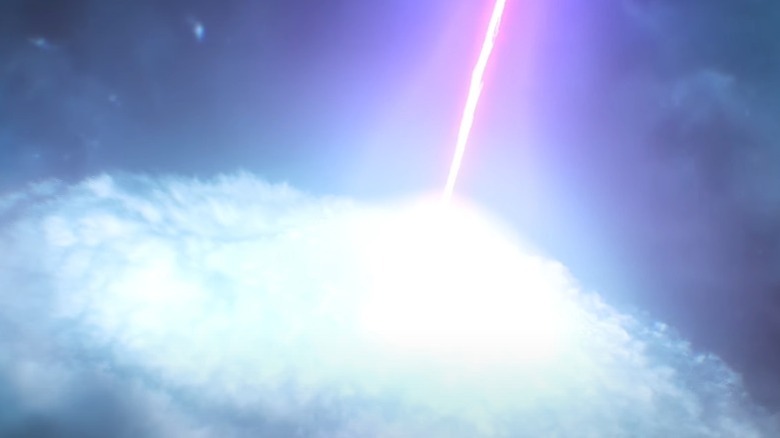
Evidently, GRB 250702B wasn't a typical gamma-ray burst. The seven hours of sound are interesting enough, doubly so when you consider that the average GRB rarely lasts longer than a few minutes, and that the previous record-holder only lasted four hours or so. NASA Researcher Eliza Neights also pointed out that the way GRB 250702B presented itself was highly unusual, too, with three bursts all appearing to come from the same point in the sky.
As noted previously, Neights explained that a helium merger could have been responsible for GRB 250702B, which is quite remarkable on its own. GRBs usually happen either when two neutron stars orbit one another and eventually combine, or when large stars suddenly collapse into black holes and create jets. Even when infrequent helium mergers do happen, they're rarely observed due to how dim they are, as most telescopes are designed for shorter, brighter space signals.
Even short trips to space can alter an astronaut's biology, so with that in mind, most of our study of space is done from Earth. Evidently, the vast universe is more than happy to engage with us from afar, sending out loud signals like GRB 250702B to keep astronomers on their toes.