

WOLED Vs. QD-OLED TVs: What's The Difference?
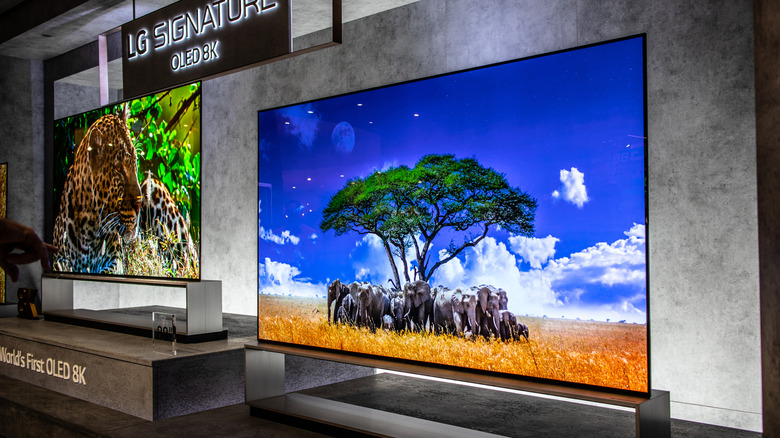
Picking the right screen size for your living room entertainment is just one of the many things you need to consider when buying a TV. 4K televisions have come down in price dramatically and no longer cost an arm and a leg, but if you're really aiming for the best picture quality, you absolutely can burn a hole in your pocket. OLED TVs, in particular, are currently leading the household entertainment industry. Unlike LED TVs, which are backlit, OLED panels consist of pixels that emit their own lights individually — hence the name: Organic Light-Emitting Diode.
This helps OLED TVs produce more accurate colors, but more importantly, it allows for richer contrast ratios. Going with OLED means you get better picture quality and a faster response time. If you've been window shopping for televisions, however, you'll know that OLED options themselves come in a few different classes, like WOLED and QD-OLED.
Both of these are a step above traditional LED TVs, but they differ in how they generate colors. In a nutshell, WOLED panels start with white light and use color filters to produce red, green, and blue light, while QD-OLED displays begin with blue light and use quantum dots to convert it into red and green colors. Beyond differences in the output, QD-OLED technology is much newer by comparison and costs a bit more. If you're wondering whether the improvements are worth paying more for, here's a deeper dive into how WOLED and QD-OLED TVs work.
How WOLED and QD-OLED work
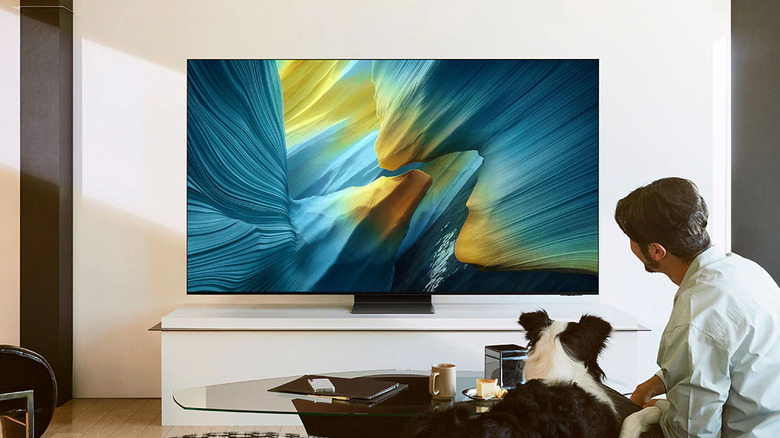
The "W" in WOLED refers to white light, which is the first big distinction between that and QD-OLED. At the pixel level, WOLED panels start by producing white light. This light is then passed through color filters to create the RGB spectrum you're familiar with. A notable difference between LED and OLED is that the latter has a comparatively lower peak brightness capability. Therefore, WOLED panels often come with a white subpixel that kicks in to boost overall brightness. Popularized by LG, WOLED is currently the recommended panel type if you're stepping foot in OLED territory.
QD-OLEDs, on the other hand, have a different approach to producing color altogether. Instead of starting with white light, they directly use blue OLED emitters as the base. A layer of quantum dots then converts this blue light into red or green when required. QD technology for TVs was primarily developed and commercialized by Samsung Electronics. The technology is impressive, and in the simplest of terms, quantum dots are tiny human-made particles that glow in different colors when light hits them. By adjusting the size of these dots, either red or green light can be emitted.
Regardless of which panel type you end up going with, both WOLED and QD-OLED are a monumental step up from LED TVs. Compared to each other, QD-OLED does produce punchier colors and can be brighter than WOLED technology. However, its resilience to burn-in is still unknown, since QD-OLED is a relatively new technology.
Perks of buying a QD-OLED TV
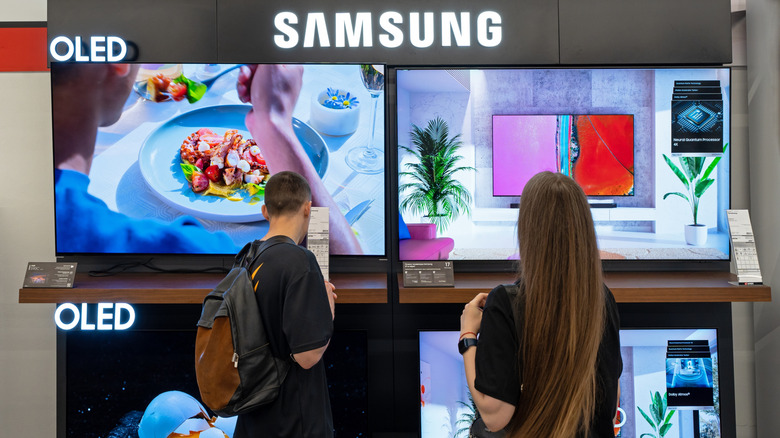
Both WOLED and QD-OLED have excellent black levels, since, regardless of the panel type, color is controlled by individual pixels. However, since WOLED uses color filters, by definition, you do end up with less brightness. The added white subpixel can help, but it does so by increasing overall luminance rather than boosting pure color intensity. In this regard, QD-OLED panels produce richer colors regardless of how bright the image needs to be. RTINGs tested both panel types in great detail, and found that QD-OLEDs offer better color saturation.
Another important difference is in relation to ambient black level raise. This refers to how black levels appear when there are external light sources in your room. QD-OLED panels skip the polarizer layer for better brightness efficiency, but this makes them more prone to ambient black level raise. WOLED TVs, on the other hand, aren't as susceptible and can therefore produce inkier blacks.
WOLED has been around longer than new TV panel technologies. It's been tried and tested, and it has been implemented long enough to cost less. For instance, the LG B5 OLED, which uses WOLED technology, is priced at $1,500 for the 55-inch model, and has been recommended by TechRadar as the best budget OLED TV you can buy. By comparison, the Samsung S90F, which is a popular entry-level QD-OLED TV, costs $1,800 for the 55-inch variant. The difference in price may be worth the improved colors for some buyers.