

Neither Concorde Nor Tupolev: This Was The First Airliner To Go Supersonic
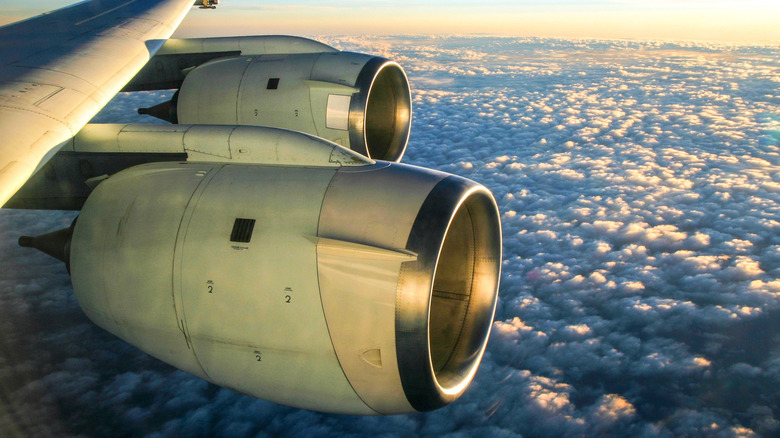
It would make a great Jeopardy question — what was the first airliner in the world to reach supersonic speeds? Many people would likely answer the Concorde, the distinctive and sleek supersonic passenger jet operated by AirFrance and British Airways. In this case, Jeopardy contestants would receive a "no, I'm sorry, that's incorrect," likely to the surprise of many. Others might guess the Tupolev Tu-144, but in reality both this Russian supersonic jet and the Concorde debuted years after another passenger airliner broke the sound barrier: the DC-8.
The Douglas DC-8 first took to the skies in 1958, and it quickly became a workhorse for both passenger and cargo flights. There are only a handful left flying today, but make no mistake, the DC-8 helped shape the modern age of commercial flight. It could move up to 259 passengers and boasted four engines, with a typical cruising speed of 556 mph. Supersonic speed is faster than the speed of sound, measured at about 768 mph at sea level, so how did the DC-8 achieve such a speed in 1961?
The story, which was shared with Smithsonian Magazine in 2011, is pretty incredible, and it includes more than one record-breaking feat. On August 21, 1961, a test pilot for Douglas named William Magruder, along with a copilot, a flight engineer, and a flight test engineer, took off from Edwards Air Force Base in a bid to show the world that the DC-8 could break the sound barrier and survive. They succeeded, but not without a few scary moments.
Hitting supersonic speeds in a DC-8
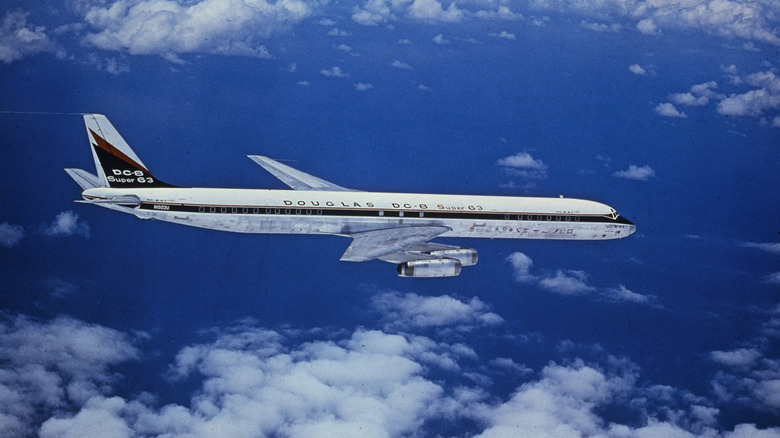
If you're wondering how on Earth a plane that wasn't designed to fly at supersonic speeds broke the sound barrier, it took some daredevil maneuvering. Magruder and his crew took off and climbed to an astonishing 52,000 feet, or almost 10 miles, which in itself set a record at the time. Then, the pilot performed what's called a half-G pushover and put the plane into a dive. As they passed through 45,000, it broke the sound barrier, reaching speeds of Mach 1.01 for about 16 seconds.
The maneuver wasn't easy to recover from. When Magruder attempted to pull out of the dive, both his elevators and stabilizers were ineffective. A skilled pilot, Magruder pushed into the dive, which eventually gave him back the stabilizer, and the plane recovered at approximately 35,000 feet. The crew landed safely back at Edwards Air Force Base.
The record-breaking jet eventually went on to serve Canadian Pacific Airlines for about 19 years before being sold for scrap, and the story has been forgotten to history for many. The Soviet Union didn't break the sound barrier with the Tupolev Tu-144 until 1968, seven years after the DC-8 test, and the Concorde first flew faster than the speed of sound in 1969. It went on to service the commercial passenger industry for 27 years, overshadowing the accomplishments made by William Magruder and his crew in a DC-8 — but they were still the first.