

5 Additives That Can Actually Increase Your Engine's Performance & Lifespan

Vehicles, like every other mechanical body of work that has ever been put together, require regular maintenance to stay in optimal shape. The magic is in the boring details; Routine procedures like getting an oil change, replacing the spark plug, and changing transmission fluids go a long way in preserving the condition of your cherished (and usually, costly) car. However, not all maintenance practices simply maintain an existing status quo — some, like the use of additives, actually help enhance your car's abilities.
If you have spent any time around gearheads or browsing automotive blogs and forums, you have probably heard of additives in some capacity. The topic usually sparks a debate, where one camp swears by fuel and oil additives as the next best thing since sliced bread, while the other dismisses everything as snake oil, which does nothing but drain your wallet. Both sides make compelling arguments, and for the most part, the skeptics have a point.
Many additives can be found on a shelf at your local store, a significant percentage of which do not contribute to the performance or protection of your vehicle and its engine. However, a few products have developed a reputation for boosting engine performance (and even lifespan) over the years. We've compiled a list of five such additives, but note that you'll need to run compatibility checks — some of these products were designed for specific engines.
Marvel Mystery Oil
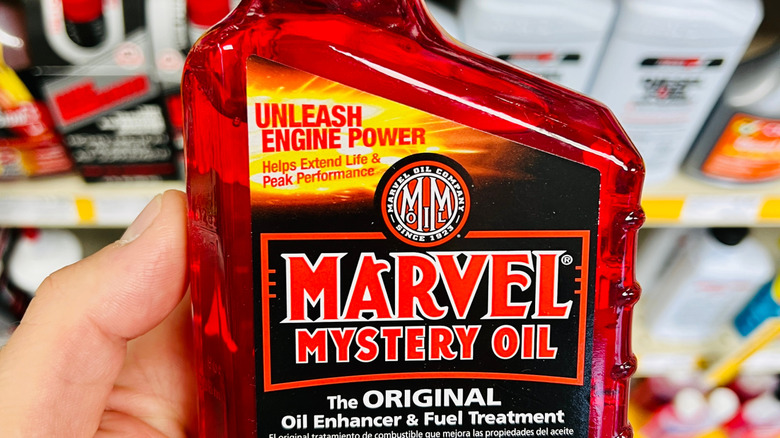
Marvel Mystery Oil is one of the most widely popular additives that has stood the test of time — its history extends all the way to 1923, just after the First World War. At the time, it was common for engines to run into all sorts of carburetor issues. Enter Burt Pierce's Mystery Oil, a set-and-forget additive that caters to the engine in different forms. Its basis hasn't changed all these years later — it cleans components of the fuel system and also releases additional horsepower by increasing compression. In a previous article, we broke down what's in Marvel Mystery Oil and whether it's safe for your engine.
That's not all of Marvel Mystery Oil's claimed capabilities, either — its formula was also reported solving cold-start problems. With such touted abilities, it's no wonder its target market extends beyond cars; If you've got gas-powered engines like lawn mowers and snow blowers, the benefits should also extend to these machines.
If you're going to use this additive, it helps to note that it works best on older carbureted engines. They're the most likely to be sludged up due to years of wear and tear, and MMO is quite good at thinning oil to give the engine the best possible protection. Just remember, applying the additive doesn't replace the standard procedure of oil changes.
Sea Foam

As you might have guessed from the name of this product, Sea Foam is a cleaning additive. It's a blend of petroleum-based compounds, including pale oil, naphtha, and isopropyl alcohol, designed to work in both fuel systems and crankcases. In simple terms, its composition means it has cleaning properties that are just as good as regular detergents — without the commensurate risk of damaging seals and gaskets.
Sea Foam has a number of ways it can be applied to suit your specific use cases. You can add it to your fuel tank; It works through injectors and carburetors to dissolve deposits and residue that would otherwise restrict fuel flow. The product can also be directly added to the engine or crankcase. Ideally, you'd want to do this about 500 miles before an oil change to remove contaminants and clean up sludge. Carrying out this procedure ensures all the liquified sludge drains away with the old oil. Finally, if you're storing your vehicle away for a while, the Sea Foam bottle sitting on the shelf in your garage can help — it reduce the fuel's evaporation and increase its potency over time.
While the manufacturer claims the additive can stabilize fuel for up to two years, you should aim to minimize the time you leave your car stored. Additionally, note that Sea Foam is incompatible with engines that contain direct injectors. We've covered some pros and cons of using Sea Foam Spray in your engine.
Torco Unleaded Accelerator
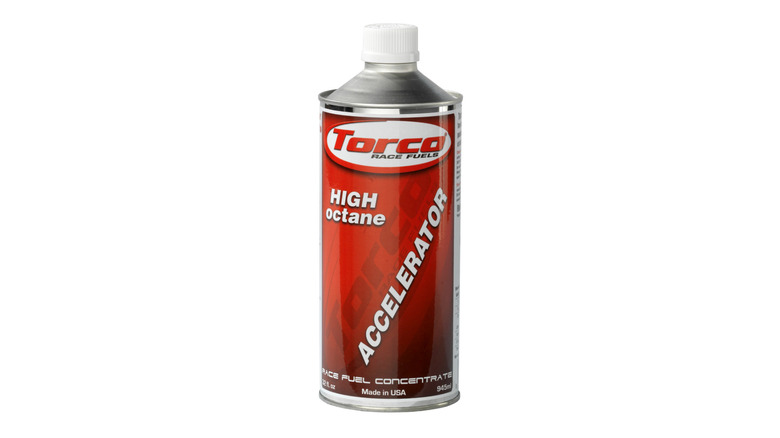
Octane boosters are something of a placebo in the automotive industry. Depending on the car they're used in, most of these store-sold boosters show little to no results impacting octane. Some might succeed in raising it, if we're being semantic, but in most cases, the ratings don't increase by more than half a point — even when label claims suggest otherwise.
With this information in mind, you might be put off the idea of investing in octane boosters at all. However, Torco Unleaded Accelerator brings something different to the table to make you reconsider. Torco bills itself as a race fuel concentrate, with a lead substitute (methylcyclopentadienyl manganese tricarbonyl or MMT) that effectively raises octane while remaining legal for street use.
By lowering the temperature required for complete combustion, Torco Unleaded Accelerator lets the fuel in the system burn more completely, which in turn pushes the engine to produce more power than it typically would. A Nissan GT-R performance enthusiast running a turbocharged engine on aggressive tuning reported eliminating knock Torco treatment, allowing them to maintain timing advance and boost pressure that would cause detonation on 91 octane pump gas alone. However, it is important to note that the manganese content can leave an orange or tan deposit on spark plugs and combustion chambers.
Liqui Moly Cera Tec
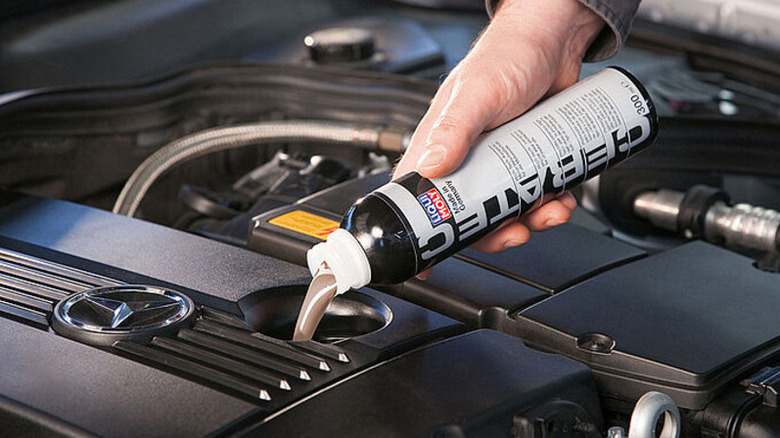
The Liqui Moly Cera Tec oil additive is engineered for specific 4-stroke, manual transmissions, and compressors — it's not suitable for use with DSG/DCT-, automatic transmission, or wet-clutch differentials. If you patronize the Liqui Moly brand, chances are you're familiar with the MoS2 product — a fellow anti-wear oil additive, and the more budget-friendly sibling. However, judging from independent testing data carried out by Project Farm, a YouTube channel that demystifies automotive products, it seems the CeraTec does the job more handily (and speedily) than the MoS2.
According to Liqui Moly, Cera Tec reduces friction and wear in the engine by preventing direct-metal-to-metal contact. The product also claims to reduce fuel consumption and lasts up to 30,000 miles (or four oil changes) with only one application, since the additive bonds well to internal surfaces. Real-world testing validates some of these claims, but others fall just short of the mark. The bottom line is that the product works, and is not one of the many snake oils that populate the shelves at auto parts stores. As always, check for compatibility with your vehicle before paying the $25 to $30 cost for a bottle.
Bar's Leak Cooling System Repair

Instead of the regular fuel or oil additives, Bar's Leak Cooling System Repair claims to protect the engine and increase its lifespan by keeping the cooling system in check. If you've ever experienced a blown head gasket, you know how dire overheating can become, with repair costs sometimes running into thousands of dollars. According to the manufacturer, the product can stop cooling system leaks. The 2-in-1 solution also contains Xtreme Cool, a formula that reduces Antifreeze loss and the coolant's temperature. One bottle of the Leak Cooling System Repair can treat up to four gallons of coolant.
The fluid contains tiny particles that circulate with the coolant. When these particles reach a leak point, the pressure forces them into the crack or hole, where they build up and form a physical plug. A YouTube channel, On The Workbench, carried out some independent testing on a 2006 Saab 9-3 to determine the veracity of these claims.
The coolant was not observed to go below the critical point until a year and 10,000 miles after application. Although it would be ideal to get your cooling system checked if you notice any leaks, Bar's Leak Cooling System Repair can help hold off on any potential issues till your next visit to the repair shop.