

China's Massive Open-Sea Solar Plant Is Changing More Than The Power Grid
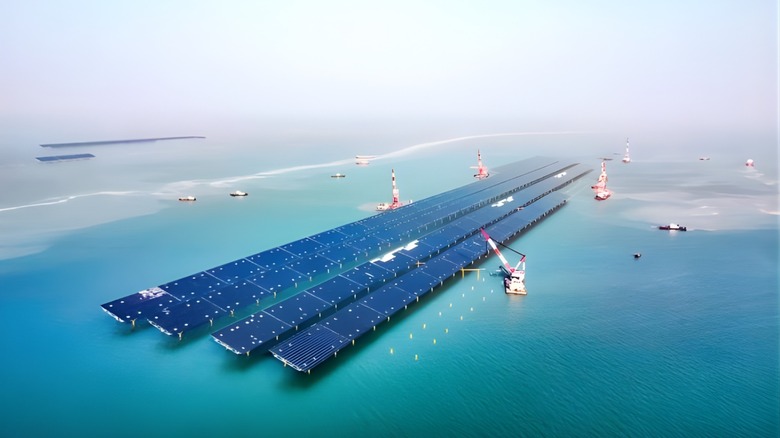
China's dominance in the solar energy segment has been swift, accounting for 80% of global solar panel production. Estimates suggest the country installed more photovoltaic panels in one year than the US has set up in its entire history of harnessing the Sun's power. The growth has been so expansive that the country can now produce panels worth one terawatt each year. A video that made the rounds on social media last year revealed how China has covered a mountain range with solar panels. It seems the ocean is next. China has started work on a gigawatt-scale open-sea solar farm, touted as the world's largest solar plant of its kind.
Covering an area of 1,223 hectares in the Shandong province, the project uses 2,934 photovoltaic panels on platforms that are each 60 meters (196 feet) in length and 35 meters (114 feet) across. Once completed, the offshore solar farm is expected to generate 1.78 billion kilowatt-hours of power each year, enough to cover the energy demands of over 2.6 million households in the region while reducing 1.3 million tons of carbon dioxide emissions. The construction is designed to withstand strong gales and icy conditions.
According to state-owned energy corporation China Energy Investment Corporation Co., Ltd. (CHN Energy), which is building the massive offshore solar project, the massive project also includes integrated fish farming. This won't be the first hybrid solar farm of its kind. In China's Guizhou province, which is home to a massive solar power generation project, mushrooms are farmed in sheds underneath the huge solar panels. The concept is known as agrivoltaics and has received a big push from the Chinese government. However, installing solar panels on water bodies has its own challenges.
The deeper picture
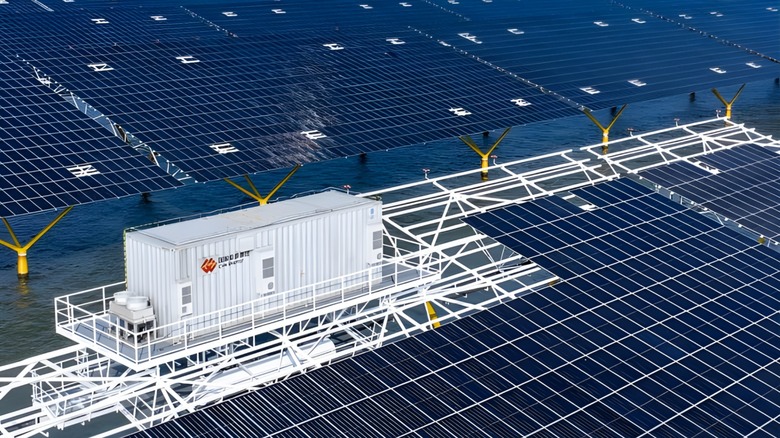
So far, no independent or state-backed analysis of the Shandong offshore solar project and its environmental impact has been released. But experts have warned about the potential risks of similar projects on freshwater bodies. The Indian government is building a 600-megawatt floating solar plant, and numerous other states have also rolled out their own "floatovoltaic" projects. T. V. Ranchandra, an ecologist at the Indian Institute of Science, told Mongabay that blocking sunlight from penetrating the water surface will disrupt the food chain and the natural cycles.
"Temperature variation, prolonged stratification, low Dissolved Oxygen (DO), anaerobic decomposition, impact on aquatic life, growth of shade-resistant cyanobacteria (blue-green algae), and impact on feeding habitat of migratory as well as resident birds are only some of the concerns," the outlet reported. But the findings aren't universal. The backwaters of a dam are different from the sea, and so is the impact of floatovoltaic projects on these ecosystems. A paper published in the Environmental Research Letters journal notes that universally predicting the impacts of floating solar plants on an ecosystem is impractical due to variations in water body characteristics and the design of the farm.
The International Union for Conservation of Nature (IUCN) also notes in its analysis that "little is known of the negative effects," even though the blockage of sunlight is deemed risky for aquatic plant life. A separate paper published in the Environmental Science & Technology journal notes the risk of microplastics and heavy metal leaching in the water body. How China manages to avoid the downsides of its massive floating solar farm in Shandong remains to be seen. However, the mention of an integrated fishing system could be a sign that steps will be taken to care for the aquatic life.