

Think Twice Before Taking Your ATV Out On Snow-Covered Streets
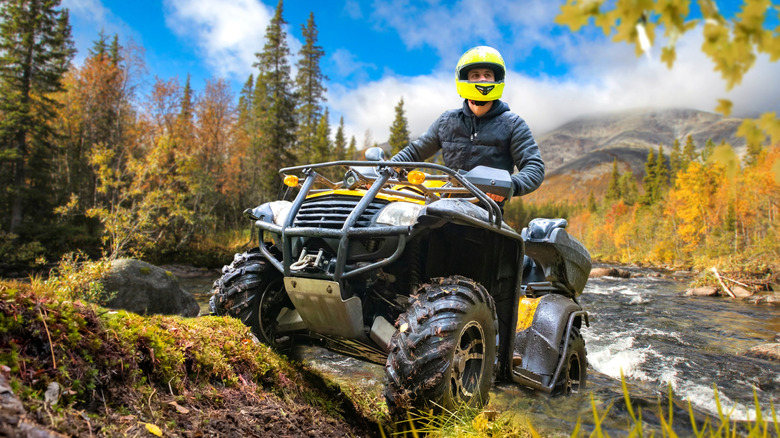
ATVs, or all-terrain vehicles, can be a fun, exhilarating way to experience rugged terrain. Beyond recreation, these four-wheeled motorized vehicles can be used for plowing, mowing, camping, and even racing. They are designed for off-road use, with compact frames, straddle seating for good balance, and handlebars with thumb throttles. They have large, specialized tires that are made for muddy trails or rocky terrain and even snow-covered landscapes. And according to the U.S. Consumer Product Safety Commission, there is one place that you should never ride your ATV — paved roads.
Because they're specifically built to handle rough terrain, ATVs can be dangerous on paved roads. They can easily tip over or collide with a much larger car or truck. ATV manufacturers, the Consumer Federation of America, and even the Specialty Vehicle Institute of America, a national not-for-profit trade association representing manufacturers and distributors of ATVs, also warn that use on paved roads, even when allowed by your state or municipality, is highly discouraged and dangerous. This applies in good weather or bad, even when roads are closed or simply empty due to snow. According to the Specialty Vehicle Institute of America, 324 ATV riders were killed in accidents that happened on public roads in 2015, which was the most recent data available at the time of writing. Here's why experts agree that you should always stick to off-road fun.
Why are public streets so dangerous?
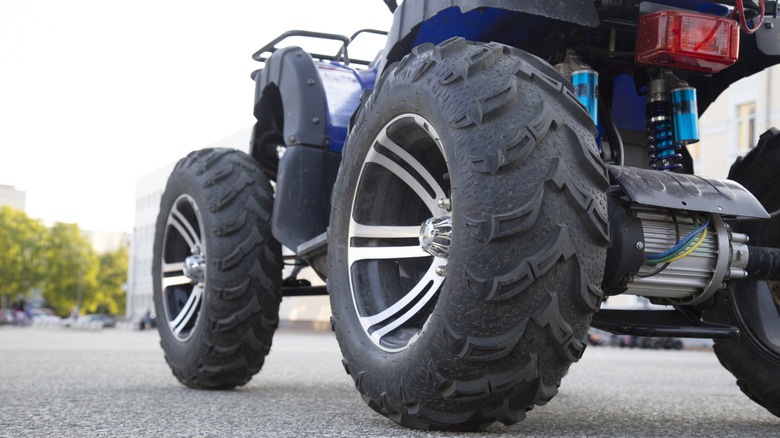
ATVs have a high center of gravity and a narrow wheel base, which means they tip over more easily than other types of vehicles. Their tires also have much lower pressure than the tires on your typical on-road vehicle — they're made for rugged terrain, not your neighborhood's paved streets. While three-wheeled ATVs are banned in the U.S., even four-wheeled models aren't designed for on-road use. Riding your ATV on a public road also increases your risk of being involved in an accident with a much larger vehicle that is made for those roads and is supposed to be there. Going out in the snow is even more dangerous because visibility may be limited. An ATV is already harder to see because it's lower to the ground, and snow, fog or other weather conditions heighten that risk.
The Specialty Vehicle Institute of America recommends you take a course from a qualified instructor before hitting the trail on your ATV. You should also stick to those trails, logging (unpaved) roads, and other off-road terrain — anywhere ATVs are allowed, provided it's not a paved road. Riders should also always wear a helmet and other gear that will protect them, including eye protection, boots, pants, and long-sleeve shirts. If your ATV is designed for one rider only, don't allow a passenger to ride along with you. Finally, off-road doesn't mean off-limits to safety — never drink and drive, it can be just as deadly on the trail as it is on the highway.