

China's Private Space Industry Is Doing A Lot More Than Building Rockets

In 1969, the United States landed a man on the moon, beating the Soviet Union to become the first to set foot on lunar soil after years of what was known as the space race. The research and innovation needed to win that race led to advances in not just rocket science and aviation, but in communications, the medical industry, and more. The world has since launched an International Space Station, landed exploratory rovers on Mars, and seen an explosion of commercial space innovation.
The United States has plans to return to the moon and send manned missions to Mars, but they're not the only ones with the drive to continue exploring that final frontier. China's private space industry is making huge strides, and its ambition goes beyond simply launching rockets. Previously dominated by state-owned ventures, China's commercial space interest has exploded in the last decade.
While it still lags behind the U.S. in terms of satellite launches and crewed spacecraft, it took a huge leap forward in 2022, when it opened up projects to more private companies. In 2025, the China National Space Administration announced plans to scale production and innovation in its commercial space industry over the next 10 years. Now, private companies in China are focused on reusable rocket technology, satellites, and even biomanufacturing.
China's strides in space exploration
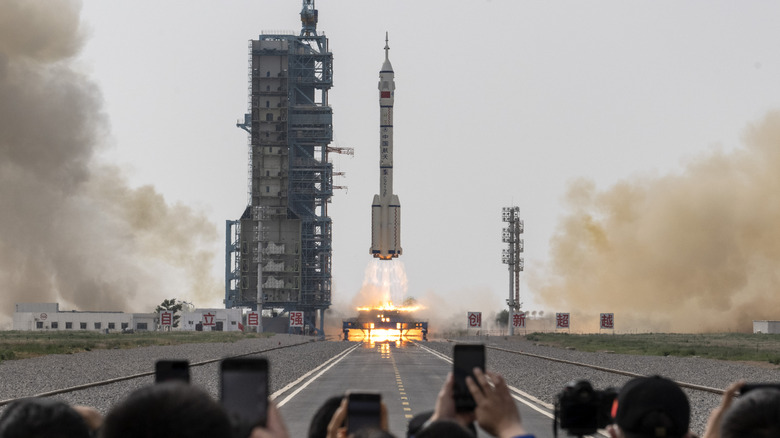
SpaceX is widely considered the world leader in reusable rockets, but China is making great strides. While traditional rockets typically consist of several stages that separate and are discarded, reusable rockets are launched, recovered, and then launched again. In mid-2025, the Yuanxingzhe-1 suborbital rocket, made by a company called Space Epoch, launched and then landed vertically, the first time such a landing was achieved by a Chinese company. According to Defense One, the test drew little international attention but signals a shift in China's focus to low-cost orbital access that will allow it overhaul commercial and military operations in space.
Reusable rockets would allow China to vastly increase its satellite network in low-Earth orbit. Over the next 10 years, five companies could launch as many as 54,000 satellites intended for internet connectivity. Shanghai Spacecom is developing a constellation of 15,000 satellites called Thousand Sails. For comparison, the SpaceX Starlink constellation has about 9,000 satellites. Airbus recently signed a deal for Thousand Sails to provide in-flight internet to its planes. Other companies plan to use Chinese satellites for car navigation services and for smartphone functions.
Beyond rockets and satellites, China is also eying space tourism. In 2024, CAS Space announced (per Reuters) its first tourist vehicle will launch in 2027, with seven passengers per flight at a cost of about $415,000. Another company, Deep Blue Aerospace, also plans to take tourists into orbit at a cost of $210,000 per person. China is also exploring biomanufacturing in space — a company named AZSpace recently sent yeast, plants, and probiotics into orbit.