

China Is Adding To Its Territory With Artificial Islands - Here's How They're Made
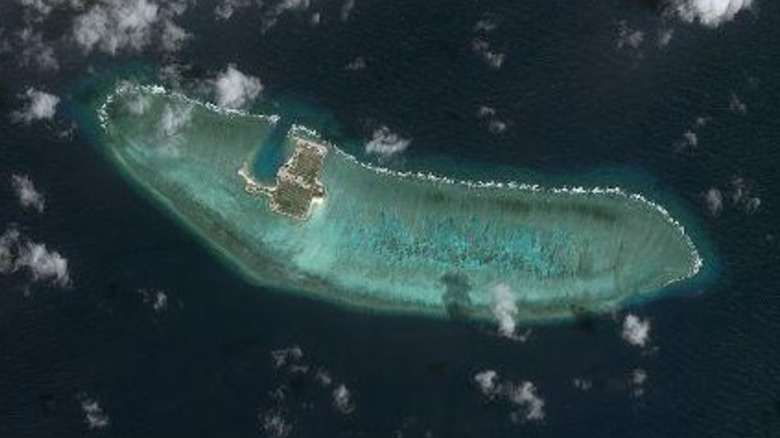
China is actively building new artificial islands, which you may have heard about in the news. The reasons are largely strategic and political, as the islands extend China's territory into the mineral-rich and highly contested Paracel and Spratly Island archipelagos. Of course, building islands isn't an easy task, as a great deal of engineering and earth-moving is needed, which can take several years.
Islands form for a variety of reasons. For China, they come about via millions of tons of rock, sand, and concrete. China's so-called "Great Wall of Sand" began in 2013, and after three years, it led to the creation of 3,200 acres of new land, allowing the nation to grow considerably throughout the region. These aren't merely mounds of sand, rock, and concrete piled onto the ocean floor, as they're capable of supporting structures, including airfields. To do this, China locates a suitable submerged reef and then covers it with massive amounts of sand and gravel dredged from the seafloor.
This gives the islands a base, keeping them from washing away. As the islands take shape, the land is reinforced with rocks and concrete, which is how they're able to support the weight of various structures. Essentially, China is performing the same feat as Mother Nature, but instead of rock layers forming over millions of years of geologic time, the nation is managing a similar feat in only a handful of years. The result, as the name implies, is a Great Wall of Sand that reinforces China's claims to the contested territory.
The cost of island creation and the Great Wall of Sand
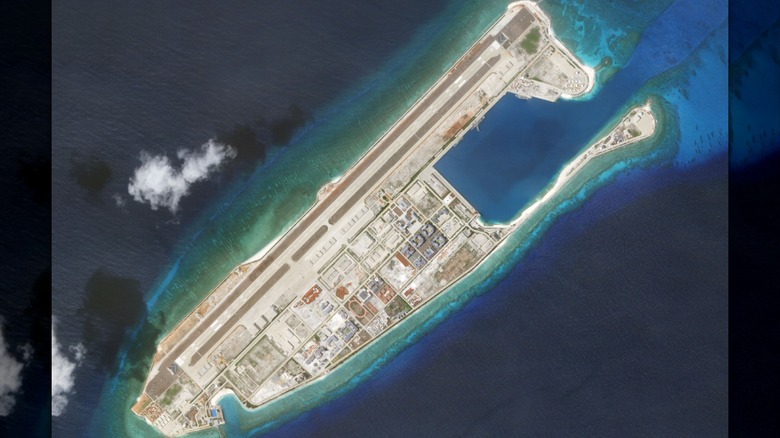
While the act of creation is certainly impressive, the Great Wall of Sand has also been incredibly destructive to natural resources in the South China Sea. This is due to the methods China uses to create its islands, which destroy delicate coral reefs and fish stocks. To make an island, China finds a submerged reef or shoal. These rarely break above the water, but offer a significant base upon which China can build. It then dredges untold tons of material from the seabed and dumps it onto the reef, destroying it entirely.
While the islands are stable, they're at constant war with the elements. Naturally occurring islands are far more stable than those created by China, so they must be constantly maintained to ensure they don't wash away. Saltwater degrades concrete and other materials, so the islands may one day return to the sea, but so long as China maintains them, they're likely to remain. This regular maintenance has allowed for small populations to relocate to the islands, which house military facilities and other government interests.
Dredging the seafloor to reinforce, reclaim, or build stable land is nothing new, but the scale upon which China has built its islands is staggering. They require a great amount of effort in terms of time, manpower, and money to build, making China's new islands an engineering marvel. While China isn't the only nation building islands in this way, it certainly perfected the process, taking the lead technologically via its ability to establish new land where there was only open water.