

Why The Boeing 777X Has Folding Wings, But Can't Fly With Them Folded
If you've ever visited an aviation museum like the San Diego Air & Space Museum, you're probably familiar with the F4U-7 Corsair, a striking World War II-era fighter that is notable for its gull wings, which fold to save space on aircraft carriers. It's one of the world's most recognizable planes due to its unique wing design, but the idea of a folding wing is even older than the Corsair, patented a mere 17 years after the Wright Brothers' first flight by a man named F.M. Osborne.
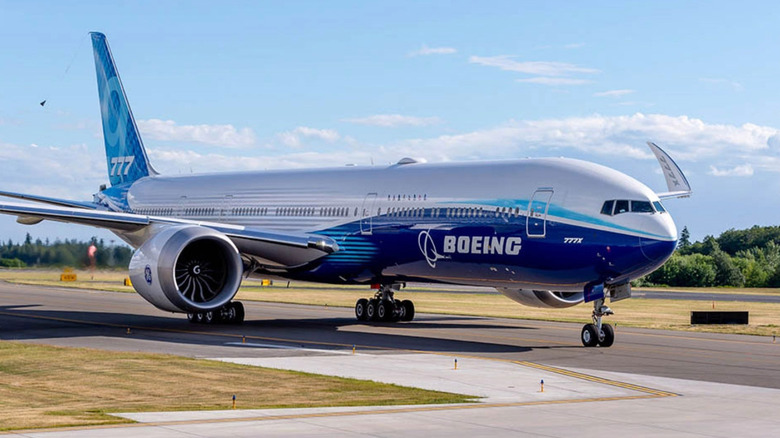
Today, there are a few modern planes with wings that fold, including the F-35C, which has folding wingtips to allow more to be stored on an aircraft carrier, and the new Boeing 777X, the first commercial plane ever to boast wings that fold. Of course, no one plans to land a 777X on an aircraft carrier, but it is a similar space-saving design to that Corsair you can see in museums.
The wings on the new Boeing are about 23 feet longer than the wings on a 777. Boeing could have kept the wings on the 777X the same length, but it opted for an extended wingspan to make it more fuel efficient. Then it faced a new problem — that extension meant the 777X would be too big for many airports. The solution? Folding wingtips. But don't expect to see those wings fold mid-flight. The extended wings are needed to improve the plane's performance, and while it could theoretically remain in the air, the wings must be fully extended during takeoff for maximum lift.
Folding wingtips to match existing infrastructure
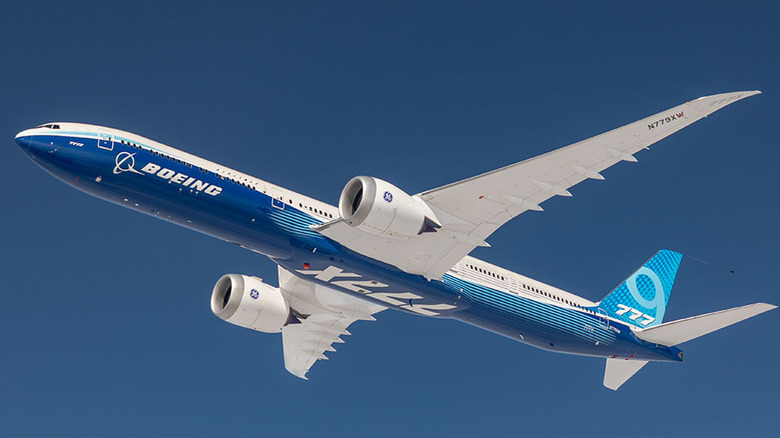
The Boeing 777X was first announced at the Dubai Airshow in 2013 and was originally scheduled to debut in 2020, but at time of writing has not yet been certified for passengers. Deliveries are now expected to begin in 2027. The delay is not surprising to some considering the complexity of the 777X's design, including its folding wing tips, and its massive engines that are larger than the fuselage of a 737.
The Boeing 777X is similar in many ways to the 777 and the 787, which will make it easier for pilots, but it's still a new design — and it's huge. There are two versions of the 777X, the 777-9 and the smaller 777-8, which are both passenger planes. The 777-9 is more than 251 feet long. Both versions have a massive wingspan of 235.5 feet that is actually too wide to fit into current 777 airport gates. Boeing didn't want to force airports to update infrastructure or limit from where it could fly, so it added those folding wingtips. Because the wings are longer and Boeing wanted to improve fuel efficiency, it's using a lightweight composite material that doesn't add any additional weight.
The 777-9 will be the largest commercial plane to hit the skies and will carry up to 426 passengers. Inside, the cabin is designed to be quieter, with better humidity and more space in every class. According to Boeing, it will use 20% less fuel than the planes it is intended to replace, and those folding wingtips help.