

Chinese Company Claims This AI Robot Just Achieved A World's-First Dexterity Feat
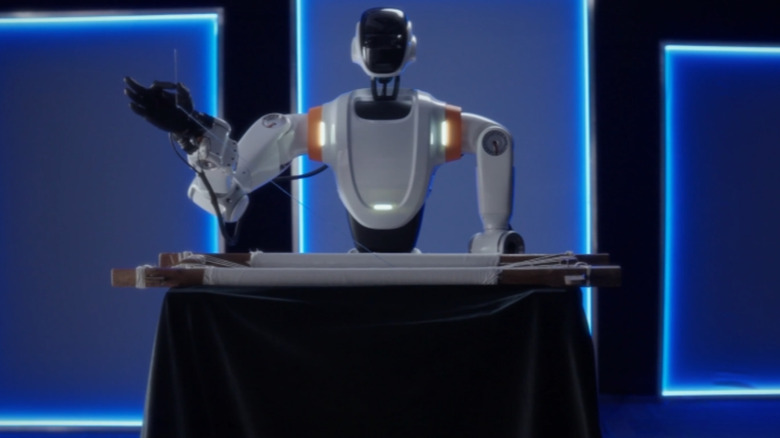
Artificial Intelligence (AI) was once a primitive tool that many people believed was impractical for real-world use. However, the technology has greatly improved over the past several years, to the point that a humanoid robot scored a Guinness record in 2025. To demonstrate just how far AI has come, a Chinese robotics firm says its own humanoid robot has successfully threaded a needle and performed hand embroidery on fabric.
TARS Robotics, an embodied AI (EAI) company, conducted a demonstration of the bot's sewing in late December of 2025. This is a major milestone for AI, as such a task requires two-handed precision that would normally only be possible from humans. TARS relies on a multi-faceted approach to its AI integration, using a combination of high-tech systems, AI models, and actual data, for a complete physical process. The company believes this process can easily be upscaled for a wider range of activities in the real world.
It's important to note that while there is a video online depicting a robot threading the needle and stitching the design, it's the only video available. No company technicians, or reporters, are seen in the video, and there are some computer animated elements on display as well. Meanwhile, a complete recording of the TARS demonstration doesn't exist, and the company does not have a front-facing website where any videos or photos can be shared with the public.
The worldwide growth of embodied AI
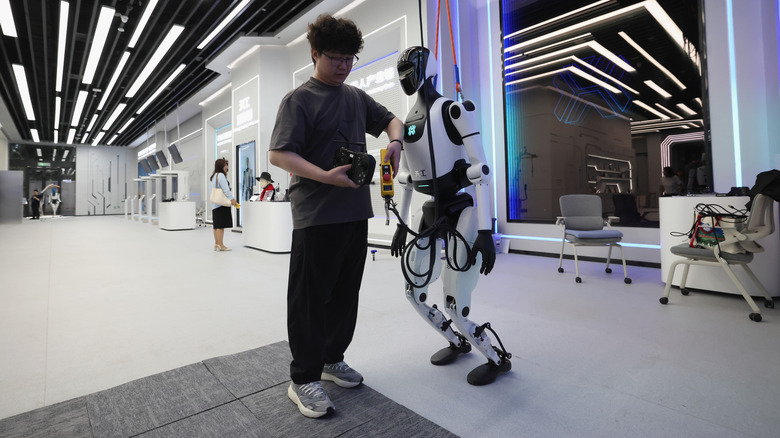
TARS Robotics is a Chinese start-up that was founded in February of 2025, and is lead by former engineers and executives from major tech firms. The company secured some serious funding early on in order to pursue its work in embodied AI (EAI), which integrates artificial intelligence into robots. TARS is a full-stack EAI company, which means it utilizes AI software, develops hardware, and produces the robotic systems in-house. TARS is working toward advancing AI robotics for real-world use cases. TARS' goal, while ambitious, isn't unrealistic, especially when considering that China's AI robots are shocking the world with their humanoid characteristics.
In fact, China as a whole is emerging as a world leader in advanced humanoid robotics. The country has included EAI as one of its major future industries, and is supporting the movement with government financing. The push for quick commercialization means that robotic prototypes are moving to large-scale models, as industrial adoption increases. The EAI market in China is so robust that the humanoid robot segment alone is expected to eventually reach around half of the global total.
Online reports estimate that the $4.44 billion spent globally on EAI in 2025 will grow to over $23 billion by 2030. This includes a wide range of applications, from humanoid and mobile robots to service robots, autonomous systems, and more. Different sectors, including healthcare, manufacturing, and defense, could be impacted by this growth, which is being driven by advancements in robotics and machine learning.