

'Invisible Grabbers' Let You Move Objects Using Nothing But Sound Waves
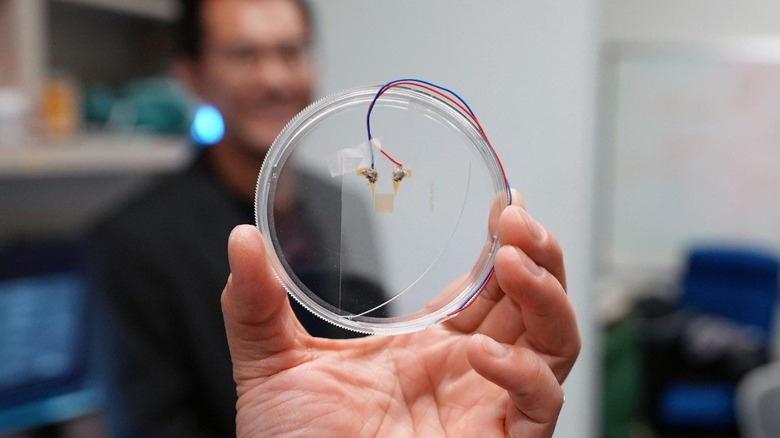
Physically, sound is just pressure moving through a medium. If you harness that pressure correctly, you can actually push things around using nothing but sound. That's exactly what researchers at Virginia Tech decided to do, except with a unique spin. They developed a new chip that uses high-frequency sound waves to grip and manipulate tiny objects – think particles the size of a dust mote. Basically, these act like "invisible grabbers." Before this, scientists mostly relied on interdigital transducers, or IDTs. The problem is that IDTs produce straight, flat waves, which are clumsy.
The researchers describe the clumsiness as trying to pick up a ping pong ball with a flat hand. You can shove the ball around the table, sure, but you cannot really grab it or lift it up. To fix this, the team engineered a new setup called a Phased Interdigital Metamaterial, or PIM. This same class of materials is used to explain how stealth aircraft hide their engines from enemy radar.
PIM uses curved electrodes instead of the clumsy, straight lines. The best way to describe it is as a lens for sound. Just as a curved glass lens bends light to a focal point, those curves bend sound waves with extreme precision. Essentially, sound is converted into a pair of invisible tweezers. Researchers can use these tweezers to steer waves and direct energy exactly where they want it. Best of all, all this happens entirely on a tiny chip, so there's no heavy machinery required. You can head to the full research paper on Nature to dig into the math, but for everyone else, the actual use cases of this thing is where it gets really interesting.
Why the technology matters

So why does moving specks of dust around on a chip matter? Well, just take a look at the potential applications. Since the tweezers can handle delicate things without physical contact, they are perfect for medicine. The team suggests they could eventually lead to noninvasive surgeries where sound waves clear out blood clots or sort cells in a petri dish. It effectively does the work of a centrifuge but on a much smaller scale.
There is another really cool trick the technology can pull off, too. It functions like a "diode" for sound. In electronics, a diode lets electricity flow only one way. Similarly, this new setup routes acoustic information forward while completely blocking anything trying to come back. That is crucial for keeping signals clean. When they put this to the test, the results were undeniable. They successfully trapped microscopic beads in precise patterns and even aligned tiny carbon nanotubes – a far from easy task. Beyond solids, they created swirling eddies to mix liquids with extreme precision. It basically gives scientists a level of fluid control they have never had before.
Now, all the researchers need is to figure out how to handle multiple frequencies at once and deal with thermal drift — basically, ensuring the chip doesn't go out of tune as it heats up. They are also exploring how the tech could improve biosensors and semiconductor cooling. If the chips truly work as advertised, who knows, maybe they could eventually join the ranks of tech inventions that changed the health industry forever.