

How To Tell If Your Brake Pads Are Glazed
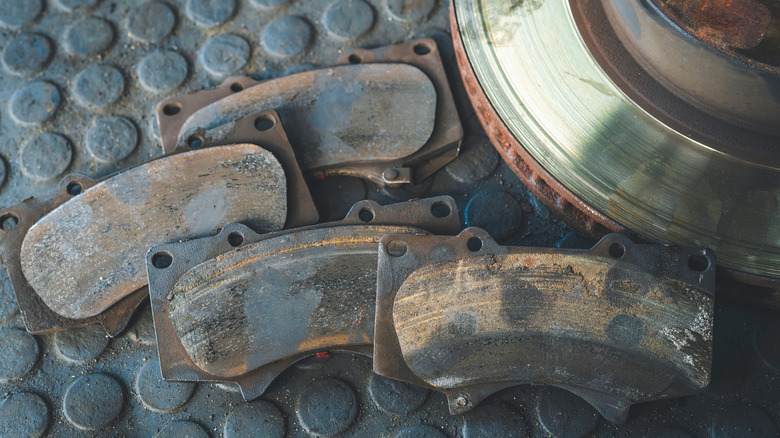
You might assume that as long as the pedal goes down and the car eventually stops moving, the brakes are working exactly as the engineers intended. That said, there is a specific failure state called brake pad glazing where the friction material on your pads gets pushed past its thermal limit and actually crystallizes. Instead of a gritty texture that bites into the rotor to scrub off speed, the surface hardens and turns into a smooth, glass-like substance that just slides right over the metal. It almost mirrors the rotor rather than gripping it.
So how do you spot this? The most obvious giveaway is the sound. If you hear a high-pitched squeak or squeal even when you are only applying light pressure to the pedal, that is the sound of the smooth pad slipping against the disc. You might also feel a weird vibration or shudder in the steering wheel or the pedal itself because the material has likely transferred unevenly to the rotor surface.
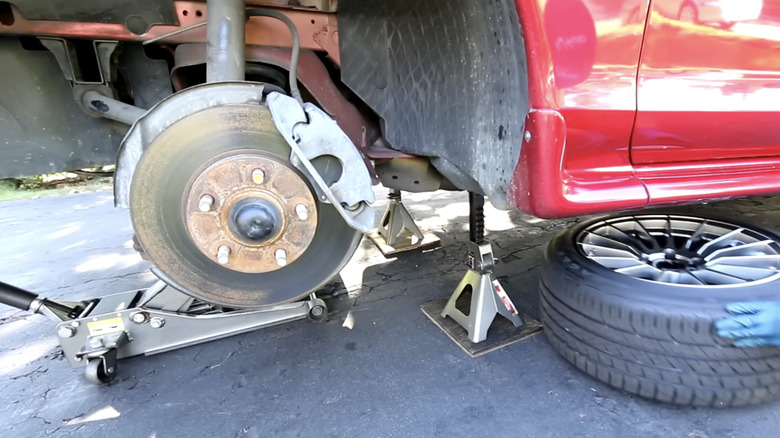
Smell is another big indicator. If you get out of your vehicle after a drive and catch a whiff of something sharp and acrid – like a pungent burning smell – it usually means the components are cooking. Visually, you can check this yourself if your wheels have enough clearance. You can even check your brake pads without removing the wheel sometimes.
Once removed, you'll notice that a healthy pad looks dull and matte, while a glazed one looks shiny or reflective. The scariest symptom, though, is what happens when you actually need to stop quickly. You will notice that it takes significantly longer to come to a halt, and the pedal feels responsive, but the car just keeps rolling forward because the physical grip is gone.
Glazing can't be stopped but it can be slowed down
Now that we know the friction material is ruined, we have to talk about why it happened. Most of the time, it comes down to how you drive. If you are constantly riding the pedal while going downhill or braking hard at high speeds, you are generating sustained heat that the assembly simply cannot dissipate fast enough. It essentially cooks the pads in their own juices. Occasionally, a mechanical failure is the culprit. A compromised caliper can get stuck and fail to retract, which keeps the pad dragging against the rotor constantly, even when you aren't trying to slow down.
To prevent this in the future, you need to change your habits. Downshift and use engine braking on steep declines rather than riding the pedal. Leave more space in traffic so you aren't slamming on the brakes constantly. As for fixing it, you have two options. Some people will tell you that you can take the pads off and sand them down against a rough concrete floor to remove the shiny layer, but frankly, that is a temporary hack that rarely solves the underlying structural issue. The heat has likely altered the chemical composition of the material deep down.
The only real fix is to replace them entirely. While you might wonder if you really need to replace all four sets of brake pads at the same time, swapping out the glazed axle set is non-negotiable. While you are at it, you should also probably check the rotors, too. If they are warped from the heat, swap those out as well. It is always better to spend a few hundred bucks on premium ceramic pads now than to realize you can't stop during an emergency later.