

These Crashed US Navy Aircraft Were Too Dangerous To Leave On The Seafloor: Here's Why
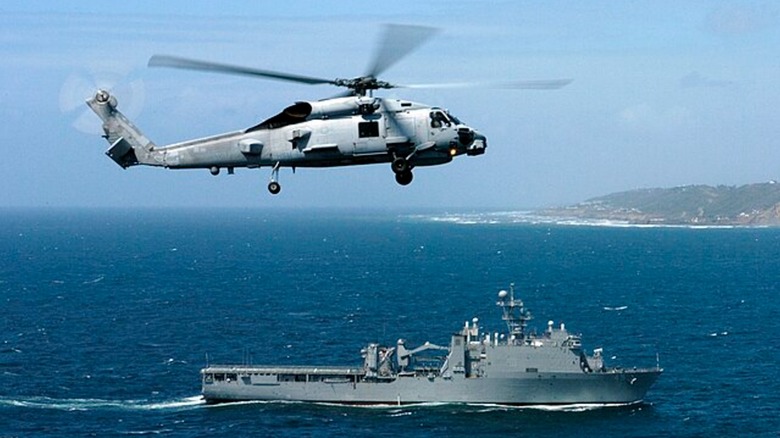
Even the U.S. Navy isn't immune to error. Deploying far away from home on both routine and high-risk missions, across hundreds of ships and thousands more aircraft and personnel, there's more than enough room to spare for the inevitable occasional mistake. Two such mistakes occurred on October 26, 2025, in the South China Sea. An MH-60R Seahawk helicopter and an F/A-18F Super Hornet fighter, both operating as part of the air wing of the USS Nimitz (the Navy's oldest aircraft carrier), crashed within half an hour of each other while conducting routine missions.
Thankfully, the day recorded no casualties, but millions of dollars' worth of material settled on the sea floor, mere miles from the maritime backyard of one of Washington's chief strategic rivals: China's People's Liberation Army Navy (PLAN). Moving swiftly to ensure it got to and retrieved the wreckage first before adversaries, the U.S. Navy successfully conducted a joint operation involving Task Force 73, the Naval Sea Systems Command's Supervisor of Salvage and Diving (SUPSALV), and a Mobile Diving and Salvage Unit.
What is sensitive about an F/A-18 Super Hornet and MH-60 Seahawk?
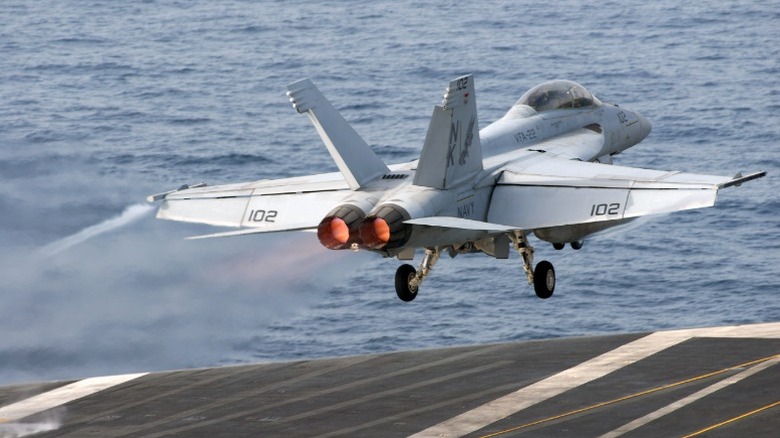
The mission to retrieve the crashed aircraft wasn't about restoration or salvage. Rather, it was intended to prevent technology deemed sensitive from falling into the hands of adversaries eager to study what makes the fighter—and multi-mission helicopter of choice of the world's most powerful aircraft carrier fleet—tick.
That said, in 2025, the systems aboard the Super Hornet and Seahawk can hardly be described as groundbreaking technology. This isn't merely a matter of age (both have been in service for over two decades, and the Super Hornet itself is a heavy upgrade of the much older Hornet) but also because, unlike the F-35 Lightning stealth fighters or B-21 Raider stealth bombers, it's not hard to find closely matching analogs. The French-made Dassault Rafale M and Chinese-built, Soviet-origin J-15 Flying Shark compare well to the Super Hornet. The British-Italian AW101 Merlin, European NH90 NFH, and Russian Kamov Ka-27 and Ka-28 series perform similarly to the Seahawk.
Still, the electronic warfare suites on the F/A-18F, as well as its AN/APG-79 active electronically-scanned (AESA) radar and data-sharing systems, would be a goldmine for any reverse engineer. Also, both aircraft are currently undergoing upgrades, which means any remaining on the seafloor would likely represent a loss of some of the best technology the U.S. Naval Aviation has to offer.
The U.S. Navy has undertaken much more daring recovery operations
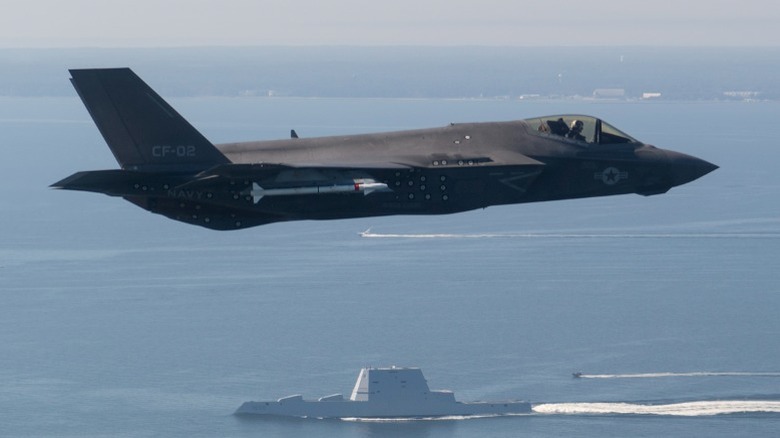
As recently as March 2022, an F-35C Lightning stealth fighter that was lost two months prior during a botched landing atop the aircraft carrier USS Carl Vinson was successfully recovered in the same South China Sea. Back in 1976, the Navy went to extraordinary lengths to recover a $500,000 AIM-54 Phoenix missile and the crashed F-14 Tomcat it was attached to, near Scottish waters.
Perhaps the boldest ever remains the multi-year, multi-million-dollar top-secret mission to recover a sunk Soviet K-129 ballistic missile submarine in the 1960s and '70s. Code-named "Project Azorian," the mission entailed building an entire new 50,000-ton salvage ship, the Hughes Glomar Explorer, capable of hauling state-of-the-art equipment needed to reach the required depths. To preserve secrecy, it was built under the guise of a deep-sea project funded by billionaire Howard Hughes. Project Azorian wasn't a hundred percent successful: parts of the recovered sub broke off on its return to the surface. But so ambitious was the operation that it cost $800 million (worth billions today) and still remains partially classified.