

Lost Robot Rescued From The Antarctic Ice Carrying Crucial Data
If you're one of the millions that followed the little Mars rover that could, Opportunity, for 15 years and whose heart was broken when it sent its final message before shutting down (translated to "my battery is low and it's getting dark"), well, this account of a lost ocean-exploring robot has a happier ending. Though it didn't have a cute name or a social media following, the Argo ocean float deployed by CSIRO (Commonwealth Scientific and Industrial Research Organisation), Australia's national science agency, drifted away from its intended target area and went on an unexpected two-and-a-half-year journey.
Argo floats are robotic instruments used to study the ocean that free-float in the water. They can go to depths of up to two kilometers, or about 1.2 miles, and collect information about water temperature and salinity. They rise to the surface about every 10 days in order to transmit the collected data via satellite. Argo floats are an invaluable tool to track how the planet is warming, because the ocean acts as a heating reservoir, storing about 90% of the extra heat generated by our planet in the last 50 years.
This particular float was meant to study the area near the Totten Glacier in eastern Antarctica. Instead, it drifted away and spent more than two years on an unmanned mission, including an incredible nine months underneath two ice shelves which have never been studied in this way before. When it eventually surfaced, it had valuable data about rising sea levels, including a dangerous vulnerability that could pose a future risk to humans.
A bit of science and a lost robot
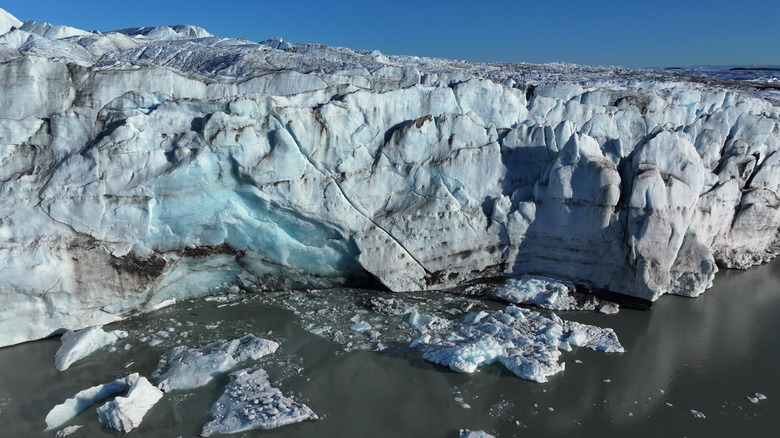
Understanding why this robot's journey matters requires a bit of science and a vocabulary lesson (we promise to be quick, but it will help!). A glacier is a mass of ice that forms on land. An ice sheet is an even bigger mass of ice on land, sometimes made up of a collection of glaciers. An ice shelf is an extension of that ice sheet that forms over the ocean, and icebergs are large chunks of ice in the water that break off a glacier or an ice shelf.
As the planet warms, sea levels are rising and potentially posing a threat to millions of people. Scientists are not sure how Antarctica may drive the rise of sea levels, and they work to get measurements from underneath oceanic ice because we can't see what's happening from up above. The future of the Antarctic ice sheet depends on how much heat from the surrounding ocean water gets to the base of the ice shelves. Those ice shelves act like barriers, keeping the glacial ice from reaching the ocean. If those ice shelves collapse, more ice ends up in the sea, potentially causing it to rise. Because the ice shelves are so thick, we can't easily study what's happening underneath.
The Argo float unintentionally provided data that may help scientists grappling with this issue. Initially deployed near the Totten Glacier, it drifted and collected data near the Denman Glacier, which experts knew may be unstable. It then disappeared and spent time floating underneath both the Denman and the Shackleton ice shelves.
What did the Argo float find?
While on its unsanctioned journey underneath the ice shelves, the Argo float collected the data it was designed to collect — temperature and salinity data all the way from the seafloor to the base of the shelf. This information represents first-of-its-kind data from beneath the ice shelf in East Antarctica.
Because the float was not able to surface to transmit its data that way it was intended, scientists don't know where each measurement was made, but they were able to make an educated guess. Every time the float bumped into the ice, scientists knew how deep it was. They could then compare that data to satellite measurements to track a likely path. The news is good for the Shackleton ice shelf, which is not yet showing signs of exposure to warm water. The Denman ice shelf, however, has warm water flowing underneath it, causing the Denman Glacier to melt.
The Totten glacier is also at risk, and the data shows that understanding how ice in East Antarctica is melting is extremely important to estimating the potential for sea levels to rise. Ultimately, just like Opportunity brought back incredible data from Mars, the Argo float provided scientists with an unprecedented look somewhere that humans simply can't go.