

North Korea's Su-25 Fighter Jets May Have A New Weapon Onboard
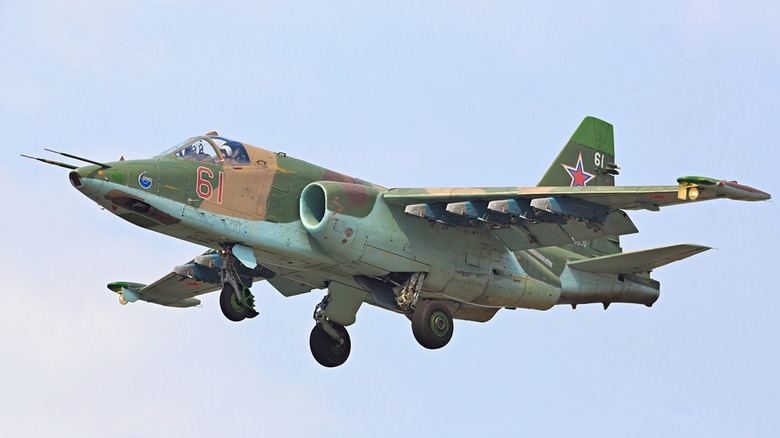
The Sukhoi Su-25 is a relatively old fighter jet, having been first introduced into service by the Soviet Union in 1984. Many still fly for various air forces, including the Korean People's Army Air Force (KPAF) of North Korea. Despite its age, the Su-25 has been updated a handful of times, and they've been used in the Russo-Ukrainian War, so they're still very much in the fight. For North Korea, its Su-25s may be sporting several entirely new onboard weapon systems.
During the 80th anniversary celebration of the KPAF, North Korean leader Kim Jong Un inspected a slew of the service's latest vehicle and weapon acquisitions. These included mobile missile launchers, cargo aircraft, and several new types of missiles seen affixed to the hard points of some Su-25s on display. Analysts in the Republic of Korea identified apparent long-range air-to-ground missiles, which they compared to KEPD 350 Taurus standoff weapons. They appear similar, as they boast a squared-off cross-section, a set of cruciform tailfins, and a pair of wings that pop out upon deployment.
The new missile is noteworthy, as it could have similar capabilities to the Taurus and not just look like them. It's not uncommon for North Korea to copy Western weapon systems, and the Taurus is South Korea's standoff missile used via its fleet of F-15K Slam Eagle fighters flown by the Republic of Korea Air Force. If the similarities to the Taurus are more than aesthetic, it will likely be programmable prior to flight, though it may not be capable of receiving updated targeting coordinates once the aircraft takes leaves the ground.
The KPAF's new missile is an interesting acquisition
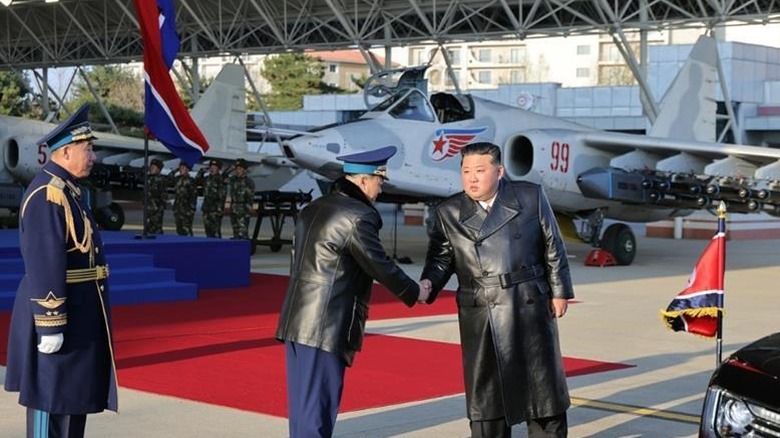
While the KPAF's fleet of Su-25s is aging, they're some of the most advanced, reliable fighters in the nation's inventory, so any upgrades are taken seriously by Western nations and the Republic of Korea. The new missile offers a tactical improvement over what was previously available and could be used against a variety of targets on the ground.
However, the Taurus lookalike isn't the only new armament; another cluster of three missiles on a separate pylon could be a different sort of precision-guided ordnance. Analysts believe it could be similar to the United Kingdom's Brimstone anti-armor missile. These appear to be outfitted with an optically transparent seeker, which would employ the Su-25's onboard rangefinder/target designator. This too represents an advanced improvement over the KPAF's legacy armaments, though the missile appears to be less advanced than those in the Brimstone family. Most of the ordnance used by KPAF prior to these advancements involved "dumb" rockets and gravity bombs.
Another, and perhaps the most significant new weapon system fielded by North Korea, appears to be a short-range air-to-air missile (AAM). Visually, these appear similar to the German IRIS-T surface-to-air missile, and they're notable because previously, North Korea was limited to using old Soviet R-60 AAMs. If the nation has finally produced its own AAMs domestically, this would mark a significant improvement in its capabilities and an overall advancement over its aging Soviet missile stockpiles. Still, while North Korea's weapons production is of interest, its newest AAM is likely far less advanced than the U.S. military's go-to AAM for the past 70 years.