

How A 400-Ton Crane Works (And Doesn't Tip Over)
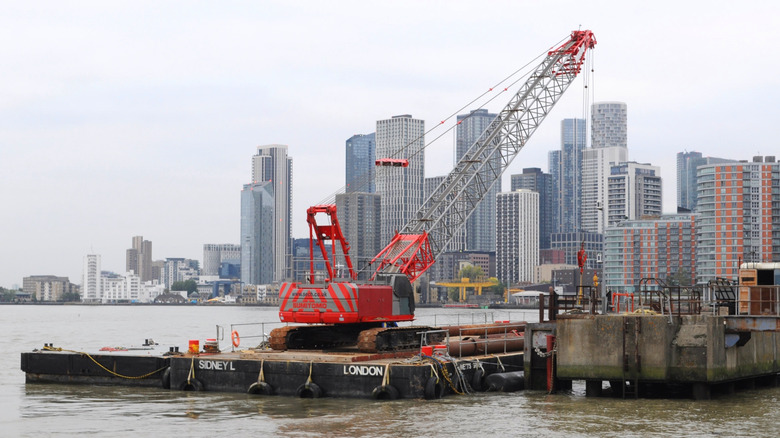
At many large-scale building projects you'll find a 400-ton crane, a huge machine that can work more carefully than you might suspect. These high-capacity cranes are commonly used in places where strength, stability, and precision are critical. A 400-ton crane can be installed permanently at a site, but many are made with tracks or mounted on trailers so they can be driven from job to job. The descriptor '400-ton' refers to the class's lifting capacity under ideal circumstances, but each crane's actual working load depends on boom size, load radius, counterweighting, and ground conditions.
The stability of a crane requires the careful balancing of all the forces acting on it. While lifting, a crane's center of gravity can be pulled sideways past what's known as the "tipping point." To stay upright, cranes use their own mass, heavy counterweights opposite the load, and a wide base provided by crawler tracks or extendable outriggers. Crane manufacturers design and build these machines to safely support their rated loads, then test them thoroughly to ensure safe operation.
How 400-ton cranes stay upright
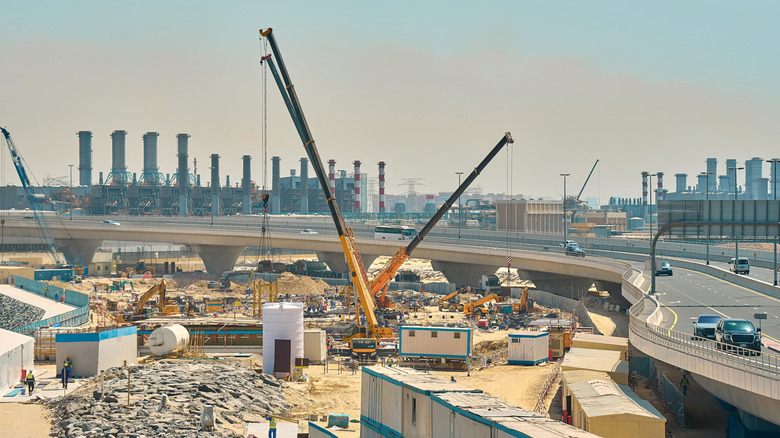
A 400-ton capacity machine wasn't necessary when Volvo used a crane to drop cars for extreme crash testing in 2020, but the overkill wouldn't have been a problem. Large cranes rely on sound engineering, robust hydraulics, and multilayered stability management systems. One critical component is the boom, the arm that extends from the base to lift and carry the load. Crane operators will opt for a telescopic or lattice boom depending on the job. Telescopic booms like the ones shown above extend on command, while lattice booms are stronger and lighter but can't be resized as easily. Heavier and high-radius lifts are safer with lattice booms because they distribute force more evenly, and you often see them at long-term projects because they're cost-effective to operate once fitted.
A 400-ton crane can use either type of boom depending on the specific task and job site. Counterweights are also critical to keeping 400-ton cranes stable while working; these heavy steel or concrete weights stabilize a crane by acting opposite load forces, much like a ship's ballast. Some cranes can support over 250 tons of ballast, and there are mobile and adjustable systems to make cranes more effective.There are even variable-position counterweights that automatically adjust as a load moves; an effective counterweight system is essential to the safe operation of a 400-ton crane.
How 400-ton cranes differ from smaller cranes

The obvious difference between a 400-ton crane and a smaller one is lifting capacity; this is a product of different materials, boom architectures, and counterweight mechanisms. Smaller cranes are more easily driven or carted from place to place and usually have shorter booms and a simple counterweight setup. A 400-ton crane might have a multi-section boom, attachments that increase lifting capability or radius, or a so-called 'luffing jib' that allows it to be operated in tight quarters.
The counterweight packages for 400-ton cranes are also bigger than those of smaller cranes, and some are operator-adjustable on the fly. Larger cranes are also made with stronger materials and redundant structures to help them counteract large tipping forces. This also means mobile 400-ton cranes can spread outriggers wider, making them all the more stable. While trigonometry and robust construction do the heavy lifting to keep them upright, mobile 400-ton cranes also have reinforced tracks and drivetrains to keep them moving.