

Scientists Ramp Up Search For 'Ghost Particles' Beneath Lake Superior

When the idea of a neutrino was proposed in the 1930s, scientists lacked the technology to confirm its existence. Today, these ghost particles — dubbed so because they are invisible, pass through objects without being detected, and have no charge and nearly no mass — are known to form when atomic nuclei merge or come apart. Researchers have detected neutrinos in the sun's core and even linked them to black holes outside our galaxy. Because these particles hold important clues into some of the big questions of the universe, scientists have built detectors designed to "catch" them in remote places, like underground. Now, researchers are searching for neutrinos underwater at the bottom of Lake Superior.
As part of the Experimental Neutrino Detector (END), scientists have placed sensors at the bottom of Lake Superior in an attempt to detect artificial neutrinos leaving the Fermilab accelerator. The main goal is to observe neutrino interactions while also establishing a clear system to distinguish between artificially produced neutrinos and those stemming from natural sources like cosmic radiation. Essentially, this experiment could help scientists pick out the neutrinos they produced at Fermilab from all the other background noise already in the lake, including signals coming from cosmic rays. The new sensor will represent a key link in the chain, catching the neutrino beamline from Fermilab and complementing other sensors based in Lake Vermilion and the Ash River.
The search for these ghost particles on site has ramped up significantly before this Fermilab beamline is decommissioned in 2027. If they are able to detect neutrinos shot from the accelerator, it would be a historic moment in science, since artificial neutrinos have yet to be "caught" in a natural body of water.
Why is this particular experiment a big deal?
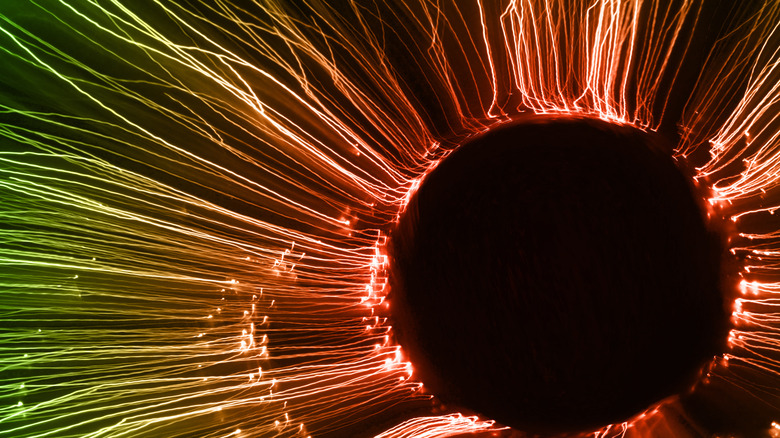
Neutrinos are the most widespread particles in the universe that have mass, owing to the abundance of atomic reactions. As ridiculous as it may sound, even a banana creates neutrinos because of the radioactive nature of its potassium. Yet, despite our understanding of them, they still represent quite a mystery. For example, we're yet to determine their mass (likely a millionth of a single electron), and they're painfully hard to detect as they rarely interact with matter.
That's where the Lake Superior experiment comes in. When neutrinos collide with other particles, it creates a fast-moving particle that emits a small amount of blue light underwater. Scientists use photosensors to detect these faint glimmers of light and relay them to shore through a fiber optic cable. Though it's still early to tell if and how the experiment will further our understanding of neutrinos, studying these ghost particles may provide clues on how the universe was formed.
Interestingly, the U.S. Department of Defense is sponsoring the project. No information was released about any potential military applications that could come from experiments like these, but the Defense Advanced Research Projects Agency (DARPA) has explored the possibility of using neutrino detectors as a way to detect nuclear submarines without using sonar.