

What's The Difference Between Yellow And White Speed Limit Signs?
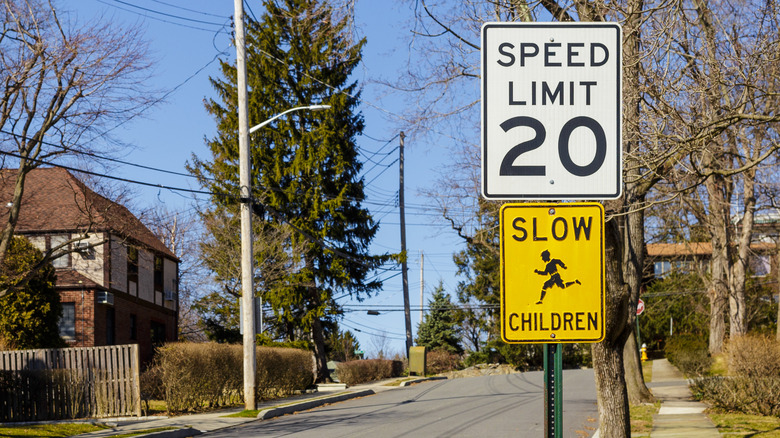
Various types of road signs are different colors, and the same is true for speed limit signs. Most speed limit signs you see on the road have a plain white background with black numbers, but you may spot a yellow one instead in certain circumstances. Different colors on speed limit signs mean different things. White speed limit signs indicate the number displayed is maximum legal speed you can reach on that road. There's plenty of thought that goes into picking that number based on factors like how fast drivers already move, the shape of the road, and how many folks walk nearby. Most of the time, this figure lands on a multiple of five, though very rarely you may spot something oddly specific, like a speed limit sign with a decimal point on it.
Like other yellow signs, such as curve-ahead or pedestrian-crossing signs, yellow speed limit signs are meant to be taken as a warning rather than a legal mandate. On the white speed limit signs, you'll see "Speed Limit," typically in all caps, above the number. If you see that, then know that the speed is legally enforceable. Meanwhile, yellow speed limit signs typically have "MPH" under the advisory number. Technically, you cannot "violate" a yellow speed sign because those are designed to simply advise drivers on an appropriate speed. Still, they tie into what most states call the basic speed law, which is why it is important to follow them.
The costs of not following yellow and white speed limit signs
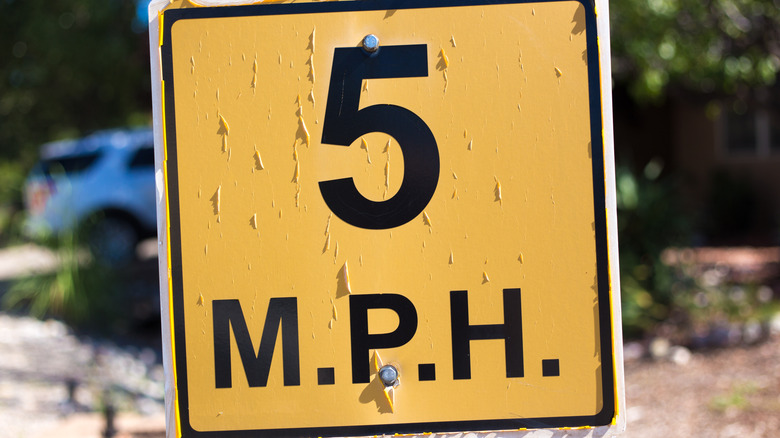
Basic speed laws say that drivers must operate at speeds that are reasonable for the conditions. California's Vehicle Code 22350, for instance, states that it's illegal to drive faster than is reasonable or prudent given the weather, visibility, traffic, and the road's surface and width. When you take that into account and tie it back to a yellow sign, the picture sharpens. Suppose there's a blind bend with a yellow sign that reads 35. You choose to take that at 50 and end up losing control, crashing, and maybe taking another car with you. That may make it to the crash report as proof you were moving too fast for the spot, and the blame then lands on you.
Meanwhile, violating a white speed limit sign is flat-out against the law. Depending on the state and how far over you push it, the fallout can run from a small fine to points on your record, higher insurance, or even a criminal charge. Other times, white speed limit signs can be paired up with yellow advisory signs as well. In school zones, for example, a yellow banner reading "SCHOOL" or an image of children crossing the street is often paired with a white speed limit sign. The white sign remains the enforceable limit, but the yellow sign provides an additional advisory. A lot of states also wrap a higher fines zone around schools.