

Is GM Really Eyeing A Return To The Two-Stroke Engine?
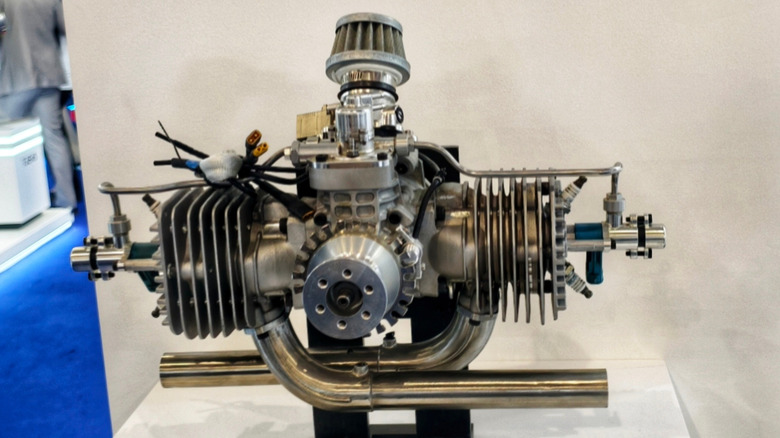
The last time you may have heard that distinct, high-pitched sound of a two-stroke engine was probably when you fired up a leaf blower. That's because they have fallen out of fashion when it comes to traditional modes of transportation, and the auto industry has largely moved onto four-stroke engines. Porsche even filed a patent for a six-stroke engine in 2024.
Part of the reason the auto industry moved away from two-stroke engines is because four-stroke engines are more fuel efficient and produce less pollution. That's because they work a little differently. Two-stroke engines handle combustion in just two piston movements, with one stroke covering compression and the other handling power. Four strokes, meanwhile, operate on four steps — intake, compression, combustion, and exhaust. Having fewer steps means two-stroke engines fire more often and can have an impressive amount of power for their size. Although two-stroke engines use a simpler design with fewer moving parts, however, that doesn't translate into greater efficiency.
Yet two-strokes may still have some room for improvement. At least that's the idea behind a relatively new patent filed by General Motors. The company filed a patent application for a a fresh take on a two-stroke engine valve system back in May 2024 that finally went public in late November of the following year.
How the system GM is patenting would work

The main system GM is trying to patent involves a clever new valve mechanism. The main reason two-strokes couldn't survive modern emission norms is because of how they "breathe," so to speak. Instead of using proper valves up top like a four-stroke, they rely on simple openings cut into the cylinder wall. The piston slides past these to let fresh fuel in and old exhaust out. It isn't very efficient because both openings sit open at the same time for a brief window during each cycle. As a result, some of the unburnt fuel slips straight out of the exhaust without ever combusting. This shows up as that distinctive blue haze coming out the pipe.
GM's fix for this involves adding a sliding sleeve that sits between the piston and the cylinder wall. It's controlled by what the patent describes as a mechanical or electro-mechanical actuator that moves in sync with the piston to seal off those openings at the right moments. If it works, this could allow fuel to stay where it's supposed to until it actually burns, which would improve efficiency.
How this could be used in practice remains a bit unclear, though. The patent doesn't name specific models that could use this two-stroke engine beyond broadly pointing to hybrids. Before you get too hyped for the return of the two-stroke, remember that this is just a patent filing and not a confirmed product. Automakers patent stuff all the time, and that doesn't mean it will turn into a reality. GM hasn't publicly stated it is seriously considering pursuing this either. For now, it's probably best to treat it as a glimpse at what their R&D team is messing around with.