

US Army Names New Aircraft In Honor Of A Historic Kansas Tribe
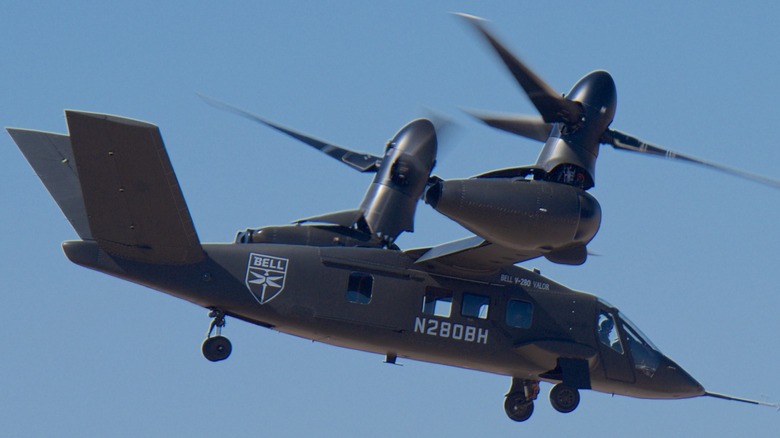
The United States military has flown the Bell Boeing V-22 Osprey since the 1990s, and while the tilt-rotor aircraft has flown for the Air Force, Navy, and Marine Corps, it hasn't operated for the Army – but that's changing in 2026. Bell Textron Inc. has been working on a new vehicle specifically for the Army, and on April 15, 2026, it was officially designated the MV-75 Cheyenne II.
The naming convention is consistent with the Army's helicopter naming convention, which honors Native American tribes. In the case of the MV-75, the honored tribes include the Northern Cheyenne Tribe in Montana and the Cheyenne & Arapaho Tribes in Oklahoma. Initially, the Cheyenne Tribes were spread throughout Kansas, calling the Great Lakes and Great Plains regions their home for around four centuries before they were forced to relocate to reservations in Montana and Oklahoma.
The Army's new helicopter is revolutionary for several reasons, including its ability to operate as a plane and a helicopter. This will give the Army the robust insertion and extraction capability that has been available to the Marines, Air Force, and Navy. The MV-75 has been in development for over a decade, first flying in 2017, when it was known as the V-280 Valor. It's now expected to begin testing in 2027 or 2028, with operational deployment beginning around fiscal year 2031.
The Bell MV-75 Cheyenne II's capabilities
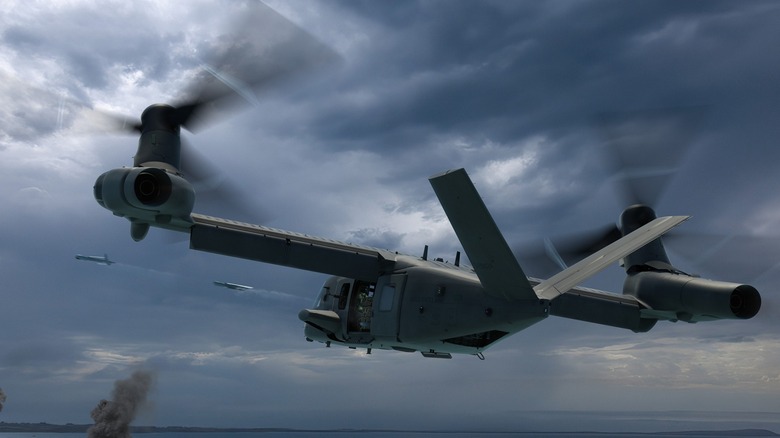
The "MV" in the MV-75 Cheyenne II's designation indicates the aircraft's purpose as a multi-mission vertical takeoff aircraft, while the "75" represents the Continental Army's founding year of 1775. As far as specifications go, some of the Cheyenne II's capabilities may change during testing, but many will likely remain the same — and a selection are already known to the public.
The MV-75 is designed with a Modular Open Systems Approach (MOSA), allowing the Army to modify certain aspects of the aircraft based on battlespace conditions and mission requirements. There's also a Special Operations configuration, the Night Stalker MV-75A. This features several modifications, including what The War Zone believes to be the AN/APQ-187 Silent Knight radar.
To meet the Army's requirements, the MV-75 will be able to transport up to 12 troops while cruising at 322 mph. It will be able to reach a ceiling of 6,000 feet and have a combat range of up to 1,956 miles. The aircraft will also feature some semi-autonomous capabilities and could potentially operate without a crew, transforming it into a drone of some kind. These, however, are the baseline requirements designated by the Army at the beginning of the project. Thus, the MV-75 may exceed them by the time development and testing end.