

Fixing Your Slow SSD Might Be Easier Than You Think
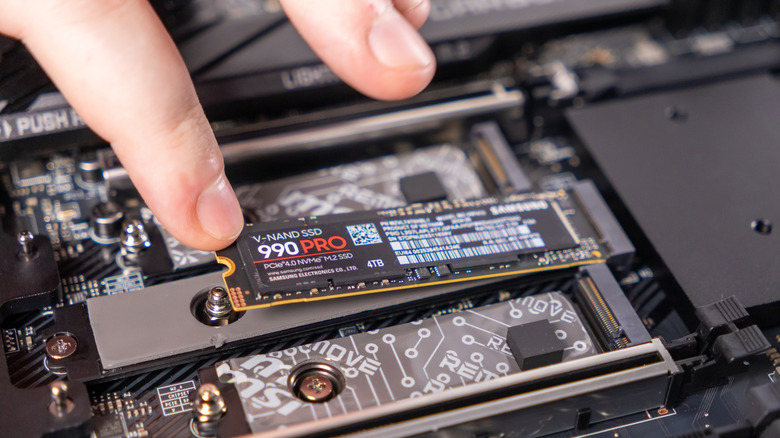
Solid-state drives have completely changed the game for storage on computers and laptops. No moving parts, no RPM (revolutions-per-minute) to worry about, and lightning-fast read and write speeds. Even early SSDs were impressive, but once the M.2 format hit the market, things got even better. While SSDs are currently monstrously expensive, pretty much every modern desktop and laptop uses them, mostly due to the demands of modern software, video games, and operating systems.
Here's the thing, though. Even though modern SSDs are super fast, and they will last a lot longer than most hard drives due to their lack of moving parts, they can still slow down. As you fill them up with data, which can happen very quickly if it's a smaller SSD, that advertised speed of several thousand megabytes per second goes down fast.
Fortunately, modern operating systems like Windows support a standard hardware command to help you solve this issue, with a very fitting name: TRIM. TRIM cleans up so-called blocks of data so that the SSD knows which ones to use, making it more efficient and increasing its lifespan.
Why should you use TRIM?
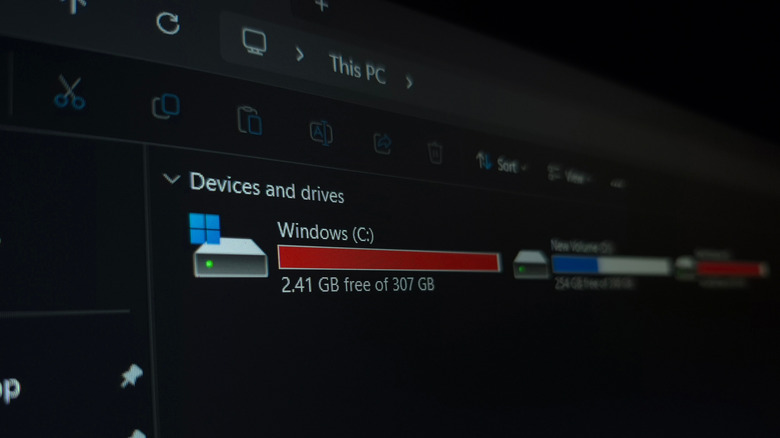
Although it has a much cooler name, TRIM is essentially the modern equivalent of disk defragmentation, which Windows can still do. Defragmenting old hard drives brought all the data closer together in a more accessible spot, allowing the hard drive to cycle through the data more efficiently and make it faster. TRIM doesn't work on the same principle as defragmentation, as SSDs and HDDs store data in different ways, but TRIM does serve a similar purpose. It increases your SSD's efficiency and lifespan by clearing up empty blocks of data that are no longer in use.
Recent releases of Windows run this process automatically in the background, and you can check this through the drive's properties from inside This PC on your computer. If the scheduled optimization (which you can find inside of Properties > Tools > Optimize) is set to On, then Windows runs TRIM for you on a weekly basis.
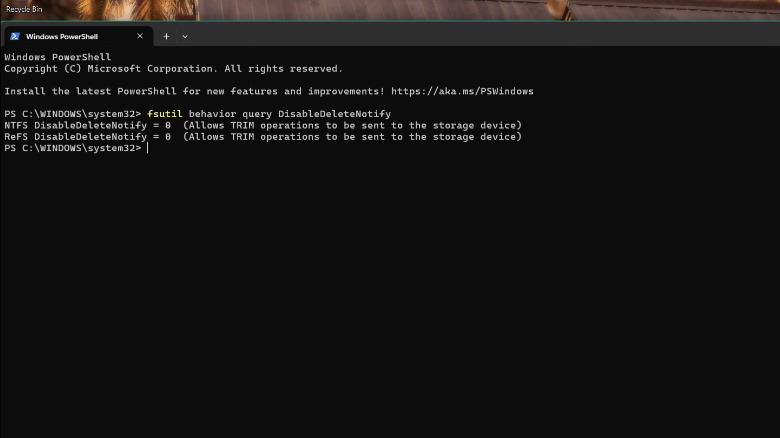
Another way to check if TRIM is on is through PowerShell. Simply run PowerShell with administrator privileges. Next, type "fsutil behavior query DisableDeleteNotify" without the quotes, then hit Enter.
 Marko Sokolovski / SlashGear
If both values are zero, then TRIM is on, and you don't need to worry about it. We would not recommend disabling it, as in this era of highly unpredictable SSD prices and the importance of keeping our data safe and secure, it's always a good idea to keep your SSD on its best behavior, and TRIM definitely helps out with that.