

iPhone 17 Pro Max Vs Pixel 10 Pro XL: Here's Which Phone Wins
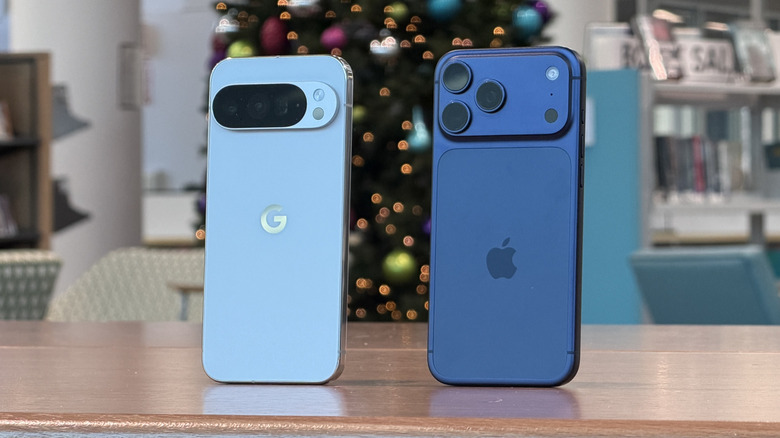
Apple and Google make the most popular smartphone operating systems in the world. As it happens, both also make their own hardware, and the best (non-foldable) phones that they make are the iPhone 17 Pro Max and the Pixel 10 Pro XL. Both phones are large, sport huge screens and batteries, and the very best of their respective operating systems. If you're in the market for a new phone, these are two very good choices.
Both phones feature their respective companies own processor, a great set of cameras, large batteries, and big screens. Both start off with 256GB of storage and 12GB of RAM on the base models. The Pixel can get up to 1TB of storage and 16GB of RAM in the top models while the iPhone can get up to 2TB of storage on the high end.
The key differentiation between the two phones, aside from their respective operating systems, is the use of and reliance upon AI. Apple rolled out its Apple Intelligence features starting with the release of the iPhone 16 series in late 2024, and it has been a slow build ever since. Google, meanwhile, has built AI and Gemini into many facets of the operating system from Gemini replacing Google Assistant to bolstering photo manipulation and more.
Picking which phone is better is not as clear-cut as the difference between the iPhone 17 Pro Max and the Samsung Galaxy S25 Ultra, but there's still a pretty solid winner here. The iPhone 17 Pro Max is very much a mainstream phone while the Pixel 10 Pro XL — like it or not — still falls in the niche category, but that might be changing.
Apple's dominance
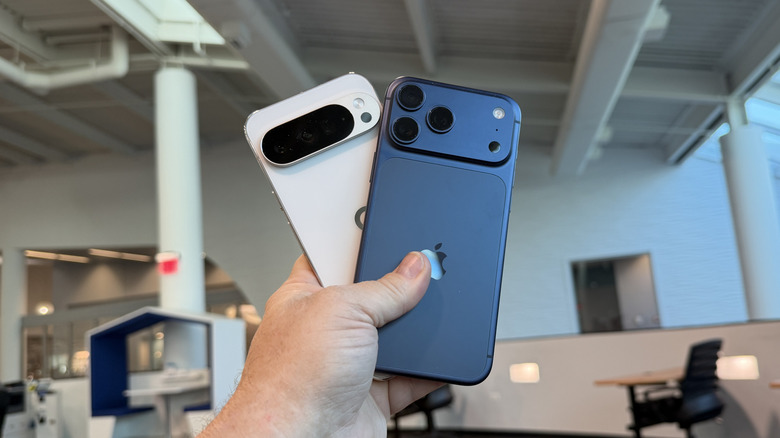
Apple controls roughly half of the U.S. consumer phone market. There are a number of reasons for this, including but not limited to Apple's ecosystem of apps and devices, the perception that Apple is just easier to use, and the wide array of accessories that you can buy to go with your phone. The Google Pixel 10 Pro XL is very steadily gaining market share — up to 7% in some areas — but it still remains more of a niche phone behind the likes of Samsung on the high end and companies like Motorola in the midrange.
One area where Apple is clearly dominant is in the processor inside the phone. While Google's Tensor G5 chip is no slouch, the Apple A19 Pro wipes the floor with it, almost doubling its Geekbench 6 score. What that means is, long term, the iPhone 17 Pro will last longer and be able to work with current apps for longer. It's one of the reasons why iPhones tend to hold on to their resale value for much longer, although that may also be shifting.
Cameras are king
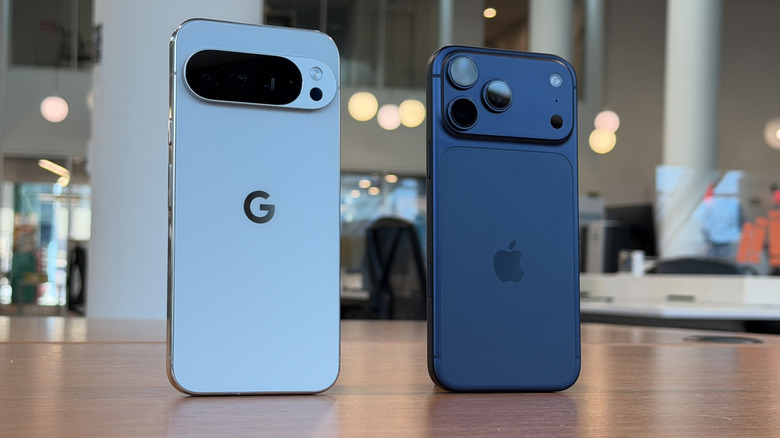
Both iPhones and Pixels are renowned for their camera chops, and in this situation, both phones stand toe to toe. The iPhone has three 48-megapixel sensors on the back covering ultrawide, main, and 4x telephoto lenses, with an 18-megapixel square sensor on the front, which we'll get to in a minute. Meanwhile the Pixel 10 Pro XL has a 50-megapixel main sensor, and dual 48-megapixel sensors for the ultrawide and 5x telephoto and a 42-megapixel sensor for the selfie camera.
That selfie camera on the iPhone is very different from others in the industry. It's a square sensor, so you can take portrait or landscape selfies while holding the phone in portrait orientation. This is a killer feature for creators and Instagramers, since the portrait format is still king in those media, while at the same time allowing for landscape shots to take in more people in a group shot, or more landscape behind you. I enjoy taking selfies that way more than I thought I would.
Overall, both camera sets on these phones are excellent. One advantage that Google has is called "Add me" which allows you to snap a photo of a group, hand the phone to someone in your group, and have them snap a photo of you with that same group, basically editing yourself into the shot. It's a neat AI trick that is unique to Google-made phones.