

Comtech Helps US Marine Corps Achieve Record-Breaking Communications Link
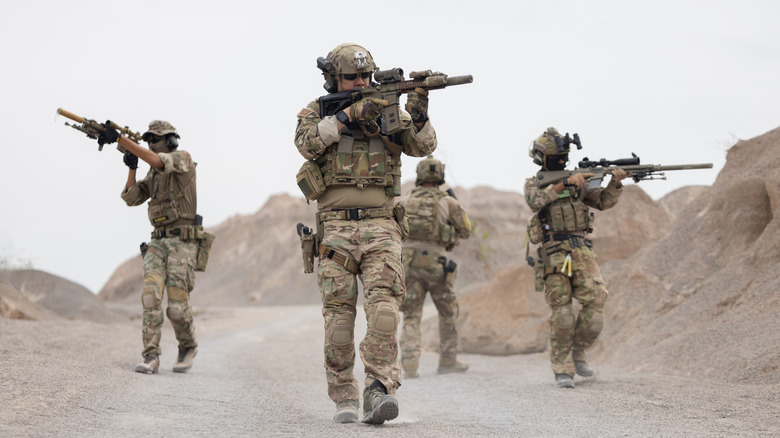
Today, the US military requires reliable long-range communication to stay efficient. More importantly, communication arrays need to get set up faster than ever, which leaves little time to install large-scale systems that power them. One communication company believes it has the solution to this quandary.
Recently, Comtech Telecommunications Corp (Comtech for short) demonstrated its new COMET Multipath Radio (MPR) platform. This system utilizes a troposcatter link, a version of radio communication that transmits and scatters high-frequency radio waves into the troposphere (the lowest layer of the atmosphere). These waves bounce off various "irregularities" within the troposphere, such as atmospheric turbulence, to reach recipients well beyond the horizon.
During the demonstration, dubbed Tropo Thunder (not to be confused with the movie "Tropic Thunder"), Comtech showed that its COMET MPR platform could send radio signals 187 miles away, specifically from Pohakuloa Training Area on Hawaii Island to Joint Base Pearl Harbor-Hickam on Oahu, all with approximately 6 milliseconds of round-trip latency. For comparison, most long-range radios and walkie-talkies cap out at around 35 miles. But more importantly, Comtech's communications system required less than 350 watts of electricity to operate. That's less power than all other troposcatter links on the market. Since the US military is facing a growing problem that impacts its stores of vital hardware, including batteries, the need for systems that run on less juice has never been higher.
What Tropo Thunder means for the future
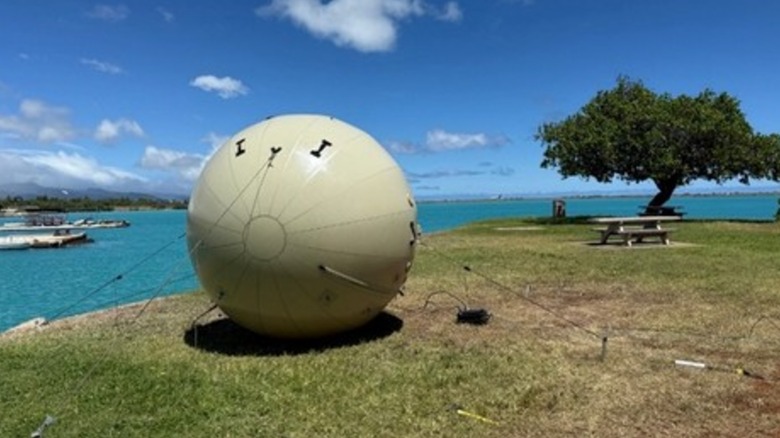
Comtech's COMET MPR is more than just a long-distance radio. Well, it is a long-distance radio, but it's so small you can check its carrying case at an airport terminal, and thanks to its inflatable antenna, operators can have the radio up and running in around 30 minutes. Not that Marines will carry these devices on commercial airlines, but you get the point.
According to Comtech, most military beyond-line-of-sight (BLOS) radios with the COMET MPR's range usually require much larger equipment, yet its device is small enough for a squad to take with them, and into locations that are difficult to navigate — especially if you're lugging around a traditional BLOS. One potential application Comtech provided was helping squads stay in communication during missions that take them island-hopping, but Comtech also believes its MPR could be crucial in operations that take soldiers across "increasingly distributed and contested environments."
During the demonstration, Mark Yamamoto, VP of North America Solutions at Comtech, stated that COMET MPR shows how far troposcatter communications have come since the early days. He is looking forward to future collaborations with the US Marine Corps, although the technologies have potential for other applications. Perhaps this system could find a home in naval ships, even if only as a backup when normal communication systems fail. Thanks to its design, the COMET could be stored on even the oldest military ships with ease. Food for thought.