Thursday, Oct 19th 2006 by Vincent Nguyen


Worth Reading?


YesNo


+7 [7 votes]
Loading ... Loading ...

SED-TV is something that no amount of words can describe. It is something that must be SEEN to be believed; literally. SlashGear journey in to the world of SED-TV through an actual demo. But, what exactly is SED-TV? To unravel the mysteries of SED-TV, a history lesson is quite helpful.
SED   TV   Surface-conduction   Electron-emitter   Display   SlashGear   Canon   Toshiba

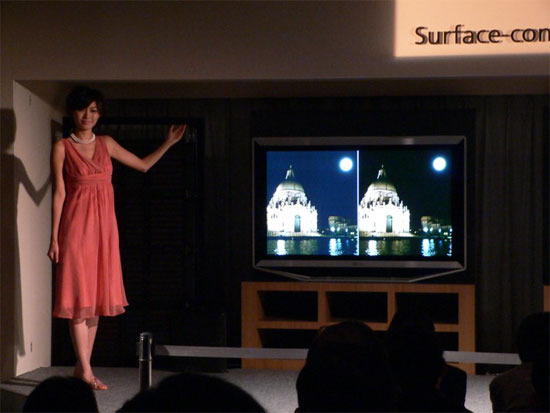
55-inch SED Display with 100,000:1 contrast ratio exhibited at the “FPD International 2006” in Pacifico Yohohama convention center.


SED   TV   Surface-conduction   Electron-emitter   Display   SlashGear   Canon   Toshiba

(The two images above are courtesy of TechOn.)

There’s nothing like a great rivalry between companies, especially if it’s over one product. The consumer decides who wins this tug of war, and in the process gets the best possible end result. Both companies strive to win over the customer, by any means necessary, whether it is a lower price, more extras, or just anything that takes that extra step to make us happy. This is what lies in store for the electronic giants Toshiba and Canon.
1_ts_sm

Canon began to visualize and develop SED-TV as early as 1986. In 1999, Canon joined forces with Toshiba in the development of this new technology. With the future looking so bright, the two started a joint venture company: SED Inc. However, fate has brought these two seemingly friendly corporations in to a battle for a better SED-TV. That’s right; SED-TV will be available from BOTH. Who will become the leading company to place their name on it? Well, that part is up to us.

3_ts_audience_sm

So, now that the history lesson is done, you might be wondering what exactly SED-TV is. In many ways, SED-TV is the future of display as we know it. SED stands for “Surface-conduction Electron-emitter Display”, a name that those not blessed with “digi-genius” will be unable to comprehend. Simply put, this type of display takes the best parts of CRT monitors (the fat one’s), and puts it in to the body of flat panel one’s (skinny one’s).
For simpletons, this explanation will do, but for those who are brave, read on for more details on what will undoubtedly revolutionize display viewing.

For the tech junkies, here’s how SED-TV works. The display consists of two flat piece of glass, sealed with a vacuum in between. One of the glasses is covered with electron emitters, while the other is covered with phosphorus. These are both methods used in CRT televisions today. The vacuum in between the glasses is only half an inch thick, which allows for extremely thin monitors. Each electron emitter is matched up with a pixel on the monitor, allowing extreme precision in images! Imagine the clear concentration of each pixel, offered in an extremely thin package; this is essentially SED-TV. These are just the basics of the technology, and for more information be sure to watch SlashGear’s EXCLUSIVE interview with Michael Zorich (Director of Marketing of Canon).

So, the technology is brilliant, but what is the end result? Again, this is something that must be seen to believe, but a basic description is possible. With the extreme precision of SED-TV, visual quality is superior to anything we have seen on the market. For one, angle viewing is no longer a problem. With other flat panels, sitting on the side of the monitor at an angle, there is a significant loss of quality and view. This is not a problem with SED-TV, as everyone sees the same gorgeous images!

Toshia SED TV Front

SED-TV is also so precise, that an object moving at high speed can still offer crisp clear letters! On any other TV, a blur would utter this impossible, but not with the SED-TV display. Colors are extremely vivid and unbelievably sharp, offering views that are as lifelike as it gets. Words do this display no justice; it must be viewed to fully comprehend what SED-TV is. Luckily, SlashGear offers an exclusive demo of SED-TV that you will not find anywhere else. So, click on that link, sit back, and enjoy viewing the mind-blowing quality.

It’s important to note, that the demo is running on 720p, and is a video, so the quality is a bit worse than the actual technology. The final product is slated to run on 1080p, which only adds to the solidity of the display. Also, the demonstration is running on a 36” monitor, but final products will be much larger, including an announced 55” version with 8600:1 contrast ratios! The final product should become available sometime in 2007 worldwide.
Now, wipe off your drool and face the facts. Such revolutionary technology doesn’t run cheap. Though no official word on price has been announced, think BIG. Most people will probably be unable to afford one of these 55” badboys in the living room. This product will most nearly be aimed at large companies that host big social events. For example, a big SED-TV monitor would be perfect for a movie-of-the-year premier.
SED-TV is the future of digital image displays; it’s as simple as that. There is currently nothing on the market that comes remotely close to Canon’s offering. Now, the question remains, how will Toshiba respond to Canon’s extremely successful debut of SED-TV technology? Either way, we are all in for a great treat as this technology becomes more widespread. Well, that’s enough text about SED-TV, go ahead and click on the videos, and see the breathtaking future in action.
[youtube]http://video.google.com/videoplay?docid=1478427017283711408&q=IFA2006[/youtube]
Video courtesy of IFA2006.net

Subscribe via RSS or Email | 5136 Subscribers


  1.  AJ   View all comments by AJ  Neutral  Add karma Subtract karma Quote

    one word…WOW

  2.  SED TV Reviews   View all comments by SED TV Reviews  +1  Add karma Subtract karma Quote

    Excellent article. Good explanation of the technology and the background behind it.

  3.  kxb   View all comments by kxb  Neutral  Add karma Subtract karma Quote

    Two companies competing? You can’t be serious. This is Japan we’re talking about. Not to mention the manufacturing facility is jointly owned by Canon and Toshiba. The competition will be between SED, LCD, Plasma, and laser (if and when laser shows up for the party). Expect to pay through the nose for SED given its clearly superior picture.

  4.  jbl   View all comments by jbl  Neutral  Add karma Subtract karma Quote

    u r right kbx http://www.sony.com

  5.  Stomp   View all comments by Stomp  Neutral  Add karma Subtract karma Quote

    > that an object moving at high speed can still offer crisp clear letters!

    That’s not an issue of the display, but of the encoding of the video-signal. Unless PAL/NTSC is going away as well (which it isn’t), things are not going to change…

  6.  d   View all comments by d  Neutral  Add karma Subtract karma Quote

    > that an object moving at high speed can still offer crisp clear letters!

    That’s not an issue of the display, but of the encoding of the video-signal. Unless PAL/NTSC is going away as well (which it isn’t), things are not going to change…

    PAL and NTSC are going away, of course, because people who buy fancy TVs will be mostly watching DTV/EDTV/HDTV content, which do not use NTSC or PAL encoding. In any event, even with NTSC/PAL SDTV signals, LCDs, especially older ones, are often not able to switch as quickly as the video signal switches, causing blurring, or in the case of computer monitors, the infamous mouse cursor that disappears when you move it. The only contribution of PAL/NTSC to any movement related problem is due to interlacing (this is also true in 1080i, but not 480p, 720p, and 1080p), where moving objects can get a “combed edge”. However, for video converted from film (24 fps), even without a progressive-scan DVD player, any decent deinterlacer can reconstruct the original 24 fps non-interlaced source, in which case you are just limited by the frame-rate of the source material. Of course digital TV adds a new problem, which is when higher-compression is used, particularly by cable providers trying to squeeze 100 more home shopping channels into the same wire, moving images will be degraded due to MPEG artifacts.

  7.  Joe   View all comments by Joe  Neutral  Add karma Subtract karma Quote

    The old Sony XBR CRT TV’s had a 3-D look to the picture. Does SED have this 3-D look. I know many TV’s have a 3-D comb fliters (not sure what that actaully does), but only a Sony picture had depth. Once you see it, you always see it.

  8.  Andy   View all comments by Andy  Neutral  Add karma Subtract karma Quote

    I can’t wait!

    Joe - I know what you mean. I own one of the 34″ Sony XBR CRT HDTVs (about 2 grand about 3-4 years ago) and its still far and away the best picture quality I, or anyone who comes into my house, has seen from a 1080i capable hdtv. I’ve had cable guys come to my house who see plasmas and lcd’s all day, and they get to my tv and do a double take. Who cares if you can hang it on your wall if the picture looks like shit.

    If SED can be even better, I’ll be first on line. Heck, i’ll take it even if the image size is roughly equal to what I have now–if they can make it flat panel and 50 inches. Granted I may need to sell my car and a few other things first to afford it.

  9.  Larry   View all comments by Larry  Neutral  Add karma Subtract karma Quote

    For all those who are guessing at what they are saying… I will tell you all that this form of TV Will be the wave. As to the Comment about moving letters blurring, that will always effect LCD.. We are Heading to 100% HDTV so get use to it.. Any body thinking that they can hang on to the past would be sorely mistaken. As of NOW there is Only 2 types of TV’s that can handle Both Movement and Crispness and that is DLP and now SED.. LCD and PLASM will never be able to give you the true “PICTURE TUBE” type resolution, as for the old Sony with the 3 comb filter, that is about 9 years old.. Technology is far surpassed that.. Those sets were only capable of LOR’s (Lines of Resolution) ALL new sets go by DPS! Therefore an old set that you would convert mathimatically would average about 250 thousand pixels.. Todays sets offer over 2.5 MILLION Pixels.. Do the math! Both DLP and SED will be able to take advantage of all that pixel count with ease and handle the FPS as well.. Unfortunately any one that has bought into LCD and PLASMA will be behind.. Andy, the Sets will start at 55″ and go up from there, The Projection of Cost will actually be Cheaper than Plasma! So dont worry about selling your Car.. Just dont buy it the day it hits the market.. Wait a year!!


Add your comments

Fill in the required fields below to leave a comment or login to your account. If you haven't signed up, you can do so free here. With SlashGear account, you will be able to participate on SlashGear Forums discussion.


Close
E-mail It
About / Advertise / Contact / Archives / Privacy Policy / Terms of Use
Copyright © 2006-2008 SlashGear, All Rights Reserved.