

MacBook Air Processor Details Revealed
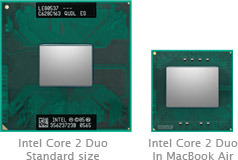
So, we know from the keynote that the MacBook Air has a Core 2 Duo that is 60% smaller than the normal Core 2 Duo chip, and we know that this came out of a partnership with Apple. What we don't know too much about is anything else including the how or why.
Well, we have some of those answers, according to what I assume was a mass mailing from Intel, "If a customer requires a different technology feature-set, then where possible, Intel will work with them to develop a solution to meet their respective needs," so, that is the why, now all we need is the how, and maybe some more specs. Well, the people over at Anandtech already have most of this figured out for us.
They know that it's a 65nm Merom-based Core 2 Duo and that it has 4MB of L2 cache and an 800MHz FSB and then we all know that you can get it in 1.6 or 1.8GHz. The packaging tech is the most interesting part though, because how they got it into such a small size was a technology that Intel wasn't going to implement until the second half of this year with their mobile Penryn chips and the Montevina SFF (small form factor) Centrino platform, but, it appears they bumped their timeframe considerably just for Apple.

The picture of the slide from some presentation was shown at the Intel Developer's Forum and shows a considerable shrinkage in not only the processor, but in the chipset as well, all of which has been applied to the MacBook Air, but with Merom chips instead of Penryn ones. The chips used in the MacBook Air are special in another way altogether, they are lower voltage chips. They aren't quite official LV or ULV parts, but they aren't regular Core 2 Duos either. Regular Core 2 Duos are rated at 35W TDP, LV and ULV chips are rated at 17W and 10W respectively, and the MacBook Air chips are rated at 20W, so, they are noticeably lower than regular Core 2 Duos, but aren't quite at the LV or ULV levels.
It kind of sucks that they didn't go with at least a Low Voltage Intel processor, especially since they could have gotten lower temperatures if they had, but that was probably one of the tradeoffs of fitting the same technology in a 60% smaller space. So, other than for performance, the SSD option might be a good one just to cut down on heat produced by the notebook, but that's a thousand dollar bullet you'll have to bite if you choose to take that route.
The MacBook Air CPU Mystery: More Details Revealed [via anandtech]