
Sprint AIRAVE Reception-Boosting CDMA Femtocell Review
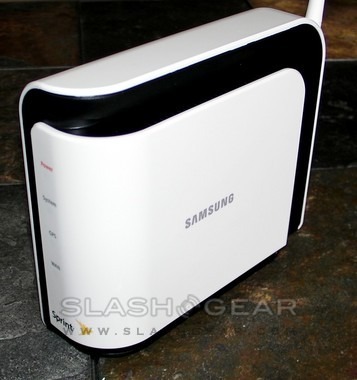
We'd forgive you if you'd given up on Sprint's AIRAVE. We've seen the femtocell – which promises to boost your CDMA signal by re-routing calls via your broadband – rolled out at so many tradeshows and events, even our tech-hungry eyes had begun to glaze over. Finally, though, the AIRAVE is here, and Sprint sent one over so that we could see whether the long wait was worth it.Check out the Sprint AIRAVE unboxing video after the cut
At first glance, the AIRAVE looks like a standard WiFi router. Up front are four LEDs for power, system, GPS and WAN status; at the back there's an antenna, ethernet port, AC connector, power switch and a connector for the included GPS puck. Setup, then, is straightforward: hook it up to your broadband router, attach the GPS puck (more on that later) and plug in the power. Then pick up the nearest book and wait.

In fact, you'll have to wait around an hour. Sprint ship the AIRAVE to you already set up with your account, but when you initially power up it still takes close to sixty minutes for everything to stabilize. Happily future power cycles only required a 5-10 minute wait, but this is still something you don't particularly want to be plugging in and unplugging.
If this were a router you'd now be delving into the setup pages; however with the AIRAVE you're all done. The silent box basically sits there, creating your own bubble of CDMA coverage. Any calls placed or received within its range – Sprint quote up to 5,000 square feet, though walls and other large objects will reduce that – will be routed through your broadband rather than over the CDMA network.
It works, too. We expected at least some troubles with the handover – walking out of range and having the call transferred to Sprint's network; note that it doesn't work the other way around, you have to hang up and redial once in AIRAVE coverage – but every time we tried it, on every Sprint phone, it was seamless. A double-beep as soon as you hit Send lets you know that you're calling via the AIRAVE. We tried it with a number of Sprint handsets, including the Samsung Instinct, and on each it was as though the signal meter had been jammed on full. Only at the limits of the range did we see the bars drop, but call quality was still decent.

Up to three active calls or data sessions can use the AIRAVE at any one time; any subsequent calls will have to use the normal network. Should one of the initial three then hang up, active calls have to hang up and redial in order to hop into the empty slot; it doesn't transfer onto the AIRAVE automatically. While the AIRAVE can support three, of course you have to have the bandwidth for it; Sprint tell us that each call requires a minimum of 40kbps, both downlink and uplink, which means you're looking at 120kbps both ways for all three. Downlink probably won't be too much of an issue, but uplink is generally much slower and could be a bottleneck for some depending on other network traffic.
Sound quality is superb, and we found ourself reaching for Sprint handsets rather than phones on other carriers (displaying good signal) or even the landline. No matter whether calling other Sprint users, people on other networks or landlines, we had no complaints – in fact the frustration then became other mobile users with their own poor signals.
Of course, when you've the promise of such mobile riches, you want to make sure it's always there when you go to use it. Out of the box, the AIRAVE is very casual with its connection: any Sprint phone within range will automatically log on. You can limit the handsets which are permitted to do so, but that requires a call to Sprint customer services. We'd have preferred to see a simple, router-style webpage where filtered numbers could be managed.

The fact that it generally works so well makes the few drawbacks of the AIRAVE all the more frustrating. First off, that GPS puck. Sprint demand a satellite lock so that they can limit AIRAVE use to the US only; give up on any plans you may have had to pack it in your luggage and avoid international roaming fees. Then there's the cost: $99.99 for the AIRAVE box itself, then $4.99 a month service charge. For that, you get to use your own broadband service to use up the Sprint minutes you've already paid for.
Unlimited in-home calling is an option, but it increases that service charge to $14.99; choosing the unlimited in-home family plan makes it a steep $24.99. Obviously if you're already signed up to Sprint's Simply Everything plan then you get unlimited calls for the basic $4.99 surcharge, but if your family wants unlimited calls and you're not all on that tariff, you're looking at almost $600 over your cellphone's two-year contract.
That's a lot of money, and it smarts when you think that you're already paying for the broadband which Sprint are using to help you call more. For some, that will be the biggest turn-off about the AIRAVE, and enough to encourage them to sit out their contract and next pick a network with better coverage where they live. Others, perhaps near the start of those two years and facing mediocre service, might feel more inclined to justify it. Technically, we think you'll love the AIRAVE; it's just those monthly fees that might take off some of the shine.
Check out the full Sprint AIRAVE by Samsung gallerySprint AIRAVE Unboxing Video: