REGISTER LOGIN

Worth Reading?

NoYes

+1 [7 votes]

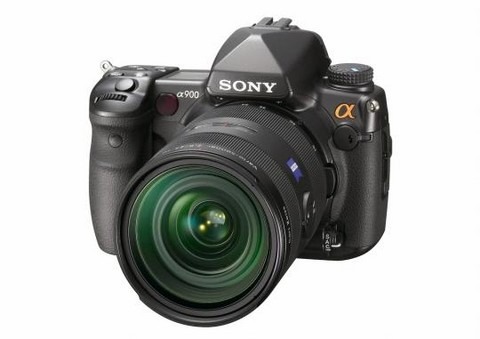
The highly anticipated Sony Alpha A900 full frame camera with a whole-lot-of-pixel is finally announced today. Sony presented the world’s first 24.6MP Digital SLR with legacy of Minolta, Konica and Zeiss glass in a full frame 35mm CMOS sensor, but the early image samples have little left to be desired.

Sony Alpha A900

As expected, Sony went for mid-level package with much attractive price. With Nikon and Canon dominating the pro arena for decade, there is little room for newcomer to get their share on the cut-throated Digital SLR market. Another reason is Sony’s lack of Supertele-lens in sport fields. But a $3000 full frame camera with ultra high resolution of 24.6Mp is a serious contender to the $5,000 12Mp Nikon D3 or the $8000 21.1MP Canon 1Ds markIII, not to mention the attractive in-body image stabilizer! But the image quality, especially the sensor noise department remains a deciding factor for many enthusiasts looking for an update.

Larger pixels capture a greater flux photons, over a given exposure time, at the same aperture. The 3 years old Canon 5D unprecedented greater high ISO sensitivity and dynamic range is the result of greater photons per pixel in a full frame image sensor. Thus, we expect no less from the new Alpha.

However, the early report from imaging-resource and DPR suggested otherwise. The image samples are rather discouraging. The dynamic range is average and ISO noise sensitivity is below expectation. May be a few found of firmware updates in the future are needed to get the best of the new Alpha. In the mean time, a $3000 Full frame body is quite a steal. The Sony Alpha A900 will be available in late October this year.

Sony Alpha A900

Sony Alpha A900

  • 24.6 MP 35mm format full-frame CMOS sensor
  • Magnesium Alloy body and rubber seals for dust and moisture resistance
  • SteadyShot INSIDE full frame image sensor shift
  • High Speed Dual Bionz processors
  • 100% coverage viewfinder, 0.74x magnification.
  • 9 point AF with 10 assist points, dual-cross AF at F2.8 or faster
  • 5 frames per second burst
  • New mirror box
  • Intelligent Preview Function
  • 3 User programmable custom memory modes on mode dial
  • Advanced Dynamic Range Optimizer (5 step selectable)
  • 40 segment honeycomb metering
  • 3.0″ 921K pixel Photo Quality (270 dpi) LCD display, 100% coverage
  • Direct HDMI output
  • ISO 200-3200 (ISO 100-6400 expanded range)
  • User interchangeable focusing screens (3 options)
  • CF Type I/II and MS slots, LI-ION battery, STAMINA 880 shots
  • New Vertical Grip
  • AF micro adjustment
  • Subscribe via RSS or Email | Read 3,867 times

    2 Responses to “Sony Alpha A900 : Unimpressive High ISO Noise”

    1. RiS September 11, 2008

      “Larger pixels capture a greater flux photons, over a given exposure time, at the same aperture. The 3 years old Canon 5D unprecedented greater high ISO sensitivity and dynamic range is the result of greater photons per pixel in a full frame image sensor. Thus, we expect no less from the new Alpha.”

      First you say this, but go on to mention that the Alpha 900 has high noise. The Alpha 900 will obviously have smaller pixels because of the higher density. The Alpha 900 has twice the pixel density, so the pixels will be half the size of the 5D. Do you even know/understand what you are writing about?

      Please don’t confuse resolution for pixel pitch.

      Neutral  Add karma Subtract karma  
    2. Mal September 16, 2008

      No one makes a 50mm 1.4 with in-lens IS. And they will probably never make that because the swing element would have to be very heavy and very large. You can do that with a F3.5 or 4.0 and even down to a 2.8 on occasion but it is very very expensive. The motors needed to quickly accelerate the compensating lens element would also be large and powerful and require a lot of current from the battery. And the housing of the lens would have to be larger to accomodate those inner motor elements. And the strength of the lens housing would also have to be beefed up which means additional weight as well.
      So with in-camera IS anyone can get the combined effect of the new better high iso sensors with our old favorite bright 50mm F 1.4s. That also holds for many other lenses in which the aperture is below 2.8. There are no IS lenses in that category. That leaves a lot of terrific prime lenses out of the equation in the future as well as now, that won’t be able to get whatever the benefit of antishake could provide with in-lens system cameras (e.g. Nikon, Canon).
      Bearing that in mind go to the Image resources website and look at the images of the D3 and the a900 in the comparator function. In order to see how the a900 competes against the D3 with a 50mm 1.4 or similar low light lens (I understand that this is a forced narrow comparison but bear with me for a few moments) put two images in the comparator. In this shoot out we have to give the a900 some of the benefit of IS as the D3 combination has none. Lets give it a mere 2 stop advantage (it is claimed to be 2.5 ro 4 stop improvement but lets be conservative and on the side of Nikon.) The next thing we need to do is look at images of the multitest scene with the a900 at iso 800 and simultaneously look at the D3 at iso 3200 (a two stop advantage). You will note that at those isos the a900 (iso 800) has less noise and far more detail than the D3 (at iso 3200). Put each image in the comparitor function and scroll around with them side by side.
      In time the sensor noise problems will be tamed. When that happens the advantage of the D3 with a zoom will melt away. At the same time and with the advances in image stabilization that will occur as a result of technology in the future all of your IS lenses will have to be traded to get the better technology in lenses satbilization. IS innovations will also accrue to the Image sensor abilities as well in the future. But then all you have to do is upgrade your body and all your lenses get the improvement at one time. In addition by upgrading the body in the future you will also get improvements in image processing times, color accuracy and new features as well as the obligate new battery. Upgrading all your lenses (far more expensive) will yield no improvements in image processing times, color accutracy etc.) And all the vintage glass will not work benefit.
      Please spare me, I easily concede that the Nikon sensor with an IS lens is the better combination today, but, many improtant lenses will yield a better photo with the current Sony or other in-camera IS technology methods.
      And there is one other comnsideration and that is resolution and what that enables you to do. Noise in any one system is interchangeable with resoultion. So the more noise reduction you use the more resolution you loose. If you believe that and most people agree with that, then you can process a 24 MP FF image with a lot of noise processing and still be sharper than say the D3.
      To show how much better the resolution is on the Sony a900 as opposed to the D3 with the D40 also put in the comparison – here is a compilation of the three camera’s images at full pixel magnification with small slices of the image colated into a single frame photo. Click on the URL below to see this ifactual pixel size. Look first at the sharpmess and detail of the paintbrush in all three crops. Then look at the 40 marking and note that there are clearly 4 quarter markings between the larger markings on the slide rule seen with the a900 photo. Then look at the D3 and it is all an indistinct blur. The D40 looses that detail at the 25 marking while the a900’s resolution shows the markings almost all the way to 50. Here is the URL.

      http://www.members.aol.com/NC4.....3.D40-comp

      As can be seen there is a lot of resolution that could be forfeited to get superior noise reduction and still come out way sharper than the D3.

      -1  Add karma Subtract karma  

    Post a comment

    Please login to leave a comment. If you haven't signed up, you can do so free here. Lost your password? Reset it. With SlashGear account, you will be able to participate on SlashGear Forums.