

Rude Robots Get Taught Some Manners
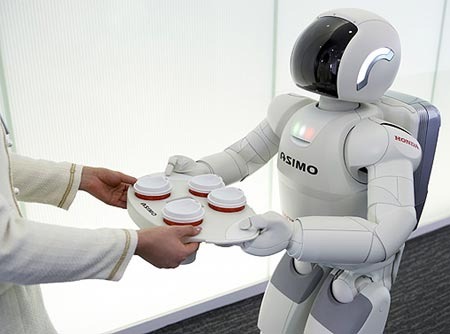
Scientists are often characterised as geeks lacking in even the most basic social skills, but someone over at New Scientist obviously thinks that robots should not be excused from minding their Ps & Qs.
In fact, they suggest that all robots that come into contact with humans should have kansei, a Japanese term for emotional notions; intuitiveness, mood, sensitivity and feeling. That way, your electronic home help wouldn't offer you a freshly cooked meal while you're sleeping (probably exhausted from working all the hours in the day to buy batteries for him), nor start doing loud housework while you're suffering from Linux-induced headaches.
In their infancy, robots could monitor their human overlords via wireless armband sensors that are attuned to pulse and blood pressure while measuring galvanic skin response as a sign of stress. Perhaps key, in laboratory testing fear was recognised correctly 86% of the time, so robots would know it wasn't such a good time to demonstrate the combo orange peeling/hedge trimming rotating blade attachment. The future, however, would demand a neural network brain that could learn from the environment – and from humans' responses to them – and adapt.
The article is free to read online to New Scientist subscribers, and appears in issue 2569 in print.
Antisocial robots go to finishing school [New Scientist]