JP REGISTER LOGIN

Worth Reading?

NoYes

+8 [8 votes]

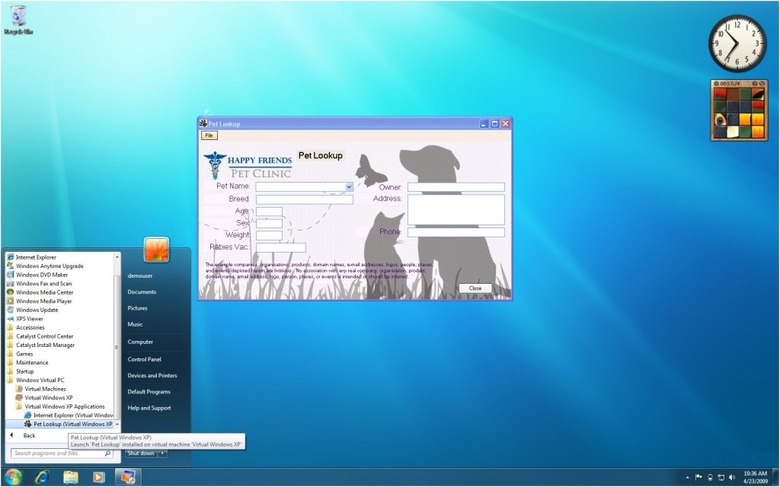
Microsoft thought it would leave Windows XP behind when it launched Vista, but the tide of netbooks has kept the old OS active for far longer than expected.  Now, the Windows team have confirmed that Windows 7 will have its own little slice of XP DNA, in the shape of an emulator intended for those with legacy apps.  Called Windows XP Mode, it will run as a Virtual PC in the new OS.

windows 7 xp mode 480x300

The Virtual PC will be more integrated with Windows 7 than many will be used to, with XP Mode accessed not as a separate desktop but on a per-app basis.  That is, legacy software is installed within the XP Virtual PC but shows up on the Windows 7 Start Menu; apps run as if native to the new OS, alongside Windows 7 software.

Microsoft will “be soon releasing” the Windows XP Mode beta, together with Windows Virtual PC for Windows 7 Professional and Windows 7 Ultimate.  That tallies with suggestions that the XP Mode feature will only be available to those with the Professional, Ultimate or Enterprise versions of Windows 7.

[via ZDNet]

Subscribe via RSS or Email | Read 4,093 times

5 Responses to “Microsoft XP Mode for Windows 7 confirmed”

  1. sashoumaru April 27, 2009

    Great, they finally fixed Vista by slapping XP underneath and calling it W7. This further proves that Vista (and 7?) is indeed a failure. I think developers, especially at MS, should program towards efficiency instead of just throwing stuff at the processora and memory to see it it can handle it. Also use the damn GPUs for all graphical presentation.
    I know, they probably just want people to buy new machines but it’s bad when the new one’s aren’t CAPABLE of running their new software.

    -2  Add karma Subtract karma  
    • Chris Davies April 27, 2009

      To be fair, that’s not exactly what they’ve done. By including an XP virtual machine, they can now claim 100% backward compatibility with all XP apps, whereas without it W7 would only have compatibility with those apps Vista had supported. Legacy support was one significant reason enterprise customers gave for not upgrading to Vista, so it’s no great surprise that Microsoft have addressed it. If you don’t need XP legacy app support, then XP will never come near your W7 install; it’s even a separate download, not included as standard.

      It’s too early to write off W7, IMO. What we’ve seen with beta builds running swiftly on netbooks suggests that it’s a far more efficient OS than Vista (and a lot of people get along just fine with Vista, don’t forget); anything recent shouldn’t have an issue.

      Neutral  Add karma Subtract karma  
  2. sashoumaru April 27, 2009

    Well, consider that while Vista and 7 may run well (to most users) their minimum requirement are still quite steep when compared common OS active today:

    Windows XP: 64MB ram, 233 mhz (x86) processor (rec: 128MB, 300mhz)
    Linux (Ubuntu as sample):64 MB, 300mhz (x86) (recommended: 384MB, 700mhz, 8GB)
    Vista: Home: 512Mb, 1000Mhz (x86), 20GB(15GB free)HD, Others (1GB ram, 50GB (15 GB free))
    W7: Basic: 1GB ram, 1000Mhz, 16GB HD
    MacOSX: 512MB, 9GB, Intel, PowerPC G5, or PowerPC G4 (867MHz or faster)

    Basically, it has the highest requirements.

    -1  Add karma Subtract karma  
    • Andy Roo September 2, 2009

      Haha, everything you compare it to is last gen software.

      XP has been here since 800mhz PCs were considered high performance, Linux is modular from the ground up, and of course its not going to have high requirements if you use NONE of its apps. Vista and W7 are current OSes, but the requirements you state for OSX are for version 10.0, and we currently are just about to have 10.6 which is intel mac only and will not run on PC’s with less than 1.1ghz single core (slowest intel CPU in a mac), or with less than 1GB RAM

      Neutral  Add karma Subtract karma  
  3. sashoumaru April 27, 2009

    [quote comment="58833"]To be fair, that’s not exactly what they’ve done. By including an XP virtual machine, they can now claim 100% backward compatibility with all XP apps, whereas without it W7 would only have compatibility with those apps Vista had supported. Legacy support was one significant reason enterprise customers gave for not upgrading to Vista, so it’s no great surprise that Microsoft have addressed it. If you don’t need XP legacy app support, then XP will never come near your W7 install; it’s even a separate download, not included as standard.

    It’s too early to write off W7, IMO. What we’ve seen with beta builds running swiftly on netbooks suggests that it’s a far more efficient OS than Vista (and a lot of people get along just fine with Vista, don’t forget); anything recent shouldn’t have an issue.[/quote]

    In the end I must concur. As a .NET developer, Windows development is my day to day and as you mentioned, XP mode is still a great addition for enterprise owners.

    Neutral  Add karma Subtract karma  

Post a comment

Please login to leave a comment. If you haven't signed up, you can do so free here. Lost your password? Reset it. With SlashGear account, you will be able to participate on SlashGear Forums.