Wednesday, Jan 24th 2007 by Chris Davies


Worth Reading?


NoYes

I’m sure there are people out there reading this who have held off from buying a KVM switch because, frankly, they’re a bit dodgy.  It only takes one missed switching-keypress and an instinctive jab at the space bar to inadvertently close an important programme before you start doubting the reliability of most consumer models, and when you add in the limitations in range of both USB and PS/2 cabling, they can be more of a liability than a boon in mission-critical environments such as trading floors, security control and AV production.  That’s where high-end Remote Graphics Units (RGU) step in, and of all the brands one of the most well-known and trusted is graphics specialist Matrox.

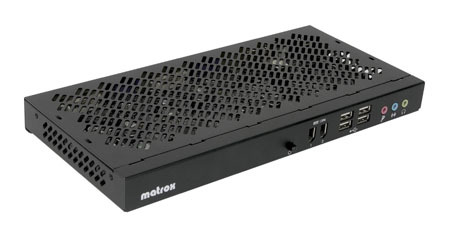
Matrox Extio F1220 RGU

So when Matrox release a new one, people with important keypresses to be made take notice; I bet they’ll be all over this.  The F1220 lets you extend one or two displays, audio, two IEEE 1394 FireWire ports, and up to six USB devices, including keyboard and mouse, by up to 820 feet (250 meters), and supports both monitors running at up to 1920 x 1200 thanks to the in-built 128mb of graphics memory.

Matrox Extio F1220 RGU 

A fanless design, it’s a quiet and flexible unit that communicates with the serving PCs via a multi-mode fibre-optic cable.

Matrox Extio F1220

Key features

Matrox [via Pclaunches - thanks to Vinit for the tip]

Tags:
Subscribe via RSS or Email | Read 174 times


  1.  Richard Cawdery   View all comments by Richard Cawdery  Neutral  Add karma Subtract karma 

    “I’m sure there are people out there reading this who have held off from buying a KVM switch because, frankly, they’re a bit dodgy.”

    I would suggest that the author of this statement has very little exposure or understanding of the KVM market place. It is similar to saying “I used a PC once, it crashed. All PCs are rubbish.” Not exactly an informed opinion.

    I would welcome the opportunity to disprove this assertion, which is very easy to do. I would suggest that people who use KVM switches, KVM via IP and KVM extenders in mission critical applications maybe a little shocked to hear that “they’re a bit dodgy”. Emergency services, radio stations and bank data centres rely on this technology all day, every day.

    Richard.

  2.  Chris Davies   View all comments by Chris Davies  Neutral  Add karma Subtract karma 

    Yes, perhaps I should’ve been more specific – I was talking about low-end KVM devices that have, in my experience and that of people I know, been occassionally prone to errors in switching. I’m sure the people who use KVM technology in mission-critical applications don’t rely on bargain-basement devices; or am I wrong?

    I would suggest that the author of this statement has very little exposure or understanding of the KVM market place. It is similar to saying “I used a PC once, it crashed. All PCs are rubbish.” Not exactly an informed opinion.

  3.  Ewdison Then   View all comments by Ewdison Then  Neutral  Add karma Subtract karma 

    i’m one of those people, struggling with resolutions when i’m using different video cards

  4.  James Lim   View all comments by James Lim  Neutral  Add karma Subtract karma 

    “I’m sure there are people out there reading this who have held off from buying a KVM switch because, frankly, they’re a bit dodgy.”

    I would suggest that the author of this statement has very little exposure or understanding of the KVM market place. It is similar to saying “I used a PC once, it crashed. All PCs are rubbish.” Not exactly an informed opinion.

    I would welcome the opportunity to disprove this assertion, which is very easy to do. I would suggest that people who use KVM switches, KVM via IP and KVM extenders in mission critical applications maybe a little shocked to hear that “they’re a bit dodgy”. Emergency services, radio stations and bank data centres rely on this technology all day, every day.

    Richard.

    i dont think you can compare professional grade KVM and home user and put them into the same category

  5.  Richard Cawdery   View all comments by Richard Cawdery  Neutral  Add karma Subtract karma 

    Yes, perhaps I should’ve been more specific – I was talking about low-end KVM devices that have, in my experience and that of people I know, been occassionally prone to errors in switching. I’m sure the people who use KVM technology in mission-critical applications don’t rely on bargain-basement devices; or am I wrong?

    you are absolutely correct. Sorry if my post was a bit aggressive.

  6.  Chris Davies   View all comments by Chris Davies  Neutral  Add karma Subtract karma 

    That’s quite alright, Richard – this is one of those areas where I’m certainly no expert, and so it’s good to have feedback from people who know more!

    you are absolutely correct. Sorry if my post was a bit aggressive.


Add your comments

Please login to leave a comment. If you haven't signed up, you can do so free here. Lost your password? Reset it. With SlashGear account, you will be able to participate on SlashGear Forums.


Close
About / Advertise / Contact / Archives / Privacy Policy / Terms of Use
Copyright © 2006-2009 SlashGear, All Rights Reserved.