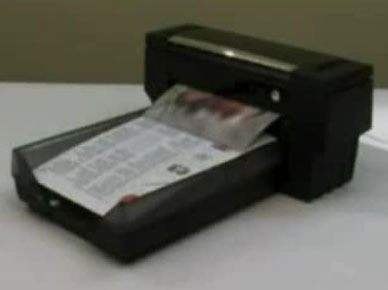
One of the worst things in life has to be waiting. And for all of our great technology these days, we’re still constantly waiting. Whether it’s downloading Windows updates, or printing off a family portrait, there’s always plenty of time to kill. Australian-based Silverbrook Research my have something to cut down on the time you spend waiting on those prints.

video after the jump
Many of the mainstream inkjets will spit out prints at about 30ppm. Their new “Memjet” technology allows for speeds of 60ppm, and that’s color. You can expect double the speed when printing black and white.
Of course, faster prints means that you’ll be running through those ink cartridges even faster. Thankfully the cost per print is reasonable at $0.06 per color page at 20% coverage.
Silverbrook Research Claims to Have Developed World’s Fastest ‘memjet’ Printer
[via gizmowatch]


3 Responses to “Fastest inkjet printer ever”
Karel Jansens March 21, 2007
I can make a video of an inkjet printer that goes ten times faster than that one!
-4Dave March 22, 2007
I call BS. This thing has to be extraordinarily low res and low quality. They’re showing full-bleed, so approx. 100 in^2 of printed area. At 600dpi, they’re dumping about 40 MB/sec of *rendered* data into the thing.
-3Andre Rebelo March 22, 2007
Hi everyone, my name is Andre Rebelo, and I work at Lyra Research, (www.lyra.com), the company that first reported this news on Memjet in a press release and in a Webcast. We’re thrilled by the active discussion that this new technology has generated, on Texyt, wiredblogs, ministryoftech, zedomax, and especially here at Slashgear’s blog. I wanted to post to help provide some factual information and clarification that might help answer some questions or correct some assumptions in some of the previous comments. And, if you have more questions for me, feel free to email me at arebelo@lyra.com or call me at US-1 617 454 2658. I’ll email you a PDF of the Webcast’s slides.
* The Back-story: Lyra is a market research firm that focuses exclusively on the digital imaging industry. We provide forecasts, analysis, news, conferences, consulting, reports, and journals to the folks that make printers, copiers, digicams, cameraphones, inkjet and toner cartridges, photo paper, etc. You get the idea. Lyra was invited by Silverbrook Research, the Australian company behind this technology, for an exclusive sneak peek at their new Memjet technology. The Webcast and the related report are the results of this information-gathering mission.
* You know how 15-second stories on the 6 o’clock news often leave out a lot of information from the whole story, leaving a string of unanswered questions as they move on to the weather? Well, I think that, in a similar way, some of the snippets of info in the comments above might lead to more questions than answers. Get the facts: Lyra’s Webcast is a great free resource for you to get an excellent overview on Memjet. Go here to see it (it runs about 35 min.): http://www.webcastgroup.com/cl.....0315073194
* You won’t be able to go out and buy a Memjet brand printer. Think of it roughly like “Intel Inside.” You can’t buy an Intel computer, but you can buy a computer that uses Intel technology. What you see in the video is a “reference design” — a sort of prototype to demo their technology. Silverbrook will be licensing the Memjet technology with partner companies who will implement the technology in their products. So, the big question now is: who will be partnering with Silverbrook? Will it be an established printer maker or a newcomer with a lot of brand recognition in another field like consumer electronics? We don’t know. What we do know is: look out for new products rolling out at the end of 2007 and into 2008 from such partner companies.
* About the video that you saw: Yes, it’s real, there’s no jiggery-pokery or hocus-pocus going on. It was not video’d by a cameraphone snuck into the company, although that does make a good story–Silverbrook _is_ very secretive. It was, in fact, video supplied to Lyra by Silverbrook and validates what our analyst Steve Hoffenberg saw with his own eyes (in addition to seeing a working photo printer, wide-format printer and a commercial volume printer). That video that’s now on the web is taken from Lyra’s Webcast.
Here’s the deal: If we could have shown it in better quality, we would have. In order to load a decent quality video in a quick amount of time for the Webcast, Lyra had to shrink the file size according to our webcast vendor’s specs (600k or less!). And, we had to convert it to Flash format. This is done to ensure that Webcast viewers didn’t wait a long time for the video to load, and everyone is able to see it in a near-universal format (like YouTube videos).
Unfortunately, as you know, this means the quality was degraded. Since the Webcast aired (you can still watch an archive), several folks on the web have bootlegged it on to Google Video and a couple of other places. We’ll take that as a compliment. :-) But, keep in mind, every time you upload a video like this to a video-related site, they often re-compress the file to their standards. So, you might be watching a very low quality video because it’s gone thru several rounds of file degradation.
Having said all that, if you want to see a HIGH QUALITY VERSION of all sorts of Memjet technology printers in action, go to the just-launched Memjet site’s video/media page: http://memjet.com/media.aspx . There are all sorts of cool videos here, including how they make the print heads, what they look like, and several samples of different reference design printers pumping out the pages! We could not use this video in our webcast because the Memjet site was just launched TODAY! This was planned to coincide with the technology being unveiled today in Kia Silverbrook’s keynote address at the Global Ink Jet Printing Conference in Prague. Go give them some eyeballs! (the release: http://home.businesswire.com/p.....wsLang=en)
*How do they do that? How can they print bleeds?
I’m not the analyst, but here goes a basic explanation: As some folks mentioned in their posts, Memjet uses a page-wide array of inkjet nozzles. Usually you see inkjet nozzles attached at the bottom of the an ink cartridge and the cartridge furiously slides left and right to print across a page. This technology allows the page to pass under a page-wide set of 1600 dpi nozzles that basically dispense a page-wide swath of 1 picoliter droplets of ink to make the image. So, if you have an 8″ wide sheet of paper, and an 9″ wide nozzle array, you can safely cover all the paper.
Instead of ink jet cartridges with a printhead at the bottom, the printer only requires replacement ink tanks, similar to HP’s Scalable Print Technology, SPT. These would cost about $20 to replace, but you’re getting 50 ml.
And, to the gentleman that mentioned HP’s Edgeline, yes, you’re right: this is a similar technology. Memjet stands out because it’s faster and cheaper. It’s cheap enough to use on consumer /small-office applications as well as commercial applications (check out our webcast to see examples of different applications). Edgeline has a diverse number of applications but, due to cost, will likely be applied to high-volume, commercial printers or retail oriented devices like photo kiosks. To Memjet’s credit, they’ve also partnered their inkjet printing technology with a high-performance on-board chip that has Over 40 million transistors and:
Calculates 900 million droplets/sec. in real time
Drives 70,400 nozzles
JPEG expansion in hardware
On-chip page memory
I/O ports
Motor control and I/O
Pretty cool for printer hardware. Bottom-line, it enables the printer to handle all the processing necessary at the speed required to print so fast. This is important because, it doesn’t matter how fast your inkjet nozzles can print, if you don’t have a processor that can keep up with the instructions.
Well, I’ve been typing away for some time so I’ll leave it at this. I hope the above info is helpful in clarifying some of the back-story. Give a call or an email and I hope to be of additional assistance!
Vote up!
+6