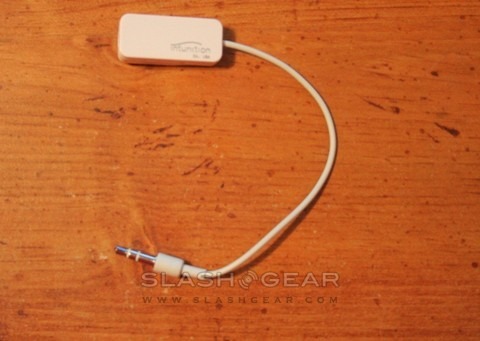
So, I’ve had the Clari-Fi for almost two weeks, I know it’s only been a couple of days since I posted about it, but I wanted to get a feel for whether it was working or not before I said anything. Bottom line, it is working. It is also worth the extra dough.
I went back to just my headphones and iPod earlier today, and the sound wasn’t horrific, because I try and rip my music at 320kbps, but it was decidedly worse. Now I want my Clari-Fi back. So, one concern I had about it prior to receiving it was that it was going to be constantly coming disconnected since it added an extra connection between me and my music, however that is not the case, I can assure you that, so, if you were having the same doubts, I assure you that won’t be an issue.
One thing I tested out and found that it worked was that my FM Transmitter, an admittedly generic unit, would constantly have spikes in it while using it, and it would always have this quiet, but high pitched ringing sound in the background whenever using it. I attached the Clari-Fi to my FM transmitter and tried it again, thinking it might help, and sure enough it did, in fact it was so clear it was almost like as if I had a direct line-in into my stereo. So, if you have an FM transmitter already, and you are going to buy a Clari-Fi for your headphones, I definitely recommend using it with your FM transmitter as well.
Overall my time with the Clari-Fi has been pretty great. It does exactly what it says it does, it will clear up your audio, and I busted out the original headphones that came with my iPod and didn’t notice as much of a difference, so, if you’ve got $60 and are looking to improve your listening experience and you are still using the stock earbuds, I’d recommend spending it on some new headphones, they’ll have a similar effect on your audio as the Clari-Fi. On the other hand, if you’ve already got a nice pair of headphones, and you’ve got $60 that you are willing to spend on enhancing your audio, I’d definitely recommend the Clari-Fi, for that reason, I give it 3 out of 5 gears.
Rating:


10 Responses to “Clari-Fi Review – for the betterment of your audio experience”
Mike April 21, 2008
I have a feeling after visiting their website that all this overpriced plastic device does is limit the dynamic range of music. “When inserted in line with earphones, all excursions beyond 4 mw @ 32Ω are compressed and the artifacts of the transients less than this power are also reduced.” Basically if you have a large crescendo or loud passage it will be at the same level as a lower passage adding to listening fatigue. Over compression is nothing that can be fixed except for recording engineers saying no to artists demands of over loud over compressed music.
+6The only true way for no fatigue is a complete analog setup. Vinyl source, tube headphone amp, listen for hours at any level and you will feel refreshed not fatigued.
Neil April 21, 2008
Mike, that’s incorrect, this works in a way that is more sophisticated. It allows ‘good’ high frequencies to be heard and only compresses highs that are peaking. Loud passages and crescendos become clearer and more pleasant to listen to, but not softer. I have used one for the last six months (I was a beta tester) and this thing flat out eliminates hearing fatigue.
Before, If I was listening to IEMs or earbuds, usually somewhere around a half hour my ears would start to hurt, with this I can listen for hours and be fine. Fifty bucks for something that allows me to listen without discomfort (and makes the music sound better) isn’t a lot of money for what it delivers.
-8Dave April 22, 2008
Neil, thanks for correcting Mike’s comment – you are right. Mike you may be thinking about a compressor that has very long release times, which will reduce the overall dynamic range. The Intunition device works differently, and it is very transparent. Unfortunately it’s hard to A-B the intunition device because you have to plug/unplug and there is a slight gain reduction. However, if you could A-B, the difference would be very subtle. I believe most people would likely prefer A-B with the Intunition device in line because the music would sound “smoother”. It’s hard to quantify audio effects like “smooth” and “warm”, but people with good ears would likely use these terms with Intunition because it is reducing the high frequency artifacts from the MP3 encoding.
-5Roberto April 25, 2008
Would be cool to see some actual measurements of this “betterment”. And I’m not talking about overly smoothed freq responses, but power, phase etc as well.
A-B would really not be that hard to arrange with any mixer unit and some cables.
How do you guys determine what exactly are the “good high freqs”?
-1Intunition April 25, 2008
A-B isn’t that hard to arrange, I think Dave just means that since some gain is lost when using the device, its hard to have a A-B comparison at the exact same volume level, obviously you can just raise the volume to try to compensate. In fact we are going to be at head-fi’s conference in Ft. Lauderdale next week doing A-B comparisons, and hopefully letting the device speak for it self.
Roberto, what is meant by ‘good highs frequencies” are ones that are 300 Hz and over AND not peaking.
Also I think something important that’s getting lost here is that we have never claimed that the clari-fi is the messiah, fix-all of digital music. It’s a brand new technology that uses semiconductor chips to miniaturize (and drive down the cost) of accomplishing a similar type of audio compression to what could only have been done previously with vacuum tubes. Now you can’t reasonably expect to get a Fairchild 670 for $49, but I think considering the price, it does a pretty good job of what we say it does. True, you can only do so much with highly compressed digital audio, but by correcting the waveform you can improve the listen-ability and to some extent the sound quality, and we make a portable device does make MP3, I think, significantly more pleasant and less fatiguing to listen to.
-5Kathy April 26, 2008
What is the difference between the clari-fi pod cast and the clari-fi music, please? There is little explanation at the manufacturers website. Thanks, kc
NeutralJosh April 26, 2008
The last thing that the audio industry is in need of is another product that is simply nothing but snake oil. I am disgusted by the marketing b.s. on the website, and am abhorred by the fact that this is coming from someone who claims to be a member of the same industry as myself. For those of us who spend countless hours engineering and mastering music to have our hard work destroyed by a 2-cent chip based compressor after it has already suffered through a conversion to MP3 is most distressing.
Save your $50 to invest in a pair of high quality headphones or in ear monitors with high specifications, good isolation, and then enjoy your music at a lower average amplitude. THIS is the only way you are going to prevent hearing damage, not by “being able to crank up the volume of hard rock or hip hop without abusing their ear drums” as stated on the manufacturer’s website.
+4Intunition April 26, 2008
Josh- see that independent review of our product up there on the top of this page, the one that says our product does exactly what we claim it does. How exactally as someone who has never used the product, do you claim to know more about it than the person who reviewed it positively.
Listen: We understand and appreciate why our device would be perceived as threatening by some members of the audio engineering community. You are right, you guys put a lot of hard work into meticulously crafting mixes that make recorded music sound optimal, and we very much appreciate what you do.
But there is a problem: once your music is released, you are no longer in control over it, and 300 million+ ipod users are taking your hard work and compressing it into 128kbps mp3s that butcher the sound. Unfortunately, that’s the just the reality of the times. The clari-fi isn’t pro studio equipment and we have never claimed this; it’s a consumer product that tries to provide a pragmatic solution to problems with the MP3 format, by removing the junky byproducts of digital compression. The goal is trying to preserve as much integrity to your original mix as possible given the inherently flawed MP3 format. It’s not a perfect solution, but contrary to what some people have suggested, it is a lot more sophisticated than a ‘louder is better’ approach, and having used the device I firmly believe that it does make the MP3 listening experience significantly more pleasant. We are with you not against you.
-5Josh April 26, 2008
The issue is simply that the explanation of how the device works on your website entirely contraindicates the realities of psychoacoustic compression artifacts. If anything, MP3 playback is SMOOTHER than non-compressed formats due to how a water-filling PAC algorithm functions, and, at a minimum, will exhibit reduced high-frequency information when compared to the original recording. There is no advantage to increasing the degree of dynamic compression on an already compressed audio signal.
The moment that you can present a clear and scientific explanation as to how your product can actually remove MP3 compression artifacts, I can assure you that I and other audio engineers will be intrigued and interested. However, with the thick layer of marketing b.s. that is on your website, I don’t expect this to be coming any time soon.
As someone with graduate degrees in both the neurosciences and audio engineering, I seek nothing but truth in how technologies are presented, and those that present anything less than the whole truth must be exposed to get to the real story. As I have said, there is far too much “snake oil” when it comes to the world of audio, and the last thing we need is yet another device that promises betterment of audio, when in reality, simple education and progression forward from highly lossy formats is the best answer – a technology that is already clipped to everyone’s belt and shirt pocket, without the need of an additional device.
Society as a whole has lost the ability to discern quality in audio recordings, and your device does not do anything to improve this issue. Louder is not better, and any compression device, regardless of how complex the algorithm, will not reduce potential for hearing loss, can not “clean the sound waves”, and will undoubtedly not ultimately improve the end listeners experience.
+5Rich May 8, 2008
I would be interested in how this works too. If it’s really good, I can understand however if the manufacturer does not want to give out such details. If objective listening tests can prove it works at least to some extent, that is fine in my opinion.
Neutral